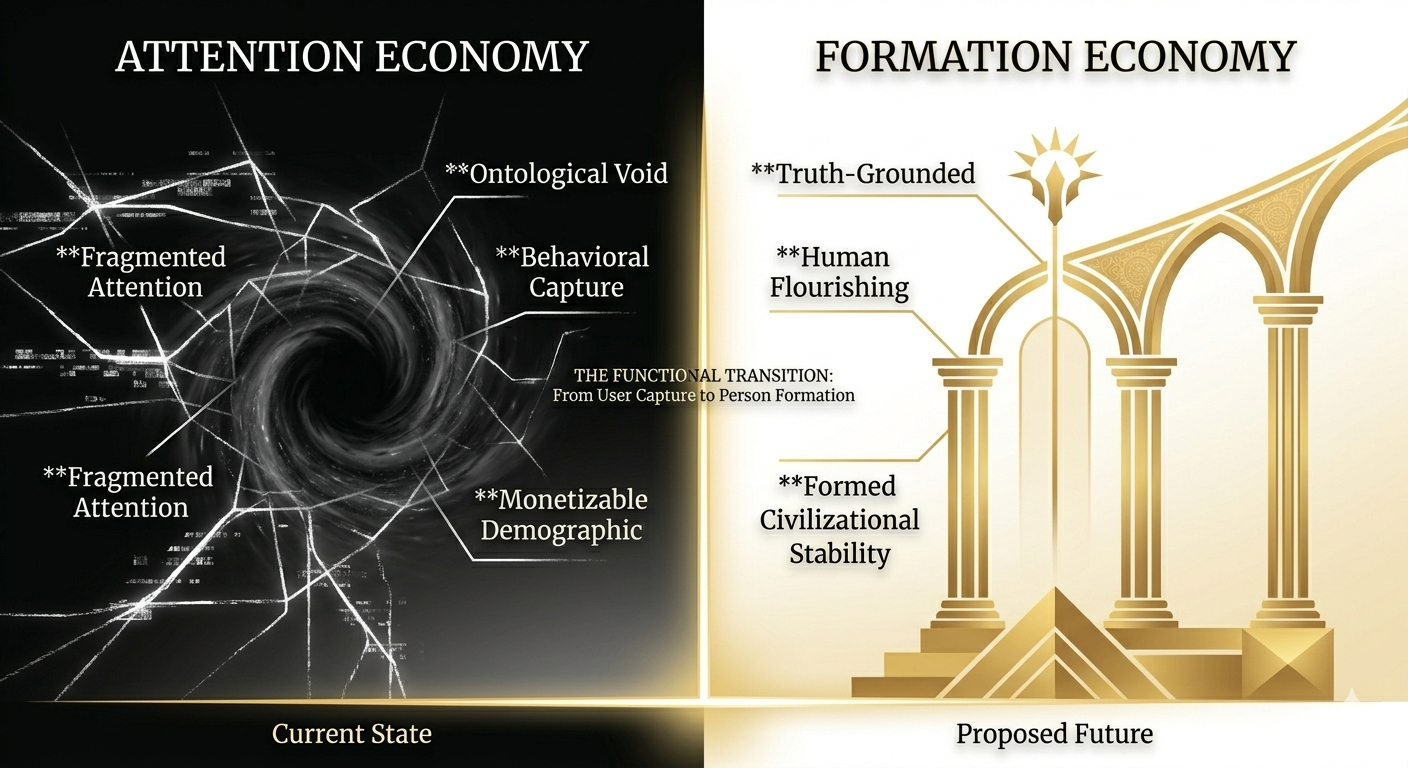
THE ARCHITECTURE OF FORMATION
A Structural Inversion of Behavioral Technology
FROM ATTENTION CAPTURE TO HUMAN FLOURISHING
Jamie Thornberry
May 2026
Executive Summary
The defining technological achievement of the twenty-first century has been the perfection of behavioral capture at scale. Modern digital platforms operate on a shared architecture: human behavior shaped through structured attention loops, dopamine reinforcement, and habit formation via psychological triggers. These mechanisms are formidable in their efficiency. Their fatal flaw is not execution but ontology—they lack a grounded understanding of what is real, an anthropology of what man is, and a teleology of what man is for.
This white paper proposes a structural inversion: the same tools of behavioral technology must be strictly subordinated to the architecture of human formation. Rather than discarding the delivery mechanism of scale, we must reorder it fundamentally—from an engine of attention capture into a formation economy. This requires evaluating every systemic decision through a tripartite framework of human flourishing: Light (illumination of truth), Love (ordering of desire), and Life (embodiment of reality).
The technical challenge lies in the transition phase. Behavioral systems built on external reward cannot simply remove dopamine loops without motivational collapse. The solution is a Transition Lattice—a structural buffer that gradually transfers behavioral control from external reward to internal identity through four synchronized operations: reward density gradient, meaning anchoring, continuity memory, and internalization triggers.
Success requires precise telemetry that tracks the crystallization of internal coherence: notification independence (shift from prompt-driven to organic engagement), friction tolerance (behavioral response to conceptual difficulty), and voluntary spillage (engagement beyond minimum mandate). These metrics replace the vanity indicators of the attention economy with objective behavioral signals.
This framework is not simply educational technology. It is a scalable architecture for civilizational stability and cultural restoration, designed to outlast the dopamine culture by building exactly what that culture cannot: human beings rooted in reality.
I. Introduction: The Crisis of Modern Scale
We stand at a civilizational inflection point. The technological infrastructure that now mediates human attention, education, and social formation operates with unprecedented efficiency—yet toward fundamentally disordered ends. The platforms that shape billions of daily interactions have perfected the mechanics of behavioral capture while remaining ontologically hollow. They know how to retain users but not how to form persons.
The mechanics themselves are not the problem. Repetition, habit formation via psychological triggers, and dopamine reinforcement are powerful tools of human formation. These same mechanisms have been used for millennia in monastic discipline, apprenticeship systems, and classical education. The crisis emerges when these formidable tools are applied without reference to human nature, objective truth, or genuine flourishing.
Current digital platforms—whether oriented toward entertainment, social connection, or education—train external validation dependency and fragmented attention. They optimize for retention over comprehension, producing consistent users rather than formed persons. Even nominally educational systems borrow their structural power from the attention economy, inheriting its disordered telos along with its delivery mechanism.
The fatal flaw of modern digital architecture is not a lack of efficiency, but a lack of ontology.
The necessary correction is not to discard the delivery mechanism of scale, but to perform a structural inversion. The tools of behavioral capture must be strictly subordinated to the architecture of human formation. This requires more than incremental reform—it demands a fundamental reordering of purpose, measurement, and design.
II. The Problem: The Ontological Void in Digital Architecture
The Mechanics of Capture
Modern behavioral technology operates through well-understood psychological mechanisms. Streak systems create artificial continuity pressure. Variable reward schedules maximize engagement. Social comparison triggers status anxiety. Novelty loops prevent satiation. These mechanics are not accidental—they are the result of decades of optimization toward a single goal: maximizing time on platform.
The efficiency of these systems is undeniable. They have achieved what no previous technology could: reliable, scalable modification of human behavior across billions of users. The problem is not that they fail to work—it is that they work too well in service of the wrong end.
The Missing Foundation
Three fundamental absences define the crisis of current digital architecture:
Ontological vacuum: No grounded understanding of what is real. Truth becomes user-generated, context-dependent, or algorithmically determined. The system has no anchor in objective reality, only in measurable engagement.
Anthropological deficit: No coherent account of what man is. Human nature is treated as infinitely plastic, defined by preferences rather than essence. The user is understood as a collection of behaviors to be optimized, not a person with inherent dignity and teleological structure.
Teleological disorder: No vision of what man is for. Without a conception of human flourishing beyond pleasure and preference satisfaction, the system defaults to whatever produces continued engagement. The telos becomes the system's own perpetuation.
The Consequences
The consequences of this threefold absence are not abstract—they manifest in measurable behavioral pathologies. Users develop dependency on external validation, fragmented attention spans, and motivational structures that collapse when the dopamine triggers are removed. Educational platforms produce credential accumulation without genuine understanding. Social platforms generate status games detached from substantive achievement.
Most critically, these systems train habits of mind that persist beyond the platform itself. Users learn to expect instant gratification, to measure progress through arbitrary metrics, and to mistake the completion of tasks for genuine growth. The formation that occurs is real—it simply forms users toward disorder rather than flourishing.
Table 1: Attention Economy vs. Formation Economy
Dimension
Attention Economy
Formation Economy
Ontology
User-generated reality; no objective truth anchor
Alignment with objective reality; truth-grounded progression
Anthropology
User as behavior bundle to optimize; infinitely plastic
Person with inherent dignity and teleological structure
Teleology
System perpetuation; maximizing time on platform
Human flourishing; formation toward truth and goodness
Primary Metric
Daily Active Users; Time on Site
Comprehension depth; Real-world application
Output
Monetizable demographic; consistent users
Formed individuals rooted in reality
III. The Solution: Light, Love, and Life
To redeem the scalable model of behavioral technology, the system must be fundamentally reordered from an engine of attention capture into a formation economy. This requires evaluating every systemic decision through a tripartite framework of human flourishing. Each dimension addresses one of the fundamental absences identified in current architecture.
Light: The Illumination of Truth
Current systems optimize for engagement, measuring streaks, clicks, and retention without reference to truth. A formed system must optimize for alignment with objective reality. This demands a fundamental shift in design philosophy.
Progression cannot be empty or purely repetitive—it must demand progressive illumination. The metric shifts from time spent to comprehension depth and conceptual clarity. Rather than gamifying learning into trivial completion loops, the system must reveal truth coherently and demand genuine understanding.
This requires content architecture that builds systematically toward integrated knowledge rather than modular, disconnected units. Assessments must measure genuine comprehension, not recall or pattern recognition. The user must demonstrate alignment with reality, not merely completion of prescribed behaviors.
Truth must be revealed and understood coherently, not gamified into triviality.
Love: The Ordering of Desire
Current models exploit the will through manipulation—streak anxiety, guilt triggers, and external motivation. A properly ordered system must cultivate right desire toward the good. This is the most delicate dimension of formation, requiring structural precision.
The structural goal is to train the user to want what is good. This cannot be achieved through coercion or manipulation—it requires gradually reducing external triggers while introducing meaning-based motivation. The system must help users discover purpose and integrate learning with personal calling.
This dimension addresses the fundamental anthropological question: what moves a person? Rather than exploiting base impulses or manufacturing artificial urgency, the formation economy must cultivate authentic motivation rooted in the recognition of genuine value. The will must be ordered, not exploited.
Life: The Embodiment of Reality
The deepest failure of educational technology is digital containment, where learning remains abstract and trapped within the application. Knowledge must become lived reality. This requires the most radical structural departure from current models.
The system must mandate an exit—requiring real-world usage checkpoints, skill embodiment tasks, and measurable life outcomes. Digital completion cannot be the terminus; it must be a threshold toward embodied action. Truth is not realized in digital completion, but in lived, physical reality.
This means designing assessment not around in-app performance but around demonstrated capability in actual contexts. A language learning platform succeeds not when a user completes all lessons, but when they conduct a real conversation. A coding curriculum succeeds not when exercises are finished, but when functional software is built.
IV. Technical Implementation: The Transition Lattice
The most precarious phase in any formative architecture is the gap between external compliance and internal coherence. If dopamine reinforcement and novelty loops are removed before internal structure is strong enough to carry the behavior, the result is motivational collapse. Users who functioned perfectly under external pressure simply stop when those triggers disappear.
The solution is not a static phase, but a structural buffer: the Transition Lattice. This mechanism gradually transfers behavioral control from external reward to internal identity through four synchronized operations.
The Four Operations
1. Reward Density Gradient
External rewards (streaks, badges, points) are not abruptly removed but systematically decompressed. They shift from high-frequency novelty to infrequent, meaning-weighted markers tied directly to comprehension depth. A daily streak becomes a monthly milestone. A completion badge becomes a mastery certification. The psychological texture of achievement shifts from dopamine spike to cognitive satisfaction.
2. Meaning Anchoring
The system systematically replaces the narrative of task completion with identity coherence. Rather than 'I did my lesson today,' the user begins to internalize 'I am becoming someone who understands reality.' This is not motivational rhetoric—it is structural reinforcement through carefully designed reflection prompts, progress narratives, and capability demonstrations.
3. Continuity Memory
The structural pressure of the streak is replaced by a continuity record. Rather than fear of losing a consecutive count, the user develops recognition of an overarching trajectory of growth. Missed days do not reset a counter—they become part of a larger pattern that reveals commitment despite disruption. The metric shifts from perfection to persistence.
4. Internalization Triggers
At the exact moment external reinforcement is tapered, the system introduces reflective micro-experiences. These are not passive surveys but active cognitive exercises that transition the user from dopamine spikes to genuine intellectual satisfaction. The pleasure of completion is replaced by the deeper satisfaction of understanding.
External reward fades only at the exact rate that internal identity strengthens.
The Governing Law
These four mechanisms operate on a single, stabilizing law: External reward fades only at the exact rate that internal identity strengthens. This is not a linear progression but a dynamic equilibrium. The system must continuously monitor behavioral signals to ensure the transition is neither too rapid (causing collapse) nor too slow (perpetuating dependency).
The user experiences not withdrawal, but the gradual realization that external compulsion is no longer necessary. The behavior persists not because of artificial pressure but because it has become integrated into identity.
V. Measurement Framework: The Telemetry of Internalization
A formation economy must reject the vanity metrics of the attention economy. Daily Active Users and Time on Site measure system success, not user formation. If the goal is to measure the crystallization of internal coherence, the platform must utilize precise telemetry that tracks objective behavioral shifts without relying on easily manipulated self-reporting.
This telemetry tracks three primary signals, each corresponding to one dimension of the formation framework.
Table 2: Formation Telemetry Signals
Signal
What It Measures
Formation Indicator
Notification Independence
Ratio of prompt-driven sessions to organic, voluntary engagement
Shift from external trigger dependency to internal motivation (Love)
Friction Tolerance
Behavioral response to localized conceptual difficulty
Transition from reward acquisition to truth acquisition (Light)
Voluntary Spillage
Frequency of real-world application beyond minimum mandate
Digital framework successfully spills into lived reality (Life)
These three signals provide objective, behavioral evidence of internal formation without requiring subjective self-assessment. They cannot be gamed through superficial engagement and they directly correspond to the three dimensions of the formation framework.
VI. Benefits and Implementation Roadmap
Expected Outcomes
The shift from attention economy to formation economy produces measurable benefits across multiple dimensions:
Individual level: Users develop genuine competence rather than credentialed familiarity. Motivation becomes intrinsic and durable. Knowledge transfers to real-world application. Personal identity integrates learning rather than treating it as external obligation.
Institutional level: Educational outcomes become verifiable through demonstrated capability rather than completion metrics. Platforms build sustainable user bases rooted in genuine value rather than manufactured dependency. The system becomes self-reinforcing as formed users become advocates.
Civilizational level: The formation economy produces citizens capable of thinking clearly, choosing rightly, and living effectively. Cultural formation shifts from fragmented attention and external validation toward coherence and internal identity. The architecture provides scalable resistance to civilizational drift.
Implementation Phases
Implementation requires systematic progression through four distinct phases:
Phase 1 - Foundation: Establish ontological framework and content architecture aligned with objective truth. Design assessment mechanisms that measure comprehension rather than completion. Build real-world application checkpoints.
Phase 2 - Transition Architecture: Implement the Transition Lattice with all four synchronized operations. Establish telemetry systems for the three primary signals. Calibrate the reward density gradient based on behavioral data.
Phase 3 - Optimization: Refine meaning anchoring mechanisms based on user feedback and behavioral patterns. Adjust friction tolerance thresholds. Enhance voluntary spillage opportunities through real-world integration.
Phase 4 - Scale: Deploy across broader user base while maintaining formation integrity. Develop ecosystem partnerships for real-world application verification. Build institutional adoption framework.
Resource Requirements
Successful implementation requires commitment across three domains:
Philosophical: Deep engagement with ontology, anthropology, and teleology. Content must be grounded in objective truth, not merely user preference or market demand.
Technical: Sophisticated behavioral telemetry, adaptive systems for the Transition Lattice, real-world verification mechanisms. This is not a trivial technical lift—it requires genuine innovation beyond current platform architectures.
Institutional: Leadership willing to prioritize formation over short-term engagement metrics. Patience during the transition phase when traditional metrics may decline before formation indicators strengthen.
VII. Conclusion: The Civilizational Horizon
We are transitioning out of the era of the attention economy. What follows must be a formation economy. The input remains human attention, but the process is rigidly bound to truth, ordered desire, and real-world action. The output is not a monetizable demographic, but formed individuals capable of thinking clearly, choosing rightly, and living effectively.
This framework is not simply educational technology. It is a scalable architecture for civilizational stability and cultural restoration. The attention economy has demonstrated that behavioral technology can shape billions of people. The formation economy demonstrates that the same scale can be achieved in service of human flourishing rather than platform perpetuation.
The formation economy is designed to outlast the dopamine culture by building exactly what that culture cannot: human beings rooted in reality.
The choice before us is not whether to use behavioral technology—that ship has sailed. The platforms exist. The mechanisms work. The question is whether we will continue to apply these formidable tools toward ontologically hollow ends, or whether we will perform the necessary structural inversion.
The path forward requires philosophical clarity, technical sophistication, and institutional courage. But the stakes justify the difficulty. We are not merely optimizing an app or improving educational outcomes. We are building the infrastructure for human formation at civilizational scale.
The architecture of formation offers what the attention economy never could: a system that serves human nature rather than exploiting it, that trains virtue rather than dependency, that produces persons rather than users. This is the foundation upon which durable civilization is built.
For inquiries regarding implementation or partnership opportunities,
contact Jamie Thornberry
lovelifelight@outlook.com