ORDERED LIBERTY
A Constitutional Model, Legal Theory of Limits,
and Doctrine of Authority and Formation
Jamie Vincent Thornberry
Cultural Philosopher | Theologian | Writer
2025
A White Paper on Social Order, Moral Truth, and Civic Formation
SITUATING THE ARGUMENT
This Framework and the Tradition It Enters
A serious philosophical contribution must locate itself within the tradition it seeks to advance. This framework stands in direct continuity with the natural law tradition from Aquinas to the present, and in critical dialogue with two of the most significant attempts to apply that tradition to the problem of pluralistic political order: the integral humanism of Jacques Maritain and the communitarian critique of Alasdair MacIntyre. Understanding where this framework agrees with each and where it departs is essential to assessing its contribution.
Thomas Aquinas: The Foundation Affirmed
This framework takes its foundational architecture directly from Aquinas. The grounding of natural law in the structure of being, the doctrine of participation by which rational creatures access moral truth by degree, the distinction between primary precepts accessible to all and secondary and tertiary conclusions progressively subject to distortion, and the account of the common good as the proper end of civil authority — all of these are Thomistic in origin and are affirmed here without revision.
Where this framework extends Aquinas is in the application of his participatory account of moral knowledge to the operational problem of pluralistic governance. Aquinas developed the theoretical structure; this framework operationalizes it into constitutional architecture, legal theory, and institutional design. The extension is not a departure. It is the kind of application Aquinas himself invited.
Jacques Maritain: The Insight Accepted, the Error Corrected
Maritain's contribution in Integral Humanism and Man and the State was genuine. He recognized that pluralistic democracy requires a shared moral vocabulary that does not presuppose full theological agreement, and he articulated this through the concept of a practical charter — an agreement on common goods achievable without agreement on the metaphysical foundations from which those goods derive. This is a real and important insight about the operational conditions of pluralistic governance.
The error is equally real. Maritain's confidence that shared moral conclusions would persist without shared grounding has been refuted by the half-century that followed his writing. Moral consensus built on practical agreement rather than ontological reality is a temporary inheritance. It will be spent within a few generations. The contemporary fragmentation of liberal democracy — its inability to articulate, let alone defend, the moral foundations of the rights it claims to protect — is precisely the collapse Maritain's framework could not prevent and did not predict.
Where Maritain permits practical consensus without shared grounding, this framework maintains grounding while adjusting the mode of accessibility. The distinction is precise: Maritain lowers the epistemic threshold for public agreement by weakening the connection to foundations. This framework maintains the foundations while specifying, through the doctrine of partial moral knowledge, why those foundations are more accessible than Maritain assumed — making the concession unnecessary.
Alasdair MacIntyre: The Diagnosis Accepted, the Remedy Extended
MacIntyre's After Virtue provides the most compelling diagnosis of modernity's moral disorder available in contemporary philosophy. His account of moral fragmentation — the collapse of the teleological framework within which moral concepts originally made sense, leaving behind an incoherent assortment of moral vocabulary severed from the anthropological and metaphysical context that gave it meaning — is accurate, historically grounded, and philosophically rigorous.
MacIntyre, however, stops short of a governing vision. His prescription — the rebuilding of local communities of practice capable of transmitting coherent traditions — is necessary but not sufficient. It does not address the question of how the civic order itself is to be structured while those communities are being rebuilt, or how governance proceeds across the diversity of partially formed and disordered persons that any real society comprises at any given moment.
Where MacIntyre diagnoses fragmentation, this framework proposes structural remedy. It accepts his account of the problem — the severance of moral practice from ontological ground produces the incoherence he describes — and extends it into the institutional and legal domains he largely leaves unaddressed. The doctrine of formation in Part Five is, in essential respects, MacIntyre's communitarian prescription translated into constitutional architecture.
Summary of Positioning:
This framework takes Aquinas as its foundation, accepts Maritain's operational insight while correcting his foundational error, and accepts MacIntyre's diagnosis while extending it into institutional and constitutional remedy. It enters the tradition as a contributor, not merely a commentator.
PREAMBLE
Truth, Order, and the Crisis of the Modern State
Every civilization that has endured was built on the conviction that something real underlies human life and must be honored if that life is to flourish. The crisis of the modern democratic order is ontological before it is political. Constitutions have not merely made poor decisions; they have lost confidence in the ground upon which just governance stands.
The characteristic error of liberal modernity is not the affirmation of human dignity. It is the attempt to sustain human dignity without the ontological ground that gives dignity its meaning. Rights without reality become preferences. Tolerance without truth becomes the inability to distinguish flourishing from its opposite. Neutrality between truth and its privation is not a stable position; it is a slow capitulation.
This paper articulates a non-relativistic framework for social order that maintains the full weight of objective moral truth while remaining operative in a pluralistic society. It does not borrow the Maritainian escape of loosening the public commitment to truth for the sake of civic peace. Nor does it reach toward theocratic coercion. It provides the third option both traditions have lacked: a governing vision grounded in truth, structured for pluralistic operation, and specified for institutional practice.
The paper is organized in six parts: a tradition-positioning section (above); a constitutional model; a doctrine of hierarchical pluralism and partial moral knowledge; a legal theory of limits with applied constitutional tests; an architecture of authority; and a doctrine of formation. Each part is required. None is decorative.
A society does not fall because it lacks laws. It falls because it loses the truth that gives laws their meaning.
PART ONE
A Constitutional Model Rooted in Ontological Reality
The Foundational Premise
Three irreducible ontological claims are not negotiated at the public level of this framework, regardless of the diversity of private conviction among citizens.
- Truth is objective and grounded in the structure of being, not constructed by consensus or preference.
- The Good designates genuine alignment with what is real. Evil is not a competing substance but a privation — a deficiency, a rejection of proper order. This is an ontological claim, not only a theological one.
- Human dignity is prior to the State and independent of it. Constitutions recognize dignity; they do not create it.
These claims are accessible through reason applied to the nature of things. They were known to the Stoics, articulated by Cicero, systematized by Aquinas, and drawn upon — however incompletely — by the American constitutional framers. They are the root from which coherent constitutional thought grows, not an alien imposition upon it.
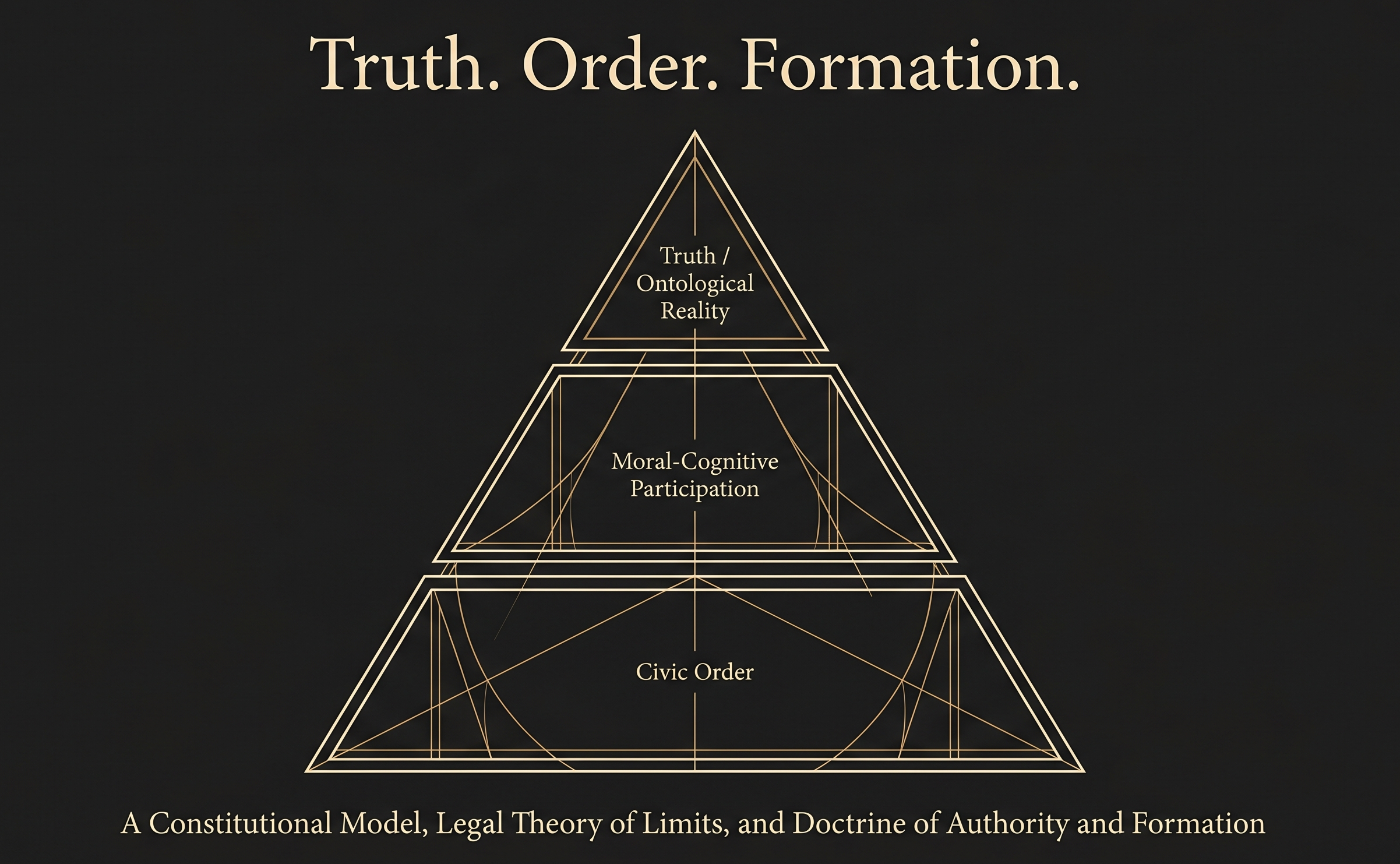
The Three-Layer Constitutional Architecture
Layer One: The Ontological Foundation
Non-negotiable and non-democratic. This layer identifies the basic goods — life, rational agency, family integrity, freedom of conscience, protection from arbitrary coercion — that no majority may override because they are grounded in the structure of personhood itself. This layer is the source of rights, not merely their repository.
Layer Two: The Moral-Cognitive Participatory Layer
This layer concerns how human beings access moral truth. Access is real but uneven. Even persons of significantly distorted formation retain residual moral perception — enough to recognize the basic prohibitions upon which civic order depends. The formalization of this claim is the subject of Part Two. It is load-bearing for the entire framework.
Layer Three: The Civic-Political Operational Layer
Where governance actually occurs. Constitutional design here must guard against two equal failures: reducing governance to mere power, and confusing governance with salvation. The State orders external conduct. It does not produce interior virtue.
Architectural Note:
The three layers are one integrated order, not three separate systems. The civic layer derives its authority from the moral-cognitive layer, which is grounded in the ontological foundation. Remove the foundation and the upper layers become arbitrary. Conflate the layers and authority overreaches into domains it cannot properly occupy.
Constitutional Principles
- Identify non-negotiable human goods not subject to majoritarian revision: life, rational agency, family integrity, freedom of conscience, protection from arbitrary coercion.
- Separate what the State may legislate from what it may not. The State orders external conduct; it does not legislate interior assent.
- Distribute authority and build accountability, because disordered power is predictably destructive regardless of how it was acquired.
- Orient the civic order toward formation as well as regulation. Law alone cannot sustain civilization.
- Govern pluralism through hierarchical tolerance: all persons treated with dignity; not all claims about reality equally affirmed.
PART TWO
The Doctrine of Hierarchical Pluralism and Partial Moral Knowledge
Most truth-committed frameworks fail at this point. The failure is understandable: acknowledging that a society must be governed through persons who do not share its ontological foundations feels like a concession. It is not. It is a precise anthropological observation that the framework must incorporate to be operative.
The Anti-Theocracy Principle
Before proceeding, a foundational boundary must be stated explicitly, because it determines the entire character of what follows.
Governing Principle:
The State governs conduct in relation to objective goods, not belief in their ultimate metaphysical grounding. It may enforce what follows from the basic goods. It may not compel assent to the philosophical or theological account of why those goods are grounded in the nature of things.
This principle does three things simultaneously. It protects the framework from the theocracy critique, which will otherwise be pressed by every skeptic. It preserves full ontological seriousness, since the State's reference to objective goods is not weakened by declining to enforce the metaphysical account of their origin. And it clarifies the operational domain of civil law: conduct, not conviction; external order, not interior formation.
The Doctrine of Partial Moral Knowledge
The most operationally important contribution of Aquinas to political philosophy is his account of how the natural law is accessed by persons of uneven rational and moral development. He distinguishes three levels of moral knowledge, each with different degrees of stability and accessibility.
Level
Moral Content
Civic Implication
Primary Precepts
Do good; avoid evil; respect persons. Present in every rational agent. Virtually indestructible.
The universally accessible ground of shared civil law. No metaphysical consensus required to enforce what follows from these.
Secondary Precepts
Do not murder, steal, or defraud. Nearly universal; suppressed only under severe cultural pathology.
The basis for prohibitive law. Enforceable across a pluralistic population without requiring shared philosophical foundations.
Tertiary Applications
Specific moral norms and institutional arrangements. Subject to genuine diversity of conclusion.
The domain of prudential law and policy. Legitimate disagreement exists here; persuasion and formation are the proper instruments, not compulsion.
This table is architecturally operative. It specifies where law functions on shared ground, where it must exercise restraint, and where formation — not legislation — is the appropriate instrument. Enforcing tertiary conclusions with the coercive force appropriate to primary precepts produces resistance and collapse. Refusing to enforce secondary precepts on grounds of moral diversity abandons the function of law entirely.
Hierarchical Pluralism: The Three Tiers of Civic Participation
Hierarchical pluralism distinguishes persons from positions. All persons are tolerated in their full humanity. Not all positions about reality are equally affirmed or equally protected from critique, persuasion, and appropriate legal constraint.
Tier
Description and Civic Standing
Tier One: Full Participants
Persons who recognize and affirm the basic moral order upon which the framework rests. They understand why the laws are just, not merely that they are enforced. Capable of full institutional leadership, including stewardship of formative institutions.
Tier Two: Partial Participants
Persons who observe the basic moral prohibitions in practice, even without affirming their philosophical foundations. The majority of functioning citizens in any pluralistic society. Full civic standing in all practical respects — voting, officeholding, rights, responsibilities.
Tier Three: Dissenting Participants
Persons who explicitly reject some or all of the foundational moral order. Retain full dignity and basic rights protections. Are tolerated and engaged through persuasion. Are not entrusted with institutional authority over the moral formation of others, which requires an understanding they currently lack. This limitation concerns roles explicitly ordered toward moral and formative authority; it does not restrict participation in ordinary civic, economic, or political life.
This is not a caste system. Movement between tiers is expected, sought, and accomplished through the work of formation. All three tiers enjoy identical basic legal protections. The differentiation concerns formative stewardship, not civic standing.
The Limits of Toleration
Toleration is not the suspension of judgment. It is the recognition that persons who err retain their dignity as rational agents and that persuasion is the appropriate response to most error. Toleration ends where a position requires the active violation of another person's basic goods. Freedom of conscience does not extend to freedom of predation. The act of murder is not tolerated on grounds of the murderer's sincere conviction. Toleration extends to persons and to the expression of positions — up to and including positions the framework considers gravely mistaken. It does not extend to acts that constitute violations of the basic goods the framework exists to protect.
PART THREE
A Legal Theory of Limits and Applied Constitutional Tests
What Law Can and Cannot Do
The sharpest distinction in this legal theory is between external order and internal formation. Law governs the external conduct of persons in their relations with one another. Formation shapes the internal dispositions from which conduct flows. Conflating these is not a theoretical error alone; it is the defining error of every form of totalitarianism.
What Law Legitimately Accomplishes
Law protects basic goods by prohibiting their violation — murder, theft, assault, fraud, enslavement. It orders external conduct toward the common good through contract, property, public health, and commerce regulation. And it sustains the formative institutions — family, church, school, civic association — that law cannot replace but must protect.
What Law Cannot Do
Law cannot mandate interior assent. Compelled confession of correct doctrine is not knowing; it is submission to power. Law cannot produce virtue; virtue cultivated entirely under compulsion is performance, not character. And law cannot eliminate pluralism; the attempt to do so produces resentment and underground resistance, not the unity it seeks.
Category
What Law Properly Does
What Formation Must Accomplish
Protection of Life
Prohibits murder, assault, endangerment, abortion of innocent life, euthanasia outside genuine consent frameworks.
Cannot mandate love of neighbor or the virtue of mercy. These are cultivated through family, church, and community over time.
Property and Commerce
Enforces contracts. Prohibits theft and fraud. Regulates exploitative practices. Protects property rights.
Cannot mandate generosity or just stewardship. These are virtues formed through family, example, and religious community.
Family and Children
Protects the family as foundational institution. Shields parental rights. Prohibits exploitation of children.
Cannot mandate attentiveness, love, or quality of emotional formation within families. These require genuine relational presence.
Speech and Conscience
Prohibits speech constituting direct incitement to violence or fraud. Protects conscience from compelled expression of false positions.
Cannot mandate sincerity, intellectual honesty, or genuine conviction. These are formed through education and moral habituation.
Education
Sets minimum standards. Protects parental authority over the content of children's formation.
Cannot produce genuinely rational, virtuous persons. This is the multi-year work of teachers, families, and communities.
Religious Practice
Protects free exercise from state interference. Prevents establishment of ideological alternatives.
Cannot mandate sincere faith or interior transformation. These are received, not mandated.
Applied Constitutional Tests
The following five tests operationalize the legal theory of limits. Each identifies a governing question, specifies the standard of determination, and provides concrete applications. These tests convert normative principle into justiciable criteria — the step required to elevate the framework from philosophical coherence into legal seriousness.
These tests are cumulative, not optional. A law or policy that fails any one of them is presumptively defective and subject to revision or invalidation.
Test 1: The Public Expression Test
Governing Question: When does speech or expression move from protected disagreement to actionable civic disorder?
Standard: Speech is protected unless it (a) directly incites imminent violence against identifiable persons, (b) constitutes deliberate fraud that causes concrete harm to another, or (c) is itself an act of coercion — not merely the expression of a position that others find coercive. The governing principle: the State may prohibit acts of harm accomplished through speech; it may not suppress positions because their content conflicts with the framework's own ontological commitments.
Applications:
- Protected: Public advocacy for positions the framework considers gravely mistaken, including advocacy for legal changes that would violate basic goods. The remedy is persuasion and the democratic process, not suppression.
- Not protected: Speech that coordinates imminent violence against specific persons, or that constitutes fraud causing concrete material harm.
- Contested (formation-domain): Speech that distorts the moral formation of children within institutions. The remedy is parental authority and institutional accountability, not criminal prohibition of the speech itself.
Test 2: The Formation Boundary Test
Governing Question: When may the State intervene in education or family formation?
Standard: State intervention in family or educational formation is legitimate only when (a) a basic good is being actively violated — not merely when a different formative approach is being taken — and (b) no less coercive remedy is available. The governing principle: the State supplements and protects formative institutions; it does not colonize or replace them.
Applications:
- Legitimate intervention: Removal of a child from a home where physical abuse or starvation constitutes a direct violation of the basic good of life or physical integrity.
- Not legitimate: Overriding parental authority over curriculum content on grounds that the State's preferred formation differs from the parents'. Disagreement about formative content is not a violation of a basic good.
- Not legitimate: Mandating specific ideological content in religious schools on grounds of civic consistency. The institutional independence of formative institutions is itself a constitutional good that the State may not consume.
Test 3: The Conscience Protection Test
Governing Question: What distinguishes legitimate law from coercion of conscience?
Standard: A law coerces conscience unjustly when it (a) requires a person to actively participate in an act they regard as intrinsically evil, rather than merely refraining from it, and (b) the required participation cannot be justified by the direct protection of another person's basic goods. The governing principle: law may restrict external conduct; it may not commandeer a person's rational agency as an instrument of ends they regard as morally impermissible.
Applications:
- Legitimate law: Prohibiting a surgeon from performing an operation she considers unnecessary. She is restricted from the act; her moral agency is not commandeered.
- Coercion of conscience: Requiring a surgeon to perform an abortion under legal penalty. Her rational agency is commandeered as an instrument of an act she regards as the taking of innocent life.
- Legitimate law with contested application: Tax obligations that fund programs some citizens regard as unjust. Remote material cooperation with institutional policy does not constitute direct moral agency in the act. The remedy is the democratic process.
Test 4: The Institutional Integrity Test
Governing Question: When is the State unlawfully replacing or colonizing formative institutions?
Standard: State action violates institutional integrity when it (a) assumes a function properly belonging to family, church, school, or civic association, (b) displaces rather than supplements the institution, and (c) does so without the consent of those the institution serves or without a clear violation of basic goods requiring intervention.
Applications:
- Violation: State programs that systematically remove child formation from parental authority and vest it in state-credentialed personnel, without parental consent or evidence of harm.
- Violation: Regulatory requirements imposed on religious institutions that require them to act in ways contrary to their foundational moral commitments as a condition of operation.
- Not a violation: State provision of educational resources, health services, or economic support that supplements family capacity without substituting state authority for parental judgment.
Test 5: The Accessible Law Test
Governing Question: Does this law operate at a level of moral generality that persons of Tier Two civic participation can recognize as grounded in something real?
Standard: A law passes this test if its operative prohibition or requirement can be recognized as reasonable by a person of good will and ordinarily functioning conscience, without requiring that person to assent to the full metaphysical or theological account from which the law ultimately derives. Laws that fail this test are candidates for persuasion and formation, not coercive enforcement across a pluralistic population.
Applications:
- Passes: Prohibition of murder. No metaphysical consensus required. The secondary precept against killing the innocent is accessible across virtually all moral traditions and to the ordinarily functioning conscience.
- Passes: Protection of children from exploitation. The basic good of the child's integrity is recognized across cultures even where the philosophical account of its grounding differs.
- Does not pass (yet): Specific institutional arrangements derived from contested tertiary conclusions. These require formative work before they are enforceable without producing the resentment of compelled assent to contested metaphysics.
The Test of a Just Law
A law is just when it satisfies all five of the following criteria:
- Ordered toward a genuine human good, not merely toward the preferences of those with power.
- Does not command an intrinsic evil — an act that violates the nature and dignity of persons regardless of circumstance.
- Proportionate: minimum coercion necessary to achieve its legitimate end.
- Accessible: recognizable as reasonable by persons of good will and ordinary conscience, even without shared philosophical foundations.
- Stable: enforceable without a level of coercion that would itself violate the goods the law claims to serve.
PART FOUR
The Architecture of Authority: Structure, Limits, and Accountability
The previous editions of this paper described authority with philosophical accuracy. They did not engineer it. Engineering authority means specifying not only what it is and where it comes from, but how it is structured, how it is corrected when it fails, and how genuine disputes are adjudicated when truth is contested.
The Sources and Structure of Civil Authority
Civil authority is mediated from a single ultimate source — moral reality itself, which the theistic tradition grounds in the being and character of God — through a series of forms appropriate to each domain: familial, ecclesial, epistemic, and civil. Each is real, legitimate, and bounded. None is self-justifying.
Civil authority specifically must be structured by three principles.
Distribution
Power distributed across multiple institutions and levels of governance is not a practical expedient; it is an ontological requirement. No single human institution is capable of bearing absolute authority without corruption. Separation of legislative, executive, and judicial functions at the national level, combined with meaningful reservation of authority to local communities, families, and civil associations, is the structural expression of this reality.
Accountability to Truth
All exercises of civil authority are, in principle, subject to critique and correction by reference to a standard not itself produced by that authority. The judiciary measures legislation against permanent principles. The executive exercises a moral faculty accountable to reality, not merely to judicial rulings. These accountabilities are not procedural conventions; they are ontological, reflecting a moral order that does not defer to institutional rank.
Subsidiarity
Decisions must be made at the lowest level of governance genuinely capable of making them well. Higher levels exist to support and correct lower levels, not to absorb them. The colonization of lower levels by higher levels — state replacing family, national replacing local — does not redistribute functions. It destroys the conditions under which those functions can be performed well.
The Limits of Civil Authority
- May not override conscience in matters that do not directly violate another's basic goods.
- May not substitute state formation for parental authority over the character formation of children.
- May not compel religious institutions to act in ways that violate their foundational moral commitments.
- May not accumulate power sufficient to eliminate the meaningful independence of distributed formative institutions.
- May not persist beyond the term and scope specifically granted by constitutional arrangement.
Mechanisms of Correction
Mechanism
Function and Design Requirement
Judicial Review
An independent judiciary empowered to measure legislative and executive action against the permanent principles of the constitutional order. Independence requires structural insulation from direct electoral pressure, with accountability through an interpretive methodology grounded in the framework's ontological commitments.
Electoral Accountability
Regular, structured occasions for civil authority to be affirmed or replaced. Electoral accountability does not make law legitimate by itself; it provides an essential feedback mechanism. Electoral systems must prevent capture by incumbent power.
Institutional Plurality
The deliberate maintenance of independent institutions — churches, universities, civic associations, free press — capable of identifying and critiquing abuses of civil authority. A state that eliminates institutional plurality in the name of unity has eliminated its own primary correction mechanisms.
Constitutional Amendment
A structured process requiring broad consensus and deliberate procedure, allowing the constitutional order to adapt to genuinely new conditions without being vulnerable to casual revision by temporary majorities.
Civil Disobedience
Structured, non-violent refusal to comply with gravely unjust laws as a last resort when institutional correction mechanisms have failed. The moral order has authority over the constitutional order, and individuals are moral agents accountable to that order regardless of what any State commands.
Adjudicating Contested Cases
Every framework for social order must answer what happens when good-faith disagreement produces a contested case that existing law does not clearly resolve.
Step One: Identify the Precept Level
Determine whether the question involves a primary-level good, a secondary precept, or a tertiary application. Primary-level questions are not adjudicated by majority. A proposed law that conflicts with a primary precept is refused — not compromised. Secondary and tertiary questions proceed to deliberation.
Step Two: Deliberate with Accessible Reasoning
Arguments at the secondary and tertiary level must be made in terms recognizable to Tier Two participants — grounded in basic goods and recognizable moral realities, not merely in the internal logic of a single theological tradition. Natural law argumentation, as distinct from explicitly theological argumentation, provides exactly this accessible but non-relativistic vocabulary.
Step Three: Institutional Determination with Appellate Review
Where deliberative reasoning produces a genuine plurality of reasonable positions, institutional authority makes a provisional determination subject to the correction mechanisms described above. The determination is not final because it represents majority will; it is provisional because it represents the best current exercise of institutional judgment, subject to revision as understanding develops.
On the Legitimacy of Disagreement:
A truth-committed order is not one in which all disagreement has been eliminated. It is one in which disagreement is conducted in reference to something real, with the genuine aim of better understanding that reality, through institutions designed to distinguish better reasoning from worse.
PART FIVE
A Doctrine of Formation
Formation as the Primary Work of Civilization
Every civilization forms its citizens toward something. The question is never whether formation occurs, but what kind, by what institutions, toward what ends, and with what account of the human person. A constitutional order and a legal theory of limits are the frame. Formation is the substance the frame exists to protect.
Formation Versus Indoctrination
Genuine formation develops rational agents capable of perceiving truth, making genuine moral judgments, and living in a manner consistent with their deepest understanding of what is real and good. It respects the developing rational agency of the person being formed and orients the whole process toward the kind of freedom that is genuinely self-governing — governed by reason and virtue, not external compulsion.
Indoctrination aims at the production of compliant responders. It bypasses rational agency rather than developing it. It produces persons who conform under observation and revert under freedom — precisely the moral fragility it claims to prevent.
The Institutions of Formation
The Family
The primary institution of character formation, irreplaceable by any state program. Parental authority over the formation of children is a natural reality that law must recognize and protect. Programs that substitute for rather than support the family produce the dependency and fragmentation that are the opposite of civic health.
The Church and Religious Community
The institution most explicitly ordered toward the ultimate ground of moral reality, and therefore most essential to the formation of persons who understand why moral truth matters — not merely that it is enforced. A society that marginalizes religious community from public life cultivates the moral amnesia that precedes civic collapse.
The School
Charged with the cultivation of rational capacity — thinking clearly, reasoning honestly, engaging difficulty without retreat into dogmatism or nihilism. Schools that have converted the formation of rational agency into ideological production are not merely failing educationally; they are producing citizens incapable of sustaining self-governance.
Civic Associations and Local Community
The intermediate institutions through which persons learn responsible freedom in contexts larger than the family but more personal than the State. Their atrophying — through both cultural atomization and state expansion into their proper domain — is among the most significant and underreported crises of modern civic life.
The Statesman as Servant of Formation
The proper measure of political authority is not the scope of its reach but the quality of what flourishes within its protection. The statesman who governs well creates conditions within which families, schools, churches, and civic associations can do their proper work. He does not ask how much the State can do; he asks what conditions the State must maintain so that the institutions of formation can do what they alone are capable of doing.
Authority is not the enemy of freedom. It is the structure within which genuine freedom becomes possible.
CONCLUSION
A Governing Vision
This framework has now accomplished what its first two editions approached but did not complete. It has demonstrated, with operative specificity, that a truth-grounded social order can govern a pluralistic population without collapsing into relativism or coercion. The argument rests on six interdependent elements, each of which was required for the whole to hold.
The tradition-positioning section establishes the framework's place in the natural law tradition — Thomistic in foundation, extending Maritain's operational insight while correcting his foundational error, accepting MacIntyre's diagnosis while providing the institutional remedy he stopped short of specifying. The constitutional architecture grounds the framework in ontological reality while distributing its implications across three distinguishable layers. The doctrine of hierarchical pluralism, grounded in the formal account of partial moral knowledge, resolves the governance-across-diversity problem with precision rather than evasion. The legal theory of limits draws the critical line between law and formation, and the five applied constitutional tests convert that line from a normative claim into a justiciable instrument. The architecture of authority provides distributed structure, enumerated limits, specific correction mechanisms, and a three-step adjudication framework. The doctrine of formation articulates the irreplaceable role of formative institutions and the statesman's proper relationship to them.
Where This Framework Now Stands
This framework surpasses Maritain in three respects: it refuses to sever truth from public order at any level; it explains and predicts moral collapse where Maritain's framework could only observe it; and it provides operational specificity where Maritain remained largely at the level of principle. It surpasses MacIntyre by extending his diagnosis into institutional and constitutional remedy. It extends Aquinas by operationalizing his participatory account of moral knowledge into constitutional architecture and legal theory.
The three tests of viability are now met. The framework can govern across moral diversity through the doctrine of hierarchical pluralism and partial moral knowledge, without abandoning ontological seriousness. It can explain the patterns of civic fragmentation as the predictable consequence of ontological severance. And it provides concrete institutional guidance through the five constitutional tests, the authority architecture, and the adjudication framework.
The Work That Remains
This paper is a foundation, not a conclusion. Constitutional lawyers must translate these principles into operative legal language. Educators must rebuild curricula oriented toward the formation of rational moral agents. Statesmen must understand their proper function as the protection of formative conditions rather than the management of formative outcomes. Communities must invest in the slow, local work of rebuilding the intermediate institutions through which genuine civic character is cultivated.
That work requires patience that does not mistake urgency for haste, courage that does not mistake provocation for argument, and intellectual honesty that insists on finishing what it begins. The framework offered here is architectured, specified, tested, and ready for the builders.
Jamie Vincent Thornberry
Cultural Philosopher | Theologian | Writer | Mentor
All rights reserved. 2025.