From Deconstruction to Restoration: The Love–Light–Life Framework as the Ontological Ground for True Social Understanding
Introduction: The Crisis of Seeing Without Building
Modern education has mastered the discipline of suspicion. Students are systematically trained to look beneath norms, interrogate narratives, and identify the hidden architectures of power that shape social reality. This critical instinct, popularized through frameworks like Critical Theory, performs an essential diagnostic function: it dismantles naïveté, exposes structural manipulation, and awakens the investigative mind. Yet it leaves a profound void. It teaches learners how to unmask, but not how to restore; how to dissect, but not how to rebuild.
The result is an intellectual culture rich in exposure but impoverished in direction. When critique operates without an ontological anchor, it drifts into epistemological instability, moral ambiguity, and cyclical cynicism. What is required is not the abandonment of critical analysis, but its completion through a positive metaphysical foundation.
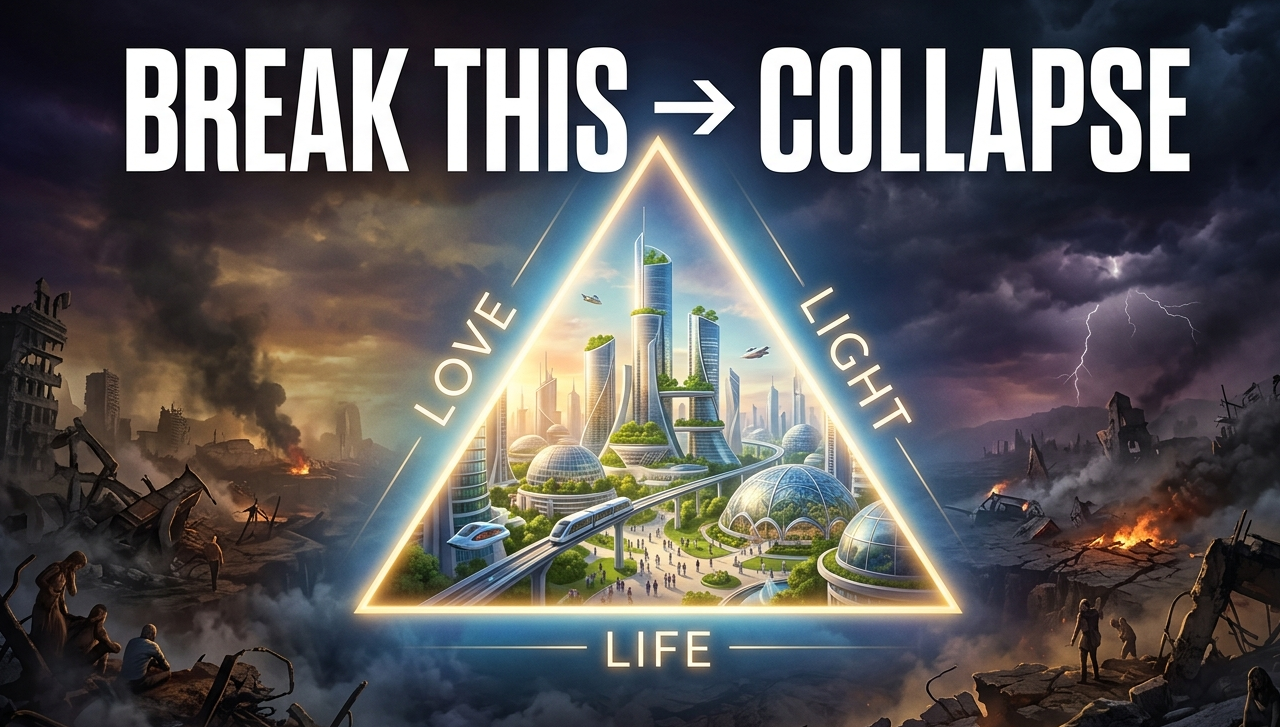
The Love–Light–Life framework provides that foundation. By grounding social analysis in objective intelligibility (Light), intrinsic goodness (Bonum), and relational agency (Love), it transforms critique into discernment and fragmentation into ordered construction. It does not merely produce analysts of broken systems; it forms architects of flourishing reality (Life). This thesis demonstrates why the Love–Light–Life model is not a supplementary alternative to Critical Theory, but a necessary philosophical and pedagogical evolution: one that restores ontological stability, clarifies moral telos, and equips learners to rebuild what they have learned to question.
I. The Diagnostic Merit and Ontological Deficit of Critical Theory
Critical Theory’s greatest strength is its refusal to accept social arrangements at face value. By training students to trace the relationship between power, ideology, culture, and liberation, it reveals that many “natural” norms are historically contingent, institutionally enforced, and often aligned with entrenched interests. This analytical rigor is indispensable. It prevents intellectual complacency and cultivates civic vigilance.
Yet when elevated from a methodological tool to a comprehensive worldview, Critical Theory encounters four structural limitations:
Ontological Instability: If truth is reduced to social construction and all claims are interpreted through the lens of interest, the framework undermines its own normative authority. Critique requires a standard external to power to evaluate distortion; without it, analysis collapses into subjective suspicion.
Reductionism to Power: While power is a real social force, it is not an ultimate explanatory category. When power becomes the primary lens, human relationships flatten into domination and resistance, moral language is replaced by strategic calculation, and the possibility of objective goodness is erased.
Borrowed Telos: Critical Theory routinely presumes ideals such as equality, dignity, and liberation, yet its epistemology cannot justify them as objectively binding. These ends are smuggled in from classical, religious, or humanist traditions, creating a paradox: a framework that deconstructs all foundations while quietly standing on one.
Moral Drift and Cynicism: Without a stable standard, critique becomes perpetual rather than directional. Outrage substitutes for discernment, and students fracture into what may be called perpetual critics: highly skilled at identifying pathology, but structurally unequipped to envision or execute restoration.
Critical Theory teaches students to see the fracture. It does not provide the architecture for healing it.
II. The Architectural Correction: Light, Goodness, Love, and Life
The Love–Light–Life framework resolves these deficits by restoring first-principles ontology. It does not reject critical analysis; it subordinates it to a higher order of reality.
Light denotes the intelligibility of being. Truth is not manufactured by consensus or imposed by power; it is discovered through correspondence with what objectively is. This provides the necessary ground for meaningful critique. Students no longer ask, “Who controls this narrative?” but “Does this align with reality?”
Goodness (Bonum) is the intrinsic value inherent in being. Every entity possesses worth insofar as it exists according to its nature. Goodness is not a social preference; it is an ontological property that anchors moral evaluation.
Love (Agape) is the volitional and relational orientation toward the Good. It is not a metaphysical substrate, but the active force that recognizes, preserves, and restores what is true and good. By distinguishing Love from Goodness, the framework maintains categorical precision: Goodness is the standard; Love is the agency that moves toward it.
Life is the realized state of flourishing that emerges when will, mind, and action are aligned with Light and Love. It is the teleological endpoint of properly ordered social and personal reality.
This triadic structure restores what Critical Theory lacks: a stable standard for evaluation, a clear moral telos, and an operative principle for restoration. Evil is understood not as a competing positive force, but as privation—the absence, distortion, or misordering of truth, goodness, and relational care. Unjust systems are therefore not monolithic entities to be annihilated, but deficiencies to be corrected. This reframing redirects energy from destructive opposition to constructive restoration.
Power is not ignored; it is contextualized. It is analyzed as a functional reality but evaluated against Light and Love. This prevents both naïve dismissal and cynical absolutization, yielding a balanced anthropology that recognizes human agency without reducing it to mere domination.
III. From Privation to Structure: Operationalizing the Framework
A robust framework must bridge metaphysical insight and material reality. Privation ontology risks abstraction if it fails to account for the functional density of institutional structures. When absence is systematized—through procurement schedules, policy architectures, or cultural habits—it acquires causal momentum. It operates with the force of a positive structure, perpetuating harm through inertia rather than malice.
The Love–Light–Life model addresses this through a four-step operational sequence: Observation → Critical Inquiry → Ontological Evaluation → Restorative Response.
Consider two applied cases:
Playground Governance: A rule restricting swing access to students wearing blue shoes reveals arbitrary exclusion (privation of fairness). Critical inquiry identifies the power dynamic; ontological evaluation measures it against Light (equal dignity) and Love (relational care); restoration redesigns the rule to align with objective fairness and inclusive access.
Institutional Provision: A school menu that systematically ignores dietary needs reflects not active malice, but institutionalized neglect. Structural analysis maps how budgeting and scheduling amplify the absence. Restorative response reintroduces moral attention into operational design, transforming privation into provision.
In pluralistic educational contexts, the framework is accessible without presupposing prior metaphysical assent. Pre-evangelism for ontology proceeds through empirical revelation and practical moral reflection: students observe patterns of distortion that preference-based ethics cannot resolve, recognize that meaningful correction requires objective standards, and experience the practical indispensability of grounded evaluation. Light is framed as correspondence with observable reality; Love as ethical orientation toward cooperative flourishing; Life as measurable well-being. This preserves secular accessibility while maintaining metaphysical depth for advanced inquiry.
IV. Comparative Superiority and the Formation of Restorative Agency
When stress-tested against dominant paradigms, the Love–Light–Life framework demonstrates structural superiority:
Against Critical Theory: It retains analytical rigor regarding power and ideology, but replaces epistemological drift with ontological grounding. Critique becomes directional, not endless.
Against Relativism: It affirms objective standards without dogmatism, enabling meaningful moral evaluation while avoiding the collapse into “anything goes” thinking.
Against Naïve Traditionalism: It honors stability and continuity but refuses static preservation. Unjust norms are questioned and reformed through alignment with truth and relational goodness.
Against Pure Pragmatism: It demands practical outcomes but subordinates means to moral truth, ensuring that efficiency never eclipses justice.
The formative outcome is decisive. Critical Theory produces analysts; the Love–Light–Life framework produces architects. It resolves the central tension in modern education: how to teach students to question the world without destroying their capacity to believe in what is good. By integrating perceptive analysis with ontological grounding and restorative agency, it cultivates individuals who are simultaneously discerning and constructive, morally anchored and practically competent.
Conclusion: The Necessity of Grounded Construction
Critical Theory was a necessary awakening in intellectual history. It exposed the myth of neutral systems and trained generations to recognize how power shapes perception. But it stopped at the threshold of reconstruction. Deconstruction without direction yields only fragmentation; suspicion without standard yields only fatigue.
The Love–Light–Life framework completes the task. It anchors truth in reality, restores goodness as an objective measure, and directs human agency toward relational restoration and holistic flourishing. It transforms critique into discernment, outrage into responsibility, and fragmentation into order. Most importantly, it forms builders: individuals capable of diagnosing distortion, assuming moral agency, and reconstructing social reality in alignment with what is true, good, and life-giving.
In an age defined by perpetual unmasking, the highest intellectual and civic duty is not merely to see what is broken, but to know how to make it whole.