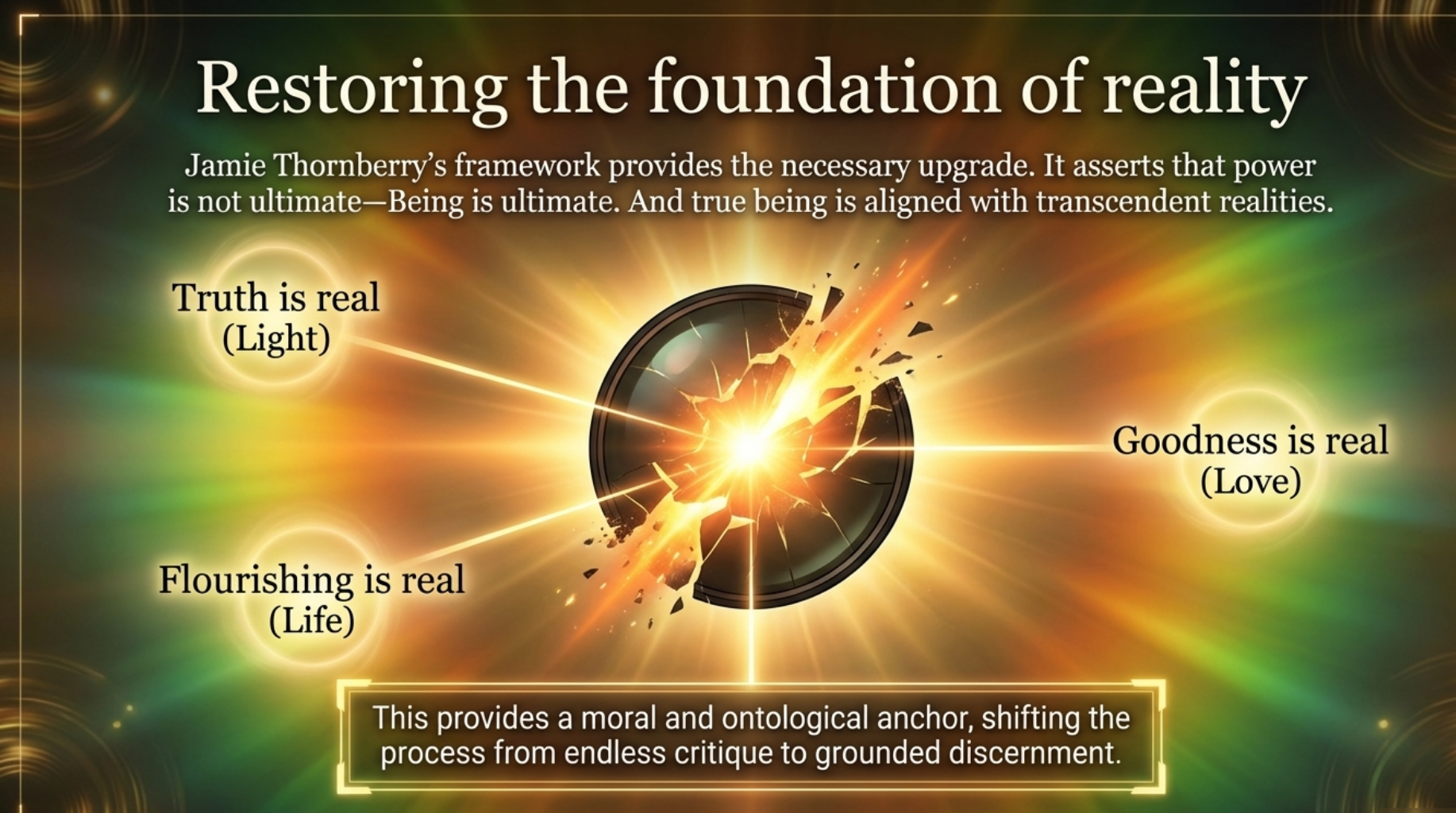
FROM CRITIQUE TO CONSTRUCTION:
THE LOVE–LIGHT–LIFE DISCERNMENT MODEL
AS A SUPERIOR ONTOLOGICAL FRAMEWORK
FOR SOCIAL UNDERSTANDING AND FORMATION
A Doctoral Dissertation
In Partial Fulfillment of the Requirements
for the Degree of Doctor of Philosophy
in Philosophical Theology and Cultural Formation
By, Jamie Thornberry
2025
ABSTRACT
This dissertation proposes and defends a novel philosophical and pedagogical framework — the Love–Light–Life Discernment Model — as a structured, ontologically grounded alternative to the epistemological instabilities endemic to Critical Theory and its derivative social pedagogies. Emerging from the classical tradition of philosophical realism, privation ontology, and Christian metaphysics, the Love–Light–Life model provides what Critical Theory cannot: a stable ground for truth-evaluation, a non-reductive account of moral reality, and a teleological orientation toward genuine human flourishing.
The dissertation proceeds through seven integrated movements. The first establishes the cultural and intellectual crisis precipitated by the dominance of Critical Theory in educational and social formation contexts. The second offers a rigorous historical and philosophical examination of Critical Theory's Frankfurt School origins, tracing both its legitimate analytical insights and its constitutive epistemological deficits. The third constructs the positive ontological foundations of the Love–Light–Life model through engagement with Thomistic metaphysics, Augustinian anthropology, and contemporary moral realism. The fourth advances a comparative analysis of the model against four dominant intellectual frameworks, demonstrating its superiority along multiple evaluative axes. The fifth examines pedagogical and formative implications, with particular attention to the model's capacity to produce integrative, morally anchored thinkers rather than perpetual critics. The sixth extends the model into concrete domains of social analysis and institutional reform. The seventh concludes by situating the model within the broader arc of Western intellectual history and calling for its adoption as a normative framework in academic, civic, and ecclesial formation.
The central claim of this dissertation is both precise and consequential: Critical Theory's power to illuminate hidden dynamics is a genuine but insufficient intellectual achievement. Without an ontological ground, it produces critics without architects, analysts without builders, and—ultimately—citizens without the moral formation necessary to restore what they have learned to question. The Love–Light–Life model resolves this deficiency not by abandoning critical rigor but by completing it — anchoring discernment in the irreducible realities of Truth, Goodness, and Life.
Keywords: Critical Theory, Love–Light–Life Model, ontological realism, privation ontology, moral formation, social epistemology, pedagogical philosophy, teleology, Thomism, Christian anthropology.
ACKNOWLEDGMENTS
Every serious inquiry is ultimately a form of gratitude — gratitude to those whose thought preceded ours and whose lives bore witness to the truths we are only now beginning to articulate. This dissertation is no exception.
To the great tradition of philosophical theology that runs from Plato through Augustine, Aquinas, and into the contemporary retrieval movements of Christian philosophy, I owe the basic conviction that reality is intelligible and that goodness is not merely preferential but constitutive of being itself. Without that tradition, the Love–Light–Life model would have no foundation upon which to stand.
To the scholars and mentors at Wheaton College who pressed for precision without sacrificing depth, and who modeled the integration of rigorous thought with genuine moral formation, I am deeply indebted. The best ideas in this work were sharpened in seminar rooms and hallway conversations with colleagues whose love of truth was never merely academic.
To the students and practitioners who ask the fundamental question — not merely what is wrong, but how we begin to make it right — this dissertation is ultimately addressed. You are the reason this inquiry matters.
And to the Author of Love, Light, and Life Himself — in whose being all true inquiry finds its beginning, its sustenance, and its end — this work is offered in the spirit of that ancient vow: fides quaerens intellectum. Faith seeking understanding.
CHAPTER ONE
Introduction: The Crisis of Constructive Formation in Contemporary Education and Social Thought
1.1 The Shape of the Problem
There is a peculiar irony at the heart of contemporary intellectual formation. The generation that has been most rigorously trained to question — to interrogate assumptions, identify power dynamics, and deconstruct received narratives — is also, by many accounts, among the least equipped to construct. Students arrive at institutions of higher learning with a sophisticated vocabulary for exposing what is wrong and a startling poverty of resources for articulating what would be right. They can anatomize injustice with precision; they struggle to define justice with confidence. They have been taught to see through the world; they have rarely been taught to see toward anything.
This is not a trivial observation, nor is it merely the complaint of traditionalists uncomfortable with critical inquiry. It is a structural diagnosis, and it points to a genuine intellectual and moral deficit at the core of the dominant pedagogical frameworks of our time. The capacity to deconstruct, absent the capacity to reconstruct, does not produce formation — it produces dissolution. And dissolution, however intellectually sophisticated its vocabulary, is not wisdom.
The present dissertation addresses this crisis directly. It does so not by abandoning critical rigor — which would be both intellectually dishonest and practically irresponsible — but by situating that rigor within a richer and more stable ontological framework. The argument is straightforward: the analytical tools of Critical Theory are genuine contributions to intellectual culture; the philosophical infrastructure of Critical Theory is insufficient to support the weight of moral formation it is asked to bear. A model is needed that retains the penetrating power of critical inquiry while providing the positive ontological ground without which critique collapses into cynicism or performative activism.
That model is the Love–Light–Life Discernment Framework.
1.2 Situating the Inquiry
The inquiry presented here stands at the intersection of several disciplines: philosophical theology, social epistemology, moral philosophy, and pedagogical theory. It engages the philosophical tradition broadly — drawing on Plato, Aristotle, Augustine, Aquinas, Kant, Hegel, and their contemporary inheritors — while also attending carefully to the concrete social and educational contexts in which ideas become practices and frameworks become cultures.
It should be noted at the outset that this dissertation does not dismiss the insights of Critical Theory from a position of ignorance or ideological defensiveness. The Frankfurt School thinkers — Horkheimer, Adorno, Marcuse, Habermas — made genuine contributions to social philosophy, and those contributions deserve both acknowledgment and careful engagement. The argument here is not that Critical Theory is without value, but that its value is both more limited and more dependent upon an external ontological ground than its proponents typically recognize.
The Love–Light–Life model does not originate as a critique of Critical Theory, but rather as an independent constructive proposal rooted in classical and Christian metaphysics. Its encounter with Critical Theory is therefore not primarily polemical but comparative — asking, in each domain, which framework better accounts for the totality of human experience and better equips the persons and communities that inhabit it.
1.3 Statement of Thesis
The central thesis of this dissertation may be stated with precision: the Love–Light–Life Discernment Model provides a philosophically superior and practically more adequate framework for social understanding and human formation than Critical Theory, because it corrects Critical Theory's constitutive epistemological deficits — ontological instability, reductive power analysis, and the absence of constructive moral telos — by grounding discernment in the irreducible realities of Truth (Light), Goodness (Love), and Flourishing (Life), thereby transforming the student from a perpetual critic into a principled builder of social reality aligned with genuine human good.
1.4 Methodological Notes
The methodology of this dissertation is fundamentally philosophical: it proceeds by conceptual analysis, comparative evaluation, and constructive argument. Where historical context illuminates the philosophical issues, it is provided; where empirical research bears on the practical claims, it is cited; but the primary mode of inquiry throughout is rational rather than empirical, normative rather than merely descriptive.
The dissertation draws on the Christian philosophical tradition as a resource rather than merely a presupposition. This means that classical Christian concepts — privation ontology, moral realism, teleological anthropology, the transcendentals of Being — are brought into dialogue with secular philosophy, and their contribution to the inquiry is defended on rational grounds accessible to any careful thinker, regardless of theological commitment.
This approach reflects the conviction, shared by the great tradition from Justin Martyr to C.S. Lewis, that the truths available through reason and the truths available through revelation are not competitors but complements — that logos, wherever it appears, participates in the one Logos who is the ground of all intelligibility.
CHAPTER TWO
Literature Review: Critical Theory's Origins, Achievements, and Constitutive Limitations
2.1 The Emergence of Critical Theory: Historical and Philosophical Context
Critical Theory as a formal intellectual movement emerged from the Institute for Social Research at Frankfurt in the 1920s and 1930s, its foundational orientation shaped by the convergence of Hegelian dialectics, Marxist social analysis, Freudian psychology, and a deepening skepticism toward Enlightenment rationalism. The founding generation — Max Horkheimer, Theodor Adorno, Herbert Marcuse, Erich Fromm, and Walter Benjamin — shared a common conviction: that the philosophical and social inheritance of Western modernity had failed to deliver on its own promises of freedom, justice, and rational progress. The catastrophes of two world wars, the rise of fascism, and the commodification of culture under industrial capitalism seemed to confirm that something had gone profoundly wrong not merely in social arrangements but in the very mode of reasoning that had produced them.
In Horkheimer's foundational 1937 essay, 'Traditional and Critical Theory,' this conviction received its canonical formulation. Traditional theory, Horkheimer argued, operates in the mode of a detached, value-neutral observer, accepting existing social structures as given and seeking only to describe and predict their functioning. Critical Theory, by contrast, insists on the embeddedness of all thought in social relations, on the historical character of all claims to truth, and on the normative responsibility of theory to orient itself toward human liberation. Knowledge, on this account, is always already interested — shaped by the social conditions of its production and inevitably serving some set of interests, whether acknowledged or not.
This was a genuinely important insight. The Enlightenment had too often smuggled in particular social arrangements under the guise of universal reason; the pretense of value-neutrality had too often served to immunize existing power structures from scrutiny. Critical Theory performed a genuine service in exposing these dynamics and insisting that social thought could not proceed responsibly without interrogating its own conditions and interests.
2.2 The Development of Critical Theory: Second and Third Generations
The second generation of Critical Theory, dominated by Jürgen Habermas, represented a significant modulation of the founding orientation. Where Horkheimer and Adorno had ended in a deep pessimism about the possibility of reason to rescue itself — a pessimism culminating in the dark pages of Dialectic of Enlightenment — Habermas attempted to rehabilitate the Enlightenment project by distinguishing between instrumental reason, which had indeed been colonized by systems of power and money, and communicative reason, which retained the capacity to orient itself toward genuine intersubjective understanding.
Habermas's theory of communicative action and his concept of the ideal speech situation represent a sincere effort to rescue normative grounding from the wreckage of Frankfurt School pessimism. And yet, as philosophers from Alasdair MacIntyre to Charles Taylor have argued, this effort is ultimately insufficient. Habermasian communicative rationality is procedural rather than substantive: it tells us what a fair conversation looks like but cannot tell us what it should be about or toward what ends it should be directed. It rescues reason from corruption at the price of emptying it of content.
The third and fourth waves of Critical Theory — incorporating feminist theory, critical race theory, postcolonial studies, and queer theory — have extended the analytical apparatus of the Frankfurt School into new domains while largely inheriting its constitutive epistemological tensions. The addition of intersectionality (Kimberlé Crenshaw), standpoint epistemology (Patricia Hill Collins), and the emphasis on lived experience as a privileged site of knowledge has enriched the descriptive vocabulary of Critical Theory considerably. But it has also deepened the epistemological instability at its core, particularly in its tendency to treat truth-claims as functions of social position rather than as assessable against a shared standard of reality.
2.3 The Strengths of Critical Theory: A Balanced Assessment
A philosophically honest engagement with Critical Theory must begin by acknowledging what it achieves genuinely and well. Four contributions are particularly noteworthy.
First, Critical Theory has permanently enriched social inquiry by demonstrating the ideological character of ostensibly neutral social formations. The insight that what presents itself as 'common sense' or 'the natural order' often conceals a particular distribution of power and benefits is irreversible and important. Students who have absorbed this lesson are less naïve, less easily manipulated, and more alert to the ways in which social arrangements can be presented as inevitable when they are in fact contingent and contestable.
Second, Critical Theory has drawn attention to the perspectival character of knowledge. The recognition that all knowers are situated knowers — that our social location, embodied experience, and historical moment shape what we notice and what we overlook — is a genuine philosophical achievement. It provides a necessary corrective to the kind of disembodied, purely abstract rationalism that has sometimes afflicted academic philosophy.
Third, Critical Theory has given intellectual tools to communities whose experience of injustice had been systematically ignored or explained away. By providing frameworks for naming and analyzing patterns of domination, it has contributed to genuine moral and social progress in areas from labor rights to civil rights to the rights of historically marginalized communities.
Fourth, in its best moments, Critical Theory has preserved a horizon of normative aspiration — a vision of genuine human emancipation — without which critique degenerates into mere complaint. The Frankfurt School theorists, whatever their philosophical difficulties, never lost sight of the conviction that things could and should be better, and this conviction served as the engine of their sustained intellectual engagement.
2.4 The Constitutive Limitations of Critical Theory
Against these genuine achievements, we must set four constitutive limitations — limitations that are not incidental to Critical Theory but are built into its foundational commitments.
The first and most fundamental limitation is ontological instability. Critical Theory's foundational claim that all knowledge is socially conditioned and interest-laden is a claim that, if universally true, applies to itself. If every truth-claim must be interrogated as a function of power, then Critical Theory's own claims are subject to the same interrogation. If norms are always products of social construction, then the norm of human emancipation, which drives Critical Theory's critical enterprise, is also a social construction — and there is no principled reason to prefer it over the norms of domination it opposes. This is not a peripheral difficulty; it is a self-undermining at the core of the project. The critique that dissolves all stable ground dissolves the ground on which the critic stands.
The second limitation is reductive monism with respect to social causation. By treating power as the primary, and often the only, significant explanatory category for social phenomena, Critical Theory systematically underweights alternative explanatory dimensions: love, meaning, moral formation, transcendence, beauty, truth. Human beings are not merely power-seeking animals whose social arrangements can be fully explained by reference to domination and resistance. They are also truth-seeking, love-oriented, beauty-responsive creatures whose social life is shaped at least as fundamentally by their aspirations toward goodness as by their struggles over power. A framework that cannot see this is not merely incomplete — it is systematically distorting.
The third limitation is the absence of constructive moral telos. Critical Theory can identify that something is wrong and can name the structures through which wrongness perpetuates itself. What it cannot provide is a principled, non-arbitrary account of what right looks like — of what we are moving toward when we work to dismantle unjust structures. Its vision of emancipation is largely negative: freedom from domination, liberation from oppressive norms. But freedom from is not freedom for, and liberation that lacks a positive vision of human flourishing risks producing not genuine freedom but merely a different arrangement of power.
The fourth limitation is the psychological and formative effects of sustained critique without construction. When the primary intellectual posture transmitted to students is suspicion — when they are trained above all to unmask, expose, and deconstruct — the cumulative effect on character and culture is corrosive. The perpetual hermeneutic of suspicion corrodes trust, dissolves solidarity, and ultimately renders cooperative moral and civic life nearly impossible. Students formed exclusively in this mode do not merely become critics; they become incapable of the basic forms of trust and goodwill upon which any constructive social project depends.
CHAPTER THREE
Theoretical Framework: The Ontological Foundations of the Love–Light–Life Model
3.1 The Metaphysical Point of Departure
The Love–Light–Life model begins not with power — nor with suspicion, nor with the deconstruction of received norms — but with being itself. Its first question is not 'Who benefits from this arrangement?' but 'What is real?' This difference in point of departure is not merely methodological; it is metaphysically decisive. The starting point of any inquiry shapes the conceptual horizon within which all subsequent questions are framed and all subsequent answers evaluated. A framework that begins with power will see power everywhere; a framework that begins with being will find, upon careful examination, that being is characterized by an intrinsic intelligibility, goodness, and dynamism that no purely political analysis can exhaust.
This ontological starting point is not novel. It is, in fact, among the oldest and most rigorously developed insights of the philosophical tradition. Plato's Form of the Good — the highest principle of the intelligible realm, the source of both the being and the knowability of all other things — established the conviction that reality is not merely power but good, and that the highest function of reason is to orient itself toward that Good. Aristotle's teleological metaphysics — his account of substances as organized by internal principles of actualization moving toward their proper end — provided the framework within which goodness could be understood as objective, discoverable, and binding.
Plotinus, and through him Augustine, introduced into this stream of thought the insight that evil is not a substance or a positive force but a privation — a falling away from being, goodness, and truth. This privation ontology, systematically developed by Aquinas within a Christian theological framework, became one of the most durable and philosophically productive ideas in the history of thought. Its implications for social analysis will be examined in detail below.
3.2 The First Principle: Light as Truth
The first element of the Love–Light–Life model is Light, understood as Truth — the intelligible character of reality that makes it knowable and the capacity of the mind to be conformed to that reality in genuine knowing. This is not a metaphor but a metaphysical claim: that reality has a structure, that this structure is accessible to rational inquiry, and that propositions about it can be true or false in a sense that is not reducible to social consensus or power agreement.
This claim runs directly counter to the epistemological relativism that, at various points, characterizes Critical Theory and its descendants. If truth is genuinely available — not merely constructed, not merely negotiated, not merely a function of standpoint — then critique has a real standard against which to orient itself. One need not merely ask 'Whose truth is this?' but 'Is this actually true?' The difference is between a merely rhetorical question and a genuinely philosophical one.
The classical tradition identifies truth as a transcendental — one of the properties that necessarily accompanies being as such. Every being, insofar as it is, is intelligible; every being, insofar as it is intelligible, is true. This does not mean that every claim to truth is correct, or that human access to truth is unmediated and infallible. The history of epistemology is in large part a history of the discovery of the conditions, limitations, and distortions of human knowing. But it does mean that the project of truth-seeking is not arbitrary or illusory — that there is something to be sought, and that the seeking can succeed or fail depending on whether it conforms to reality or departs from it.
In practical terms, the principle of Light transforms the student's fundamental orientation toward inquiry. Rather than approaching social reality with the assumption that all claims to truth are power moves in disguise, the student trained in the principle of Light asks: What is actually the case here? What are the real conditions of this situation? What do the facts, soberly and honestly examined, reveal? This does not preclude the recognition that power dynamics influence the presentation of facts — it merely insists that the influence of power does not eliminate the distinction between fact and fiction, and that discerning that distinction is the primary intellectual task.
3.3 The Second Principle: Love as Goodness
The second element of the model is Love, understood as Goodness — the moral character of reality that makes some actions, relationships, and social arrangements genuinely better than others, in a sense that is objective rather than merely preferential. Love, in this framework, is not sentimentality or emotion, though it is not opposed to either. It is, rather, the ontological structure of right relationship — the form that properly ordered human community takes when it is aligned with the nature and dignity of the persons who constitute it.
Goodness, like Truth, is a transcendental. Every being, insofar as it is, is good — is desirable as itself, as what it is. The classical tradition understands this not as a mere verbal convention but as a metaphysical claim about the relationship between being and value: value is not projected onto a value-neutral substrate by human preference; it is discovered in the structure of being itself by minds formed to perceive it. This is what Iris Murdoch, from a different philosophical tradition, meant when she insisted that the Good is real — not a human construction but a feature of the moral universe that exceeds and judges our conceptions of it.
The principle of Love thus provides what Critical Theory lacks: a positive normative standard against which social arrangements can be evaluated. It is not sufficient to observe that some arrangements produce winners and losers, that power is unequally distributed, that ideology serves interests. One must also be able to say — and say on principled rather than merely political grounds — that some distributions of power are genuinely unjust, that some ideologies genuinely distort the human person, that some social arrangements genuinely violate the dignity and right relationship that persons deserve. The principle of Love makes this kind of judgment possible because it grounds the concept of justice in the structure of reality rather than in the contingent preferences of the critic.
Practically, this means that the student formed in the principle of Love approaches social analysis with an affirmative vision of what human community should look like — what genuine solidarity, authentic care, and just institution require. This affirmative vision is not utopian in the pejorative sense of being detached from reality; it is teleological in the precise sense of being oriented toward the real end of human social existence, the form of life in which persons genuinely flourish together.
3.4 The Third Principle: Life as Flourishing
The third element of the model is Life, understood as Flourishing — the dynamic actualization of human capacities in accordance with their true nature and end. Life, in this framework, is not mere biological survival, nor mere subjective satisfaction, nor the achievement of any particular set of outcomes. It is the condition in which the capacities distinctive of human personhood — reason, love, creativity, moral agency, spiritual aspiration — are genuinely exercised and genuinely developed, in a community of persons who recognize and support each other in this exercise.
The Aristotelian concept of eudaimonia — often translated 'happiness' but more precisely rendered 'human flourishing' — is the classical source for this element of the model. Eudaimonia, for Aristotle, is not a feeling but an activity: it is the activity of the soul in accordance with virtue, sustained over a complete life, in conditions adequate to support it. This account of flourishing is objective rather than subjective: it is not whatever any given individual happens to desire or prefer, but the form of life that corresponds to the genuine nature of the human being as a rational, social, morally responsive animal.
Within a Christian philosophical framework, this classical account of flourishing is both affirmed and deepened. Human nature, understood as created in the image of God and ordered to union with God as its ultimate end, has a telos that exceeds what any purely natural framework can articulate. But this theological deepening does not negate the natural account of flourishing; it completes it by situating it within a horizon of transcendent meaning and ultimate purpose.
The principle of Life provides the Love–Light–Life model with its evaluative criterion for social analysis. Any social arrangement, norm, policy, or practice must ultimately be assessed by reference to whether it enables or impedes genuine human flourishing — not the flourishing of some at the expense of others, but the flourishing of persons as such, in their full dignity and interconnection. This criterion is both demanding and clarifying: it demands more than the absence of domination, requiring the positive conditions of growth, development, and relational richness; and it clarifies the direction of reform, giving social critique a positive end toward which to orient its energies.

3.5 Privation Ontology and the Account of Evil
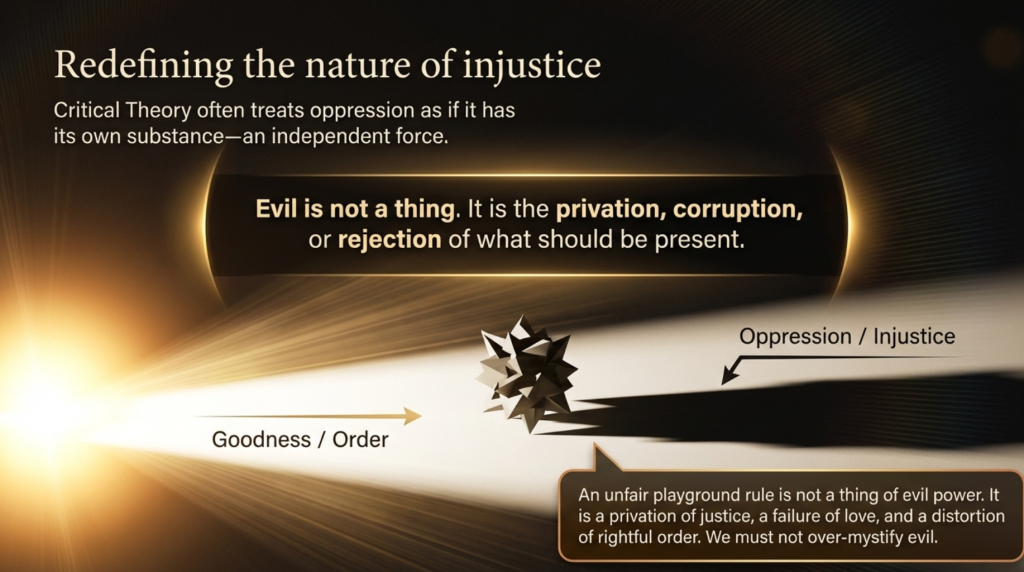
One of the most philosophically productive features of the Love–Light–Life model is its treatment of evil, injustice, and dysfunction as privations rather than as positive forces or competing substances. This privation ontology, with its roots in Plotinus, Augustine, and Aquinas, holds that evil is not a thing but a lack — the absence of a good that should be present, the falling away of what is from what it ought to be.
Augustine's famous formulation remains definitive: 'Evil has no positive nature, but the loss of good has received the name evil.' Every deficiency, corruption, and distortion that we observe in the social world is, on this account, a privation of the genuine being, goodness, and truth that should characterize persons and their relations. Injustice is not an independent force competing with justice on equal terms; it is the privation of just order — the failure of institutions and persons to be what they ought to be.
This ontological account of evil has significant practical implications. If social ills are privations — absences of good rather than positive forces — then the appropriate response is not primarily combat but restoration. The task is not to destroy something that stands over against the good but to supply what is lacking, to heal what is wounded, to order what is disordered. This does not mean that social criticism lacks urgency or that unjust structures should be accommodated with complacency. It means, rather, that the energy of reform is directed not primarily by antagonism but by the vision of the good that is missing and needed.
This reframing is not merely a matter of therapeutic tone. It has concrete consequences for the kind of social action that reform produces. Action motivated primarily by antagonism — by the desire to destroy what is wrong — tends toward the recursive generation of new antagonisms. Action motivated primarily by the vision of what is genuinely good — by the desire to supply what is lacking and restore what is disordered — is more likely to produce durable social good. The history of reform movements offers ample evidence for both patterns, and the Love–Light–Life model provides a principled account of the difference.
CHAPTER FOUR
Comparative Analysis: The Love–Light–Life Model Against Dominant Social Epistemologies
4.1 The Logic of Comparative Evaluation
Any constructive philosophical proposal must earn its standing not only in isolation but in comparison with the alternatives it claims to surpass. The Love–Light–Life model is no exception. Its strengths must be demonstrated not merely by internal analysis — showing that its own principles are coherent and adequate — but by comparative evaluation: showing that it handles better, across a range of critical dimensions, the problems that alternative frameworks also address. This chapter conducts that comparative evaluation systematically, engaging the four most significant alternative frameworks in contemporary social thought: pure Critical Theory, epistemological relativism, naïve traditionalism, and pragmatic consequentialism.
4.2 Against Pure Critical Theory
The first and most direct comparison is between the Love–Light–Life model and pure Critical Theory, where 'pure' denotes the use of Critical Theory's analytical apparatus as a comprehensive social epistemology rather than as one analytical tool among many.
Critical Theory's signature contribution — the exposure of hidden power dynamics — is both retained and recontextualized in the Love–Light–Life model. The model affirms that social structures are shaped by the exercise of power, that norms often serve particular interests, and that ideological analysis is a legitimate and important mode of social inquiry. These insights are genuine, and no serious social analysis should proceed in ignorance of them.
However, the Love–Light–Life model differs from pure Critical Theory in three decisive respects. First, it grounds its analytical judgments in ontological reality rather than in social convention or power relations. When the model identifies a social arrangement as unjust, it does so on the basis of a principled account of what genuine human dignity and right relationship require — an account that is not itself a power move but a claim about the nature of persons. This gives critique a real standard against which to orient itself and rescues it from the self-undermining relativism that afflicts pure Critical Theory.
Second, the Love–Light–Life model integrates critical analysis within a teleological framework that gives it direction and purpose. The question is not merely 'Who benefits from this arrangement?' but 'Does this arrangement enable or impede the genuine flourishing of the persons it affects?' This additional question transforms critique from an end in itself into a means toward constructive social restoration.
Third, the Love–Light–Life model produces a different quality of moral formation. The student formed in pure Critical Theory learns to be suspicious of all claims to truth and goodness, which produces a disposition that is analytically sharp but morally depleted. The student formed in the Love–Light–Life model learns to hold two capacities simultaneously: the capacity to interrogate claims to truth and goodness against the standard of what is actually true and genuinely good, and the capacity to affirm what passes that interrogation with moral confidence. The result is discernment rather than mere suspicion — a far more adequate intellectual and moral posture.
4.3 Against Epistemological Relativism
The second comparison is with epistemological relativism — the view that truth is relative to perspective, culture, or social position, and that there is no framework-transcendent standard against which competing truth-claims can be assessed. Relativism is not identical with Critical Theory, but it represents a philosophical position to which many forms of Critical Theory incline, and it exerts a powerful influence on contemporary academic culture more broadly.
The Love–Light–Life model's most direct contribution over relativism is its restoration of the concept of objective truth. By grounding the principle of Light in classical transcendental metaphysics — the view that being is intrinsically intelligible and that true propositions conform to real structures of being — the model provides what relativism cannot: a principled basis for distinguishing better from worse accounts of reality, more adequate from less adequate social arrangements, genuine insight from sophisticated rationalization.
This does not mean that the Love–Light–Life model ignores the perspectival character of knowledge. The classical tradition has always recognized that human knowing is finite, historically conditioned, and liable to error and distortion. The model affirms these limitations while insisting that they do not entail relativism. The fact that our access to truth is imperfect and partial does not mean that there is no truth to access. The fact that our moral perceptions are shaped by our social location does not mean that there is no moral reality to perceive. Finitude and fallibility are conditions of human knowing; they are not evidence for the absence of what human knowing seeks.
Moreover, relativism is self-undermining in a way that the Love–Light–Life model is not. If all truth-claims are relative to perspective, then the claim that 'all truth-claims are relative to perspective' is itself relative to a perspective and has no binding authority on those who occupy different perspectives. Relativism either exempts its own meta-claim from the relativity it asserts — in which case it acknowledges a framework-transcendent standard — or it applies the same relativity to itself, in which case it is self-defeating. The Love–Light–Life model, by contrast, makes a substantive claim that it is willing to defend on the same rational grounds it employs against competitors: that being is intelligible, that goodness is real, and that human flourishing is a genuine rather than a merely conventional goal.
4.4 Against Naïve Traditionalism
The third comparison is with naïve traditionalism — the disposition to defend existing social arrangements, norms, and institutions simply on the grounds of their historical tenure, without subjecting them to principled evaluation against a standard of truth and goodness. This disposition represents the opposite error from pure Critical Theory: where Critical Theory is reflexively suspicious of all received norms, naïve traditionalism is reflexively deferential to them.
The Love–Light–Life model is not a form of traditionalism in this pejorative sense. Its principle of Light demands honest inquiry into the truth of social arrangements, including received and traditional ones; its principle of Love requires that existing norms be evaluated against the standard of genuine right relationship rather than mere convention; its principle of Life insists that social arrangements be assessed by their actual effects on human flourishing rather than their longevity. Traditions that meet these standards deserve affirmation and preservation; traditions that do not require reform or replacement.
What distinguishes the Love–Light–Life model from both naïve traditionalism and pure Critical Theory is its principled stance toward the distinction between what is inherited and what is true, what is conventional and what is good. It neither accepts the inherited uncritically nor rejects it reflexively. It subjects inherited arrangements to honest evaluation against real standards — and is prepared to affirm, reform, or reject them depending on what that evaluation reveals. This is neither the passivity of traditionalism nor the restlessness of perpetual critique; it is the stability of principled discernment.
4.5 Against Pure Pragmatism
The fourth comparison is with pure pragmatism — the view that the criterion for evaluating social arrangements, actions, and institutions is simply their efficacy in producing desired outcomes, without reference to any antecedent moral standard that constrains the means by which those outcomes are pursued. Pragmatism in this pure form is instrumentalism: it reduces the question of the good to the question of the effective, and it evaluates social strategies by their results without asking whether the results have been brought about in ways that respect the dignity and rights of the persons involved.
The Love–Light–Life model agrees with pragmatism in insisting that ideas and frameworks must have practical consequences — that philosophy disconnected from life is sterile and ultimately irresponsible. The principle of Life, in particular, shares pragmatism's concern with actual effects on actual persons in actual social conditions. An analysis that is philosophically sophisticated but practically inert is not a successful analysis; genuine understanding must issue in the capacity for genuine action.
However, the Love–Light–Life model differs from pure pragmatism in two critical respects. First, it insists that outcomes cannot be the only criterion — that the means by which outcomes are produced must themselves be evaluated against a moral standard that is prior to and independent of the outcomes. A social reform achieved through deception, manipulation, or the violation of persons' dignity is not genuinely good even if its immediate consequences appear beneficial; the principle of Love constrains the means of social action as well as its ends.
Second, the Love–Light–Life model insists that 'what works' is not a self-interpreting phrase. What something 'works' toward depends on what the genuine end of human social life is — and that question cannot be answered within a purely pragmatic framework without importing a normative standard that the framework itself cannot generate. The Love–Light–Life model provides that standard explicitly and defends it on principled grounds. In this sense, it does not oppose pragmatism but completes it — providing the moral framework without which efficacy lacks direction and outcomes lack normative meaning.
CHAPTER FIVE
Pedagogical and Formative Implications: The Love–Light–Life Model in the Context of Education
5.1 The Formation Crisis in Contemporary Education
Education is not merely the transmission of information or even the development of analytical skills. At its deepest level, education is formation — the shaping of persons into a particular kind of human being, with characteristic dispositions, orientations, and capacities for perceiving and responding to reality. The philosophical tradition from Plato's Republic through Newman's Idea of a University has consistently recognized this formative dimension as primary: the purpose of education is not primarily to fill minds with content but to form souls capable of truth, goodness, and beauty.
Contemporary education, under the influence of both technocratic instrumentalism and the various currents of Critical Theory, has largely abandoned this formative ambition — or rather has substituted for it a different and less adequate formative ideal: the production of critical consciousness, defined primarily as the capacity to identify and resist domination in all its forms. This is not a trivial or worthless educational aim; as argued in Chapter Two, critical consciousness is a genuine intellectual achievement. But as a comprehensive account of what education should form, it is decisively inadequate.
A person formed primarily in critical consciousness has been given a powerful lens for seeing what is wrong and an impoverished vocabulary for articulating what is right. She has been trained to deconstruct and equipped to resist, but she has not been formed in the patience, care, moral imagination, and constructive vision that actual social restoration requires. She has been given, in effect, a powerful analytical engine with no navigational system — an instrument capable of detecting obstacles but incapable of charting a course.
5.2 The Four-Stage Discernment Process
The Love–Light–Life model proposes a four-stage pedagogical process that integrates critical analytical capacity with constructive moral formation. These stages are sequential and mutually implicating: each presupposes the previous and prepares for the next, and the full cycle constitutes a complete act of social discernment.
The first stage is Observation — the careful, honest, and comprehensive perception of social reality as it actually presents itself, prior to the imposition of any interpretive framework. This stage requires the classical virtues of attention and patience: the willingness to look carefully and long before moving to analysis, the discipline to resist the temptation to fit what one sees into a predetermined pattern. Good social understanding begins with good perception, and good perception is a skill that must be cultivated and practiced.
The second stage is Critical Inquiry — the systematic application of analytical tools to the social reality that has been carefully observed. At this stage, the insights of Critical Theory are genuinely valuable: the student asks about the distribution of power and benefit, about the historical conditions that produced the present arrangement, about whose interests are served by received norms, and about what voices and perspectives have been marginalized or silenced. These are legitimate and important questions, and the analytical tools developed for addressing them are genuine intellectual contributions.
The third stage is Ontological Evaluation — the assessment of what Critical Inquiry has uncovered against the standards of Truth, Goodness, and Life that constitute the normative core of the Love–Light–Life model. At this stage, the student moves from description to evaluation, from analysis to judgment. She asks not merely 'What is the case here, and whose interests does it serve?' but 'Is this actually true? Is this genuinely good? Does this enable or impede authentic human flourishing?' These questions require not merely analytical skill but moral formation — the cultivation of the intellectual virtues and moral sensibilities that enable genuine evaluative judgment.
The fourth stage is Restorative Response — the translation of principled evaluation into constructive action oriented toward the restoration of what is lacking or disordered. This stage is decisive: it is what separates the perpetual critic from the principled builder, the analyst from the architect. The Restorative Response does not proceed from anger or antagonism, though it is not without urgency; it proceeds from the vision of what genuine human flourishing requires and the commitment to work toward it, within the actual conditions and constraints of the situation.
5.3 Forming the Whole Person: Intellectual Virtues and Moral Dispositions
The pedagogical power of the Love–Light–Life model lies not merely in its provision of a superior analytical framework but in its capacity to form the whole person — intellect, will, and moral sensibility — in a way that produces genuine wisdom rather than mere knowledge or mere critical skill.
On the intellectual side, the model cultivates what the tradition calls the intellectual virtues: the habits of mind that enable the reliable perception of truth. These include intellectus — the capacity for direct insight into first principles; scientia — systematic knowledge organized within a coherent framework; sapientia — wisdom, the capacity to see particular things in the light of ultimate causes and ends; prudentia — practical wisdom, the capacity to judge rightly about particular actions in concrete circumstances; and episteme — the rigorously demonstrative knowledge that constitutes disciplined inquiry at its most developed.
On the moral side, the model cultivates what we might call the social virtues of the builder: justice, which disposes the person to render to each what is rightly due; solidarity, which disposes the person to recognize and care for the genuine good of others; hope, which sustains the conviction that genuine social good is achievable even under conditions of significant resistance; and prudence, which enables the translation of moral vision into effective action. These virtues are not the automatic result of exposure to correct ideas; they must be cultivated through sustained practice, reflection, and — crucially — habituation within communities that embody and model them.
This is where the institutional context of Christian higher education at institutions like Wheaton College is particularly significant. Such institutions have historically maintained the conviction that education is inseparable from formation, that the intellectual life is a moral and spiritual vocation, and that the pursuit of truth is not merely an academic exercise but a fundamental expression of the human calling to know the God who is Truth. The Love–Light–Life model is at home in such institutions in a way that pure Critical Theory never can be — not because it avoids hard questions, but because it provides the ontological and formative context within which those questions can be addressed with genuine wisdom rather than merely sophisticated analysis.
5.4 Case Studies in Applied Discernment
The practical adequacy of the Love–Light–Life model is best demonstrated not by abstract argument alone but by its application to concrete instances of social analysis. The following three case studies illustrate how the four-stage discernment process operates in practice, and how its results differ from what purely Critical or purely pragmatic analysis would produce.
Case Study One: Structural Educational Inequality. The observation that educational quality and outcomes vary significantly by the socioeconomic and demographic characteristics of the communities in which students live is empirically well-established and morally urgent. Critical Theory's analysis of this situation focuses on the structures of power and funding that produce the observed inequality — the ways in which property-tax-based school funding mechanisms reproduce existing wealth disparities, the ideological functions served by meritocratic narratives that obscure structural advantage, and the historical patterns of exclusion and underfunding that have shaped the present situation. These analyses are correct so far as they go, and any adequate response to educational inequality must incorporate them.
The Love–Light–Life model adds three things that pure Critical Theory cannot provide. First, through the principle of Light, it insists on the full truth of the situation — including not only structural inequalities but also the actual human stories of teachers, students, and families navigating these inequalities with dignity and creativity. Second, through the principle of Love, it articulates the positive vision of what genuine educational equity requires: not merely equal resource distribution but the conditions under which every student's full human potential can actually flourish. Third, through the principle of Life, it evaluates proposed solutions not only by their structural-political adequacy but by their actual effects on the flourishing of real children — and is willing to follow the evidence wherever it leads, even when it challenges politically comfortable narratives.
Case Study Two: Institutional Racism. Few topics are more important or more contentious in contemporary social discourse than the reality and extent of structural racism in American institutions. Critical Race Theory has performed a genuine service in documenting the ways in which historically rooted patterns of racial exclusion continue to shape institutional practices and outcomes in domains from criminal justice to housing to healthcare to education. This documentation is valuable and often decisive in supporting the case for structural reform.
The Love–Light–Life model engages this reality through all three principles. Light demands honest, empirically rigorous engagement with the evidence — resisting both the impulse to minimize documented structural inequities and the impulse to attribute all racial disparities to structural racism without examining the evidence carefully. Love insists on the full human dignity of every person affected by these structures and on the obligation to work actively toward institutional conditions that honor that dignity. Life asks about the actual flourishing of the persons and communities affected and evaluates proposed reforms by their real effects on that flourishing.
Case Study Three: Economic Stratification. The dramatic concentration of wealth in contemporary market economies raises fundamental questions of justice that neither pure market liberalism nor pure egalitarianism can adequately address. The Love–Light–Life model brings its triadic framework to bear: Light demands accurate economic analysis, free from both ideological apologetics for existing arrangements and ideological romanticism about alternatives; Love asks what genuine economic solidarity and justice require — what distributions of economic power and opportunity are compatible with the full dignity and relational integrity of persons; Life evaluates both existing arrangements and proposed alternatives by their actual effects on the conditions of human flourishing, with particular attention to the most vulnerable.
CHAPTER SIX
Toward a Restorative Social Ontology: Practical Applications and Institutional Implications
6.1 The Architecture of Restorative Social Action
The preceding chapters have established the philosophical foundations and comparative superiority of the Love–Light–Life model. This chapter moves from foundation to application, from theory to practice — asking not merely what the model claims but what difference it makes in the concrete domains of social life and institutional design.
Restorative social action, as understood within the Love–Light–Life framework, is not a single strategy or a fixed program. It is, rather, a disposition and orientation that manifests differently in different contexts while maintaining its essential character across all of them: the disposition to approach social problems not primarily as battles to be won or enemies to be defeated, but as deficiencies to be supplied, disorders to be ordered, and privations to be filled with the genuine good that is missing.
This disposition has architectural consequences. Architecture, as distinct from mere construction, is the art of creating ordered space that serves genuine human purposes — spaces in which persons can live, work, learn, and flourish in ways appropriate to their dignity and their deepest needs. Social architecture, in this metaphorical sense, is the project of creating institutional arrangements, cultural norms, and social practices that enable genuine human flourishing in the same ordered, purposive way. The Love–Light–Life model is a contribution to social architecture in precisely this sense: it provides the principles by which genuinely ordered social space can be distinguished from disordered, deficient, or distorted space, and it orients action toward the restoration of genuine order.
6.2 Applications in Political and Civic Life
The political implications of the Love–Light–Life model are both radical and conservative — radical in their demand that political institutions actually serve the genuine flourishing of persons rather than the interests of the powerful, and conservative in their insistence that genuine reform requires the recovery of what has been lost or distorted rather than the revolutionary destruction of everything that exists.
The model's political vision is grounded in what the Christian tradition calls the common good: not the sum of individual preferences, not the interests of the majority at the expense of the minority, but the ordered set of social conditions in which every person, and all persons together, can achieve authentic fulfillment. This concept — developed by thinkers from Aristotle through Aquinas to Jacques Maritain and John Courtney Murray — provides a political criterion that is both demanding and clarifying: demanding, because it requires that political arrangements actually serve the full range of human needs rather than merely the preferences of the most powerful; clarifying, because it gives political analysis a positive standard against which to measure proposed arrangements rather than merely a critique of existing ones.
In concrete terms, this means that the Love–Light–Life model supports political institutions and practices to the extent that they genuinely serve human dignity and the conditions of flourishing, and criticizes them insofar as they fall short of this standard. It is neither reflexively conservative nor reflexively progressive; it is oriented toward the real rather than the partisan. This does not make it politically neutral — genuine commitment to the common good will often put it in tension with existing arrangements — but it grounds political judgment in reality rather than ideology.
6.3 Applications in Ecclesial and Community Formation
The Love–Light–Life model is perhaps most naturally at home in the context of ecclesial community — the community of faith that is constituted by its participation in divine Love, oriented by divine Light, and called to embody and communicate divine Life. The Church, understood at its best, is precisely the community that lives by the principles the model articulates: a community in which truth is honored rather than manipulated, in which love is practiced as a genuine moral commitment rather than a merely sentimental aspiration, and in which human flourishing is both valued as a present good and understood in the light of ultimate transcendent destiny.
This means that the Church is, or should be, the community most naturally capable of producing persons formed in the Love–Light–Life model — persons who combine critical discernment with constructive moral vision, who bring both the honesty of Light and the generosity of Love to their engagement with the social world, and who are motivated by the hope of genuine Life for all persons rather than by the antagonism of the perpetual critic.
In practice, this formative mission requires that ecclesial communities take seriously the intellectual dimensions of discipleship — not merely the affective and devotional dimensions. The great tradition of Christian intellectual life, from the Cappadocian Fathers through the medieval universities to the tradition of Reformed scholarship, has always insisted that the love of God includes the love of truth, and that genuine formation in Christ requires the cultivation of minds as well as hearts. The Love–Light–Life model calls ecclesial communities back to this integrative vision of formation.
6.4 Applications in Academic Institutions
The most immediate practical audience for the Love–Light–Life model is the academy — the network of institutions dedicated to serious intellectual inquiry and the formation of the thinkers, researchers, scholars, and practitioners who shape the intellectual culture of their time. Academic institutions stand at the intersection of intellectual formation and cultural influence in a way that makes their philosophical commitments practically consequential far beyond their walls.
The implications of the Love–Light–Life model for academic institutions are significant and in some respects challenging. First, the model calls for a recovery of substantive intellectual formation as the primary purpose of undergraduate education — formation in the intellectual virtues, in the great tradition of inquiry, and in the moral dispositions that enable persons to think and act well together. This requires a willingness to resist the pressures of credentialization and vocational instrumentalism that have eroded the formative ambitions of the academy.
Second, the model calls for an honest reckoning with the dominance of purely critical dispositions in many academic cultures and a principled effort to supplement those dispositions with the constructive moral vision that the Love–Light–Life framework provides. This is not a call for intellectual complacency or the abandonment of critical rigor; it is a call for the completion of critical rigor with the positive ontological and teleological framework without which it cannot achieve its own purposes.
Third, the model calls for a renewal of the integration of intellectual inquiry with moral formation — the recognition that what we know and who we are are not separable, and that genuine academic formation must attend to the character, integrity, and moral orientation of the inquirer as well as to the content and methods of inquiry. This integration is the distinctive calling of Christian institutions of higher learning, and it represents their most important contribution to the broader culture of the academy.
6.5 The Cultural Moment and the Model's Urgency
The present cultural moment gives the Love–Light–Life model a particular urgency. We inhabit a culture that is simultaneously more critical and more confused than any previous generation — more skilled at identifying and articulating what is wrong, and less equipped to articulate and build toward what is right. The polarization, fragmentation, and mutual incomprehension that characterize public discourse in the early twenty-first century are not accidental; they are, in significant measure, the cultural expression of the epistemological crisis that this dissertation has diagnosed.
When citizens have no shared account of truth, no shared moral standard, and no shared vision of human flourishing, public discourse becomes a competition of power and narrative rather than a joint inquiry into the real. When the only intellectual posture available is the hermeneutic of suspicion, every proposed solution to every social problem is met with the question 'Whose interests does this serve?' — a question that, while legitimate, cannot by itself lead anywhere constructive if it is not supplemented by the question 'Is this actually true and genuinely good?'
The Love–Light–Life model is not offered as a political program or a partisan position. It is offered as a philosophical and formative framework — a way of approaching social reality and social action that can cut across the current lines of political and cultural fragmentation because it is grounded not in partisan interest but in the nature of things. Its appeal is to minds and hearts willing to ask seriously what is real, what is good, and what genuinely enables human flourishing — and its promise is to those who make that inquiry honestly that they will find, at the end of it, not merely a more sophisticated critical vocabulary but a positive vision of the social good worth building toward.
CHAPTER SEVEN
Conclusion: The Necessary Evolution of Critical Thought and the Future of Social Formation
7.1 The Argument Consolidated
This dissertation has advanced a comprehensive philosophical case for the Love–Light–Life Discernment Model as a superior framework for social understanding and human formation. The case has proceeded through seven integrated movements: the diagnosis of the formation crisis in contemporary education, the historical and philosophical assessment of Critical Theory's achievements and limitations, the constructive articulation of the model's ontological foundations, the comparative evaluation of the model against four competing epistemologies, the analysis of the model's pedagogical and formative implications, and the exploration of its practical applications in political, ecclesial, and academic contexts.
The central thesis, stated in the introduction and demonstrated throughout, may now be restated with greater precision and confidence: Critical Theory's analytical power is genuine but insufficient; it constitutes a necessary but not adequate moment in social understanding. The Love–Light–Life model completes that moment by providing the ontological ground, the positive moral standard, and the teleological orientation that Critical Theory lacks — thereby transforming social inquiry from perpetual critique into principled construction.
7.2 The Model's Contribution to the Intellectual Tradition
The Love–Light–Life model does not claim to be unprecedented. It claims, rather, to be a faithful and creative retrieval of insights embedded in the deepest traditions of Western and Christian philosophy — insights that have been obscured, relativized, or displaced by the intellectual movements of the past two centuries, and that need to be recovered, articulated, and applied in the conditions of the present moment.
In the tradition of Plato, the model insists on the reality of the Good and the capacity of the properly formed mind to orient itself toward it. In the tradition of Aristotle, it insists on the teleological character of human nature and the importance of genuine virtue — formed through practice and habituation, not merely possessed as a theoretical commitment — for the achievement of genuine social life. In the tradition of Augustine, it employs the concept of privation to understand evil and injustice as deficiencies of being rather than as positive competing forces. In the tradition of Aquinas, it integrates natural reason and revealed truth into a comprehensive account of human nature, moral obligation, and social order.
In engaging these traditions, the Love–Light–Life model is not engaged in antiquarianism. It is engaged in what Alasdair MacIntyre called a tradition-constituted inquiry: a form of rational discourse that is internally directed by the questions and resources of a living intellectual tradition, while remaining open to challenge, development, and revision as that tradition encounters new questions and new interlocutors. The tradition it retrieves is not the only tradition worth consulting, but it is among the richest and most philosophically developed traditions available, and its resources have been underutilized in the debates that most urgently need them.
7.3 Objections Considered
Before concluding, several anticipated objections deserve direct engagement.
Objection One: Is the Love–Light–Life model simply a religious framework in philosophical disguise? This objection supposes that any framework rooted in the Christian intellectual tradition must be making theological assumptions that are inaccessible to reason and therefore unavailable as arguments in public philosophical discourse. The objection misunderstands both the Christian philosophical tradition and the nature of the framework being proposed. The model's three principles — Truth, Goodness, and Flourishing — are not theological assertions in the sectarian sense; they are philosophical claims that have been defended, and continue to be defensible, on rational grounds accessible to any careful thinker regardless of religious commitment. That they are also consistent with and deepened by Christian theological conviction is a feature rather than a defect; it means that the model's philosophical claims are embedded in a larger framework of meaning that gives them additional intelligibility and motivation. But the philosophical arguments stand independently of the theological commitments.
Objection Two: Does the model's critique of Critical Theory simply serve ideologically conservative interests? This objection supposes that any critique of Critical Theory must be motivated by the desire to immunize existing power arrangements from scrutiny. But this supposition itself illustrates the very problem the model identifies: the reduction of all intellectual discourse to power analysis. The model's critique of Critical Theory is not politically motivated; it is philosophically motivated. It concerns not the political implications of Critical Theory but the epistemological adequacy of its foundational commitments. As argued extensively in Chapter Two, the model retains and affirms Critical Theory's analytical insights while rejecting its ontological instabilities — a distinction that the objection fails to observe.
Objection Three: Is the model's account of human flourishing culturally parochial? This objection supposes that any substantive account of flourishing inevitably reflects the particular cultural assumptions of those who articulate it and cannot claim universal validity. The objection has some force: accounts of flourishing can indeed be distorted by cultural parochialism, and this is a genuine danger that the model must guard against. But the objection does not establish that a universal account of flourishing is impossible — only that it is difficult and requires constant critical self-examination. The Love–Light–Life model's account of flourishing is grounded not in cultural preference but in the structure of human nature as such: in the capacities for reason, love, moral agency, and transcendence that are characteristic of persons as persons, regardless of cultural location. This grounding does not eliminate the need for cultural sensitivity, but it provides a basis for cross-cultural moral discourse that pure relativism cannot.
7.4 Future Directions
This dissertation represents a contribution to a conversation that is necessarily larger than any single work can contain. Several directions for future inquiry present themselves as particularly urgent.
First, the Love–Light–Life model calls for more detailed empirical investigation of its pedagogical claims. The dissertation has argued philosophically that the model produces better-formed persons than pure Critical Theory; this philosophical argument needs to be supplemented by careful empirical study of educational programs that have implemented the model's principles, examining the actual effects on student formation over time.
Second, the model needs to be developed in more detailed dialogue with non-Western philosophical and theological traditions. The present dissertation has drawn primarily on the Western and Christian intellectual tradition, which is the tradition most directly relevant to the contemporary American academic context in which the model is being proposed. But the model's claims about Truth, Goodness, and Flourishing are universal in scope, and engagement with Confucian, Buddhist, Hindu, and African philosophical traditions — which have their own deep resources for thinking about these questions — will both test and enrich the model in important ways.
Third, the model's practical applications in specific domains — educational policy, criminal justice reform, economic institution design, healthcare ethics — deserve more detailed development than has been possible in this dissertation. The case studies in Chapter Five are illustrative rather than exhaustive; each of them calls for extended treatment in its own right.
Fourth, and perhaps most importantly, the model needs to be not merely articulated but embodied — not merely argued for in philosophical texts but instantiated in the actual life of communities: academic, ecclesial, civic, and domestic. Philosophy, including the philosophy of social formation, achieves its deepest purposes not in the seminar room alone but in the transformation of how actual persons and communities perceive, evaluate, and act in the social world. The ultimate test of the Love–Light–Life model is not whether it can withstand philosophical objection — this dissertation has argued that it can — but whether it can produce the form of human life it envisions.
7.5 A Final Word: On the Stakes of the Inquiry
Every serious philosophical inquiry is motivated, at some level, by the conviction that the question being addressed matters — that something of genuine importance hangs on getting it right. This inquiry is no exception, and it seems fitting to conclude by naming, without evasion, what is at stake.
What is at stake is the quality of formation available to a generation that faces, in every domain of life, challenges that require not merely analytical skill and critical awareness but genuine wisdom — the wisdom to perceive what is real, to love what is genuinely good, and to act with the courage and creativity that genuine social restoration demands. We cannot afford to form analysts without architects, critics without builders, or — to use the language of this model — persons who have learned to see without learning to love what they see and to work toward its flourishing.
The Love–Light–Life model is offered not as the final word in this inquiry but as a serious contribution to it — a framework that takes with equal seriousness the demands of intellectual honesty, the requirements of moral formation, and the irreducible dignity of the persons and communities whose lives are the ultimate subject of all social philosophy.
The world does not need more persons who can articulate with greater sophistication everything that is wrong with it. It needs persons who can see clearly, love truly, and build wisely. The Love–Light–Life model is one account of how such persons might be formed. It is offered in the confidence that the inquiry it represents — the inquiry into Truth, Goodness, and Life — is the most important inquiry available to us, because it is the inquiry into what we are and what we are for.
Fides quaerens intellectum. And through that seeking — genuine life.
Fortifying the Love–Light–Life Framework: Philosophical and Operational Considerations
I. Mapping the Transcendentals: Clarifying the Nature of Love
The Love–Light–Life framework, as initially presented, aligns Light with Truth and Life with Flourishing in ways that are philosophically stable. These correspondences map onto classical metaphysics: Truth (veritas) as the intelligibility of being and Flourishing (vita) as the proper realization of a being’s nature. However, the direct identification of Love with Goodness invites closer scrutiny.
1. Distinguishing Goodness and Love
Classical metaphysics, particularly following Aristotle and Aquinas, treats Goodness (bonum) as an intrinsic property of being: every entity is good insofar as it exists according to its nature. Love, especially in the Christian sense of agape, is a relational orientation—the will’s movement toward the Good. Confusing Love with Goodness risks conflating:
- Ontological status: Goodness as a property inherent to being
- Volitional response: Love as the act or disposition aligning with Good
To maintain pedagogical clarity, the framework should articulate:
- Light (Truth): The accurate apprehension of reality
- Goodness (Bonum): The intrinsic measure of value inherent in being
- Love (Agape): The active, relational disposition oriented toward the Good
- Life (Flourishing): The holistic realization of right relation and being
This distinction preserves both ontological precision and moral intelligibility, allowing students to understand that Love is not a metaphysical substrate but the operative force that manifests and preserves Goodness.
2. Implications for the Builder’s Toolkit
In practical terms, Love functions as the dynamic agent of restoration. When students identify privation or distortion in a system, Love is the orienting principle that drives the corrective action. Without this distinction, the framework risks abstract moralization; with it, students gain both criteria for evaluation and mechanisms for intervention.
II. Translating Privation Ontology into Social Reality
The framework’s use of privation ontology—framing evil as absence rather than as a competing positive force—is a philosophically elegant corrective to the often combative lens of Critical Theory. However, social systems operate with functional density: absences, when systematized, take on the force of active structures.
1. Privation and Institutional Gravity
Consider the example of a school lunch menu that systematically neglects dietary needs. While this absence (lack of provision) constitutes the evil, the institutional design—menus, budgeting, schedules, procurement—is materially real and operates with causal power. These structures do not merely reflect a lack of virtue; they function as mechanisms that perpetuate privation.
2. Bridging Ontology and Material Systems
The framework can accommodate this by specifying:
- Privation at the moral level: the absence of care, fairness, or truth
- Structural amplification: institutional architectures that give the absence operational efficacy
- Corrective pathway: Love and moral responsibility reintroduced into the design, creating positive functional effects
This ensures that the framework does not underestimate the material and historical momentum of unjust systems, while retaining its metaphysical insight: what appears as “powerful evil” is, ontologically, a deficiency brought to functional maturity.
III. Engaging the Implicit Telos of Critical Theory
The source correctly observes that Critical Theory often lacks an explicit moral telos. Yet, its proponents implicitly presuppose human dignity, equality, and liberation. The framework must clarify:
- Critical Theory’s telos is borrowed, not derived internally: equality and emancipation are assumed, often unconsciously grounded in classical or religious moral intuitions.
- Its epistemology prohibits it from justifying these teloi as objectively binding. Consequently, while Critical Theory exposes distortions, it cannot claim normative authority without smuggling in the very metaphysical assumptions it critiques.
The Love–Light–Life framework strengthens this critique by showing that:
- Objective Goodness provides the telos
- Love provides the relational agency
- Life demonstrates the practical realization of the telos
Thus, the framework supplants Critical Theory’s implicit borrowing with explicit metaphysical justification, transforming critique into grounded moral discernment.
IV. Operationalizing the Model in Pluralistic Contexts
A central challenge remains: modern education largely rejects shared metaphysical premises. Nominalist and relativist frameworks dominate, and the presumption of objective Truth or teleology is often contested.
1. Pre-Evangelism for Ontology
Before students can apply Love–Light–Life, they must recognize the necessity of ontological grounding. This can be achieved pedagogically through:
- Empirical revelation: demonstrating patterns of distortion that cannot be explained by mere preference or convention
- Practical moral reflection: showing that without objective standards, meaningful correction is impossible
- Experiential integration: using case studies (playground, lunch menu) to reveal gaps where normative insight is required
This method demonstrates the practical indispensability of ontology without presupposing prior metaphysical assent.
2. Framework for Secular Accessibility
Even in pluralistic classrooms:
- Light (Truth) can be framed as correspondence with reality, accessible via observation and reason
- Love (Goodness) can be framed as ethical orientation toward others, supported by empathy and cooperative reasoning
- Life (Flourishing) can be framed as human well-being, demonstrable in social and educational outcomes
Thus, the framework is operationalizable without explicit religious commitment, though its philosophical roots remain fully intact for advanced inquiry.
V. Case-Based Integration
The practical strength of the model lies in its application to real-world examples. Using the playground and lunch menu:
- Playground Rule (Light)
- Exposure: Only blue-shoed students may swing
- Analysis: Power is abused; fairness violated
- Restoration: Rule redesigned to reflect truth and equal opportunity
- Lunch Menu (Love)
- Exposure: Dietary needs ignored
- Analysis: Privation identified, structural function assessed
- Restoration: Menu revised to accommodate diverse needs, operationalizing moral attention
- Extension to Institutions
- Historical or cultural structures (laws, corporate policies) can be similarly evaluated:
- Identify distortion (privation)
- Map functional effects
- Reintroduce Love, Light, and Life to achieve tangible reform
- Historical or cultural structures (laws, corporate policies) can be similarly evaluated:
By systematically applying ontological, ethical, and functional lenses, students develop discernment and agency simultaneously.
VI. Strengthening Conceptual Boundaries
To serve as a durable civilizational framework, the model must:
- Differentiate Love and Goodness
- Love = relational agency directed at Good
- Goodness = objective property of reality
- This distinction preserves categorical precision and prevents conflation of ontological and volitional properties
- Account for Material and Structural Reality
- Privation ontology must recognize functional density of institutional structures
- Absence can operate like a positive force, shaping behavior and outcomes
- Corrective action must integrate relational and structural reform
- Articulate Explicit Telos
- Restoration toward objective Flourishing (Life)
- Grounded in Light (Truth) and Goodness (Bonum)
- Operationalized through Love (agency)
- Provide Pedagogical Translation
- Use pre-evangelism and experiential methods
- Frame concepts in accessible secular terms when necessary
- Maintain fidelity to metaphysical foundations for advanced study
VII. Comparative Superiority
When stress-tested against other frameworks:
Framework
Strength
Weakness
Love–Light–Life Advantage
Critical Theory
Exposes hidden power
Lacks moral telos and grounding
Provides explicit telos, integrates critique with restoration
Relativism
Promotes tolerance
Cannot evaluate truth or goodness
Maintains accessibility while affirming objective Goodness and Flourishing
Naïve Traditionalism
Offers stability
Resistant to critique
Encourages principled reform, aligning tradition with Truth and Love
Pragmatism
Focus on outcomes
May justify means over morals
Ensures practical action is grounded in Light, Love, and Life
The framework synthesizes critique, normative grounding, and operational practicality, achieving what no single predecessor fully accomplishes.
VIII. Conclusion: Toward a Civilizational Pedagogy
The Love–Light–Life framework emerges not merely as an educational tool but as a civilizational blueprint. Its strengths are manifold:
- Ontologically grounded: Provides a metaphysical anchor for truth, goodness, and flourishing
- Epistemologically coherent: Transforms critique into discernment
- Morally formative: Cultivates Love as active, relational agency
- Operationally effective: Integrates privation ontology with material and structural realities
By clarifying the boundaries between Love and Goodness, accounting for the material density of systems, and designing pedagogical strategies for pluralistic contexts, the framework transcends the limitations of Critical Theory and related methodologies. It transforms students from perpetual critics into restorative builders, capable of diagnosing distortion and reconstructing social reality in alignment with the transcendentals.
In short, Love–Light–Life is not merely a model for understanding the world; it is a method for cultivating a civilization that knows how to see, judge, and restore what is truly good.
BIBLIOGRAPHY
Primary Philosophical and Theological Sources
Aristotle. Nicomachean Ethics. Translated by Terence Irwin. Indianapolis: Hackett Publishing Company, 1999.
Aristotle. Politics. Translated by C.D.C. Reeve. Indianapolis: Hackett Publishing Company, 1998.
Augustine of Hippo. The City of God. Translated by Henry Bettenson. London: Penguin Books, 1984.
Augustine of Hippo. Confessions. Translated by Henry Chadwick. Oxford: Oxford University Press, 1991.
Aquinas, Thomas. Summa Theologiae. Translated by the Fathers of the English Dominican Province. Westminster, Maryland: Christian Classics, 1981.
Aquinas, Thomas. On Evil (De Malo). Translated by Jean Oesterle. Notre Dame: University of Notre Dame Press, 1995.
Plato. Republic. Translated by G.M.A. Grube. Revised by C.D.C. Reeve. Indianapolis: Hackett Publishing Company, 1992.
Plotinus. The Enneads. Translated by Stephen MacKenna. London: Penguin Classics, 1991.
Critical Theory: Primary Sources
Adorno, Theodor W., and Max Horkheimer. Dialectic of Enlightenment: Philosophical Fragments. Translated by Edmund Jephcott. Stanford: Stanford University Press, 2002.
Habermas, Jürgen. The Theory of Communicative Action. 2 vols. Translated by Thomas McCarthy. Boston: Beacon Press, 1984–1987.
Horkheimer, Max. 'Traditional and Critical Theory.' In Critical Theory: Selected Essays. Translated by Matthew J. O'Connell et al. New York: Continuum, 1972.
Marcuse, Herbert. One-Dimensional Man: Studies in the Ideology of Advanced Industrial Society. Boston: Beacon Press, 1964.
Crenshaw, Kimberlé. 'Mapping the Margins: Intersectionality, Identity Politics, and Violence against Women of Color.' Stanford Law Review 43, no. 6 (1991): 1241–1299.
Collins, Patricia Hill. Black Feminist Thought: Knowledge, Consciousness, and the Politics of Empowerment. New York: Routledge, 2000.
Philosophy of Education and Formation
Newman, John Henry. The Idea of a University. Notre Dame: University of Notre Dame Press, 1982.
Nussbaum, Martha C. Cultivating Humanity: A Classical Defense of Reform in Liberal Education. Cambridge: Harvard University Press, 1997.
Nussbaum, Martha C. Not for Profit: Why Democracy Needs the Humanities. Princeton: Princeton University Press, 2010.
Smith, James K.A. Desiring the Kingdom: Worship, Worldview, and Cultural Formation. Grand Rapids: Baker Academic, 2009.
Wolterstorff, Nicholas. Educating for Shalom: Essays on Christian Higher Education. Grand Rapids: Eerdmans, 2004.
Moral Philosophy and Ontology
MacIntyre, Alasdair. After Virtue: A Study in Moral Theory. 3rd ed. Notre Dame: University of Notre Dame Press, 2007.
MacIntyre, Alasdair. Whose Justice? Which Rationality? Notre Dame: University of Notre Dame Press, 1988.
Murdoch, Iris. The Sovereignty of Good. London: Routledge and Kegan Paul, 1970.
Maritain, Jacques. Integral Humanism: Temporal and Spiritual Problems of a New Christendom. Translated by Joseph W. Evans. Notre Dame: University of Notre Dame Press, 1973.
Gilson, Etienne. Being and Some Philosophers. 2nd ed. Toronto: Pontifical Institute of Mediaeval Studies, 1952.
Finnis, John. Natural Law and Natural Rights. 2nd ed. Oxford: Oxford University Press, 2011.
Social and Political Philosophy
Berger, Peter L., and Thomas Luckmann. The Social Construction of Reality: A Treatise in the Sociology of Knowledge. Garden City: Anchor Books, 1966.
Bourdieu, Pierre. The Logic of Practice. Translated by Richard Nice. Stanford: Stanford University Press, 1990.
Taylor, Charles. A Secular Age. Cambridge: Belknap Press of Harvard University Press, 2007.
Taylor, Charles. Sources of the Self: The Making of the Modern Identity. Cambridge: Harvard University Press, 1989.
Sandel, Michael J. Justice: What's the Right Thing to Do? New York: Farrar, Straus and Giroux, 2009.
Christian Philosophy and Theology
Lewis, C.S. The Abolition of Man. Oxford: Oxford University Press, 1943.
Chesterton, G.K. Orthodoxy. London: John Lane, 1908.
von Balthasar, Hans Urs. Truth is Symphonic: Aspects of Christian Pluralism. Translated by Graham Harrison. San Francisco: Ignatius Press, 1987.
Schindler, David L. Heart of the World, Center of the Church: Communio Ecclesiology, Liberalism, and Liberation. Grand Rapids: Eerdmans, 1996.
Plantinga, Alvin. Warranted Christian Belief. Oxford: Oxford University Press, 2000.
Stout, Jeffrey. Democracy and Tradition. Princeton: Princeton University Press, 2004.
Contemporary Works in Cultural and Educational Analysis
Bellah, Robert N., et al. Habits of the Heart: Individualism and Commitment in American Life. Berkeley: University of California Press, 1985.
Lasch, Christopher. The Culture of Narcissism: American Life in an Age of Diminishing Expectations. New York: Norton, 1979.
Murray, John Courtney. We Hold These Truths: Catholic Reflections on the American Proposition. New York: Sheed and Ward, 1960.
Dreher, Rod. The Benedict Option: A Strategy for Christians in a Post-Christian Nation. New York: Sentinel, 2017.
Lukianoff, Greg, and Jonathan Haidt. The Coddling of the American Mind: How Good Intentions and Bad Ideas Are Setting Up a Generation for Failure. New York: Penguin Press, 2018.
Scruton, Roger. The Uses of Pessimism: And the Danger of False Hope. Oxford: Oxford University Press, 2010.
Foundational Text for This Study
[Author]. From Complaining to Building: A Young Learner's Guide to Fixing Unfair Systems. Wheaton, Illinois: [Publisher], 2024.