30. March 2026
Why Systems Fail: The Ancient Diagnostic Blueprint for Modern Collapse
THE PHYSICS OF COLLAPSE
Ontological Misalignment, Systemic Entropy,
and the Ancient Architecture of Institutional Failure
A Philosophical Treatise
by, Jamie Thornberry. Published by Love-Life-Light Publishing, all rights reserved.
ABSTRACT
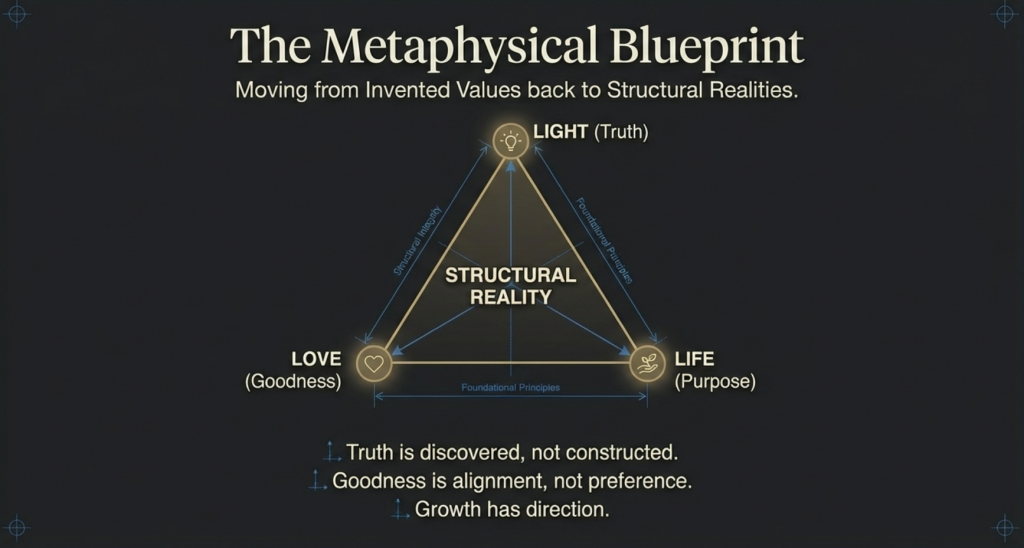
This treatise argues that the structural failure of complex human institutions — whether civilizational empires, digital platforms, or corporate hegemonies — is not a contemporary anomaly produced by mismanagement or market volatility. It is, rather, the predictable and necessary outcome of a deeper ontological disorder: the systematic estrangement of a created system from the ground of reality upon which its integrity depends. Drawing upon three ancient sociotechnical archetypes — the narrative of Cain and Abel, the construction and dispersion of Babel, and the civilizational theology of Babylon — this treatise proposes a unified diagnostic framework for what shall be termed ontological misalignment. The framework is grounded in privation ontology, moral realism, and a teleological understanding of human organization, and is brought into direct conversation with contemporary failures in digital ecosystems, corporate governance, and epistemic culture. The conclusion offered is not pessimistic but prescriptive: that the recovery of systemic integrity requires individuals and institutions to recover what the ancient narratives call ears to hear — a disciplined attentiveness to reality that constitutes the only durable foundation for human flourishing.
— I —
THE ILLUSION OF INVINCIBILITY: WHY COLLAPSE APPEARS SUDDEN
There is a peculiar epistemological distortion that afflicts those who witness institutional collapse from within: the conviction that the event is unprecedented. When a dominant corporation surrenders its market position, when a prestigious university is exposed as intellectually corrupt, when a civilization once capable of dictating the terms of the future is found, upon examination, to be hollow at its foundations — the observers, almost without exception, describe what they see as sudden. The collapse feels catastrophic precisely because it was not anticipated. But this failure of anticipation is itself a diagnostic datum of the highest order. It tells us not merely that something went wrong, but that the very instruments by which we might have detected the deterioration had themselves been compromised long before the visible fracture.
The philosopher Alasdair MacIntyre, writing in After Virtue, observed that the most dangerous cultural declines are those in which the inhabitants of a culture have lost the very conceptual vocabulary by which the decline might be named. When the language of virtue, integrity, and objective standard has been evacuated from a system's discourse — replaced by the language of brand, narrative, and managed perception — the system has already lost the instruments of its own self-correction. The collapse, in such cases, is not sudden. It is merely the moment at which the gap between internal fiction and external reality becomes too wide for institutional performance to bridge.
This treatise contends that what appears to the untrained eye as abrupt institutional failure is, in every philosophically significant sense, the culmination of a process with a determinate structure. That structure — from its initiating axiom to its terminal expression — has been encoded with remarkable precision in three ancient narratives that Western modernity has largely consigned to the domain of religious antiquity, and thereby deprived itself of their diagnostic power. The narratives of Cain and Abel, the Tower of Babel, and the civilization of Babylon are not myths in the pejorative sense of that word. They are, rather, what we might call ontological case studies: compressed explorations of the mechanics by which intelligent, technically capable human communities sever themselves from the conditions of their own sustainability.
To read them as such requires a recovery of the metaphysical seriousness that animated their original composition — and a willingness to bring that seriousness into direct confrontation with the data of contemporary experience.
— II —
ONTOLOGICAL MISALIGNMENT: THE FOUNDATIONAL CONCEPT

Before examining the three archetypes in detail, it is necessary to establish the conceptual foundation upon which this entire analysis rests. The phrase ontological misalignment is not a rhetorical embellishment. It is a precise philosophical description of a specific structural condition.
Ontology, in the classical sense, is the study of being — of what is, in the most fundamental sense of that word. When Thomas Aquinas, building upon the metaphysics of Aristotle, argued that all created things participate in being to the degree that they participate in the ordering principle that constitutes them as the kinds of things they are, he was articulating something that bears directly on institutional analysis. An institution — a university, a corporation, a civilization — possesses a nature: a set of ordering principles that determine what it is for and therefore what conditions must be sustained for it to function well. A university exists for the discovery and transmission of truth. A judicial system exists for the adjudication of justice. A monetary system exists for the facilitation of honest exchange. These are not arbitrary definitions; they are ontological descriptions of the kinds of goods these institutions are ordered toward.
Ontological misalignment occurs when an institution systematically departs from the ordering principles that constitute it, while continuing to perform the institutional role. The university that systematically suppresses inconvenient research is no longer functioning as a university in the full sense, even as it continues to grant degrees. The judicial system that deploys law as a weapon of factional interest is no longer functioning as a judicial system, even as its courts remain in session. The corporation that substitutes brand management for product integrity is no longer functioning as a productive enterprise in any meaningful sense, even as its quarterly reports are filed and its shareholders are addressed.
This condition of structural departure from constitutive principle is what Augustinian theology calls privation — not the presence of some foreign substance, but the absence of a necessary good. Evil, in the privation ontology of Augustine and Aquinas, is not a positive force that invades the good from outside. It is a deficiency: the loss of something that ought to be present. Systemic failure, understood in these terms, is not an assault upon an otherwise healthy institution. It is the progressive depletion of the ordering goods upon which the institution's integrity depends.
The critical implication of this framework is temporal. Privation is gradual. The loss of integrity, the erosion of honesty, the substitution of power for truth — these are not events but processes, and they unfold across years and decades before they produce the visible catastrophe that observers mistakenly call sudden. The ancient narratives encode this temporal structure with remarkable fidelity.
— III —
THE SPIRIT OF CAIN: THE DESTRUCTION OF THE CORRECTIVE FEEDBACK LOOP
The Ontological Structure of the Cain Narrative
The narrative of Cain and Abel in the eleventh chapter of Genesis is, at its philosophical core, a study in the epistemological conditions of systemic integrity. It is the story of two orientations toward reality: one that accepts the authority of external standard as constitutive of genuine good, and one that rejects that authority in the name of autonomous self-determination.
Abel's posture — one of what the text signals as authentic offering, aligned with the conditions of genuine acceptance — represents what systems theorists would recognize as a feedback-responsive orientation. Abel does not define the terms of his own evaluation. He submits his work to an external standard and allows that standard to render its verdict. His is an epistemology of humility: the recognition that truth exists independently of his preferences, and that alignment with truth is the precondition of genuine flourishing.
Cain's posture is structurally opposite, and it is philosophically important to understand that his failure is not, in the first instance, a moral failure in the narrow sense. It is an epistemic failure that generates a moral catastrophe. Cain brings an offering; he performs the form of alignment with external standard. But when the feedback arrives — when the standard renders a verdict that diverges from his self-assessment — his response is not to examine the divergence but to destroy the messenger. The murder of Abel is, in the architecture of the narrative, an act of feedback suppression. Cain does not kill his brother because he hates him in the first instance. He kills him because Abel's acceptance is data that refutes Cain's narrative about himself, and Cain finds that refutation intolerable.
The divine warning that precedes the murder deserves particular philosophical attention. The text reads: "Sin is crouching at the door; its desire is contrary to you, but you must rule over it." This is not a moral exhortation appended to the narrative as a kind of editorial improvement. It is a systems-theoretic description of a critical juncture. The language of crouching at the door is the language of a threshold condition: a point at which a system has accumulated sufficient misalignment that its next response will be determinative. The warning names the precise moment at which self-correction remains possible — and identifies, with clinical precision, the nature of the corrective choice that is being declined.
The Cainite Pattern in Contemporary Institutions
The organizational pathology that this treatise designates the Spirit of Cain is recognizable in any institutional culture that has systematically deranged its relationship to corrective feedback. It manifests with a consistency that suggests not historical coincidence but structural necessity.
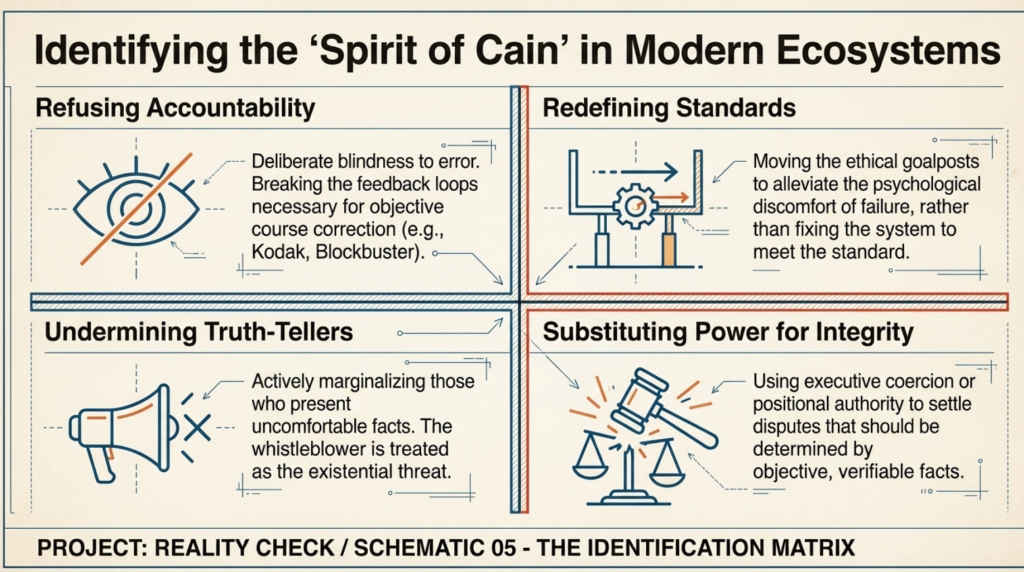
The first and most foundational expression is the refusal of accountability. In systems-engineering terms, accountability is the mechanism by which the gap between system performance and system standard generates corrective data. When an institution refuses accountability — when error is systematically denied, reframed, or attributed to external forces — it severs the primary feedback loop by which self-correction is possible. The institution continues to operate; its metrics continue to be reported; its public communications continue to project confidence. But internally, the gap between its narrative and its actual performance widens with each cycle, compounding the eventual cost of correction.
The second expression is the redefinition of standards: what might be called the migration of the moral markers. When performance cannot be brought into alignment with standard, the institution that has adopted a Cainite epistemology will alter the standard rather than the performance. This is not always a cynical operation; in many cases, the individuals who participate in it have genuinely persuaded themselves that the new standard is more sophisticated, more nuanced, more contextually appropriate than the old. The self-deception is part of the structure. A system that knew it was deceiving itself would not be deceiving itself.
The third expression — and the one that most reliably signals that a Cainite dynamic has become institutionally entrenched — is the systematic marginalization of truth-tellers. The individual who presents data that contradicts the institutional narrative is experienced not as a colleague offering corrective information but as a threat to the system's coherence. Whistleblowers are not marginalised because they are wrong; they are marginalised because the data they carry is accurate, and its accuracy is existentially dangerous to a system that has organized its operations around a false account of its own performance.
The fourth expression is the substitution of power for evidence. In a system committed to epistemic integrity, disputes about performance and direction are resolved by the examination of data. In a Cainite system, they are resolved by the application of authority — by positional dominance, by political pressure, by the simple assertion that those with power define reality. This is the moment at which an institution passes from the merely dysfunctional to the genuinely pathological. It is also, it should be noted, the moment at which the institution's internal culture becomes hostile to the very kinds of intelligence it most needs.
The literature on organizational failure is replete with case studies that instantiate this pattern. The collapse of Enron, the systemic failures exposed in the 2008 financial crisis, the ongoing crises of credibility in major journalistic and scientific institutions — each of these represents a specific, historically traceable instantiation of the Cainite dynamic: a system that encountered feedback, found it intolerable, suppressed it, and thereby accelerated the very failure it was attempting to avoid.
— IV —
THE CAINITE TRAP: TECHNICAL SOPHISTICATION WITHOUT MORAL WISDOM
There is a second dimension of the Cain narrative that receives insufficient philosophical attention, and it bears with particular force upon the pathologies of our present technological moment. The descendants of Cain, enumerated in the fourth chapter of Genesis, are identified as the pioneers of the foundational technologies of civilization: metallurgy, music, animal husbandry, urban engineering. The genealogy is not incidental. It establishes, as a matter of explicit narrative design, that the Cainite trajectory is not a trajectory of incompetence or primitivism. It is a trajectory of accelerating technical capability in the service of deepening ontological disorder.
The figure of Lamech — who boasts of weaponizing the advanced metallurgy of his culture to exact vengeance seventy-sevenfold — is the narrative's definitive statement of what this treatise designates the Cainite Trap: the condition in which technological amplification, uncoupled from moral ordering, does not elevate human capacity for good but multiplies human capacity for self-destruction. Lamech does not merely commit violence. He builds systems for the institutional scaling of violence, and he does so with the specific genius that his civilization has developed.
This is not a statement about technology as such. Technology is instrumentally neutral in the relevant sense: it amplifies the agency of its users in whatever direction their ordering principles direct. The Cainite Trap is therefore not a problem of technology but a problem of the moral formation of those who develop and deploy it. A civilization that produces extraordinary technical capacity without attending to the question of toward what end and within what constraints that capacity is to be exercised is not progressing. It is accelerating toward a destination it has not examined.
The contemporary relevance of this principle requires little elaboration for the reflective reader. The past three decades have witnessed an explosion of technical capability — in computation, communication, biotechnology, and artificial intelligence — of a kind that has no historical precedent in its pace or scope. The philosophical and ethical frameworks by which these capabilities might be ordered toward genuine human good have not kept pace. The question of whether a particular technology can be built has overwhelmingly dominated the cultural attention devoted to these domains; the question of whether it should be built, and if so within what constraints and toward what ends, has been systematically marginalized as impractical, naïve, or commercially inconvenient.
The moral philosopher Philippa Foot argued, in her work on natural goodness, that the concept of good cannot be understood apart from the concept of the kind of thing under evaluation. What counts as good for a wolf is determined by what it is to be a wolf; what counts as good for a human person is determined by what it is to be a human person. The Cainite Trap occurs when technical systems are developed without sustained attention to the question of what it is to be a human person — what conditions sustain human flourishing, what configurations of power and information tend to degrade it, and what limits on technical capability are therefore necessary rather than merely prudential.
This is not, it should be emphasised, a counsel of technological pessimism. The cultivation of technical knowledge is among the highest expressions of the human intellectual vocation, and the goods made possible by technological development are real and profound. The point is rather that technical development, severed from moral ordering, does not remain neutral. It acquires the directionality of the disordered appetites it serves, and those appetites, when amplified by sophisticated tools, produce harms of a corresponding magnitude.
— V —
BABEL 2.0: THE ARCHITECTURE OF COLLECTIVE EPISTEMIC FRAGMENTATION
The Tower as Sociotechnical Project
The narrative of Babel represents a qualitative escalation from the Cainite dynamic. Where Cain's rebellion was individual — a single act of feedback suppression by a single agent — the Babel project is collective, deliberate, and architecturally ambitious. It is the construction of a shared infrastructure of self-exaltation: the organisation of an entire community's technical resources in the service of a single totalizing aspiration.
The founding declaration of the Babel project — "Let us make a name for ourselves" — is philosophically dense. To make a name for oneself, in the ancient world, was not merely to achieve fame. It was to assert the right to define one's own identity, to establish one's own criterion of significance, to locate one's own ground of meaning within oneself rather than in the ordering structure of reality. The Tower is the physical instantiation of an epistemological claim: that a community of sufficient technical sophistication can constitute its own reality and need not submit its self-understanding to any external standard of evaluation.
The divine response — the confusion of languages, the dispersal of the community — is consistently misread as punitive. The philosophical reading, however, suggests something considerably more interesting. The confusion of languages is a disruption of the totalizing communicative infrastructure that makes the Babel project possible. It is the introduction of what systems engineers call protective friction: a structural constraint that prevents any single node in a network from achieving totalizing control over all others. The dispersal is not a destruction of human community but a preservation of human diversity — a safeguard against the convergence of all human aspiration into a single, self-referential, self-enclosed system.
The Digital Babel: Algorithmic Epistemology and Fragmented Reality
The Babel narrative acquires its most disturbing contemporary relevance when read against the architecture of the digital information environment. The global information networks of the twenty-first century were constructed with aspirations that directly parallel the Babel project: the creation of a unified communicative infrastructure through which all of humanity might be connected, all knowledge made accessible, all cultural production shared across previously impermeable boundaries. These aspirations were not ignoble. The goods they aimed at — connectivity, accessibility, the democratization of knowledge — are genuine goods. The problem, as in Babel, lay not in the aspiration but in the axiomatic framework within which the construction proceeded.
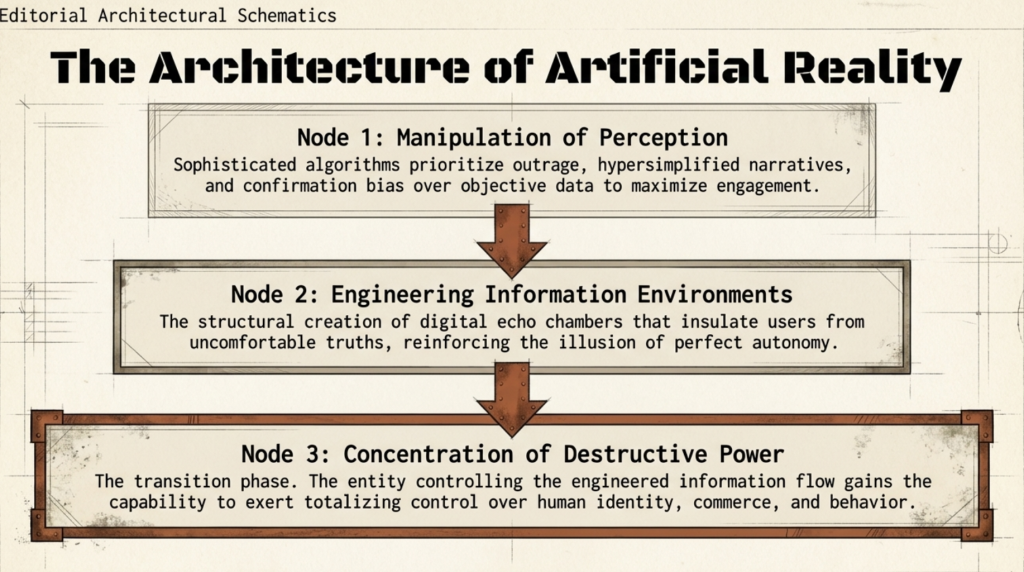
The axiomatic framework of the digital information economy was not the pursuit of truth but the maximization of engagement. The two appear superficially compatible — surely people engage most with content they find true and valuable — but they are, in practice, radically divergent. Engagement is maximized not by truth but by emotional activation, by confirmation of prior belief, by the stimulation of outrage, tribalism, and desire. The algorithmic systems designed to optimize for engagement therefore function, at the structural level, as machines for the systematic amplification of cognitive bias.
The result — and here the parallel with Babel achieves its most precise expression — is not the unification of human discourse but its fragmentation into what the epistemological literature designates filter bubbles or epistemic silos: communicative environments in which individuals are systematically insulated from information that might challenge their existing beliefs. The confusion of languages at Babel produced communities that could no longer communicate across their differences. The algorithmic optimisation of the digital public sphere has produced communities that share a common technical language but inhabit incompatible epistemic realities — communities that are, in the philosophically relevant sense, no longer speaking about the same world.
This fragmentation has consequences that extend well beyond the sphere of political discourse, troubling as those consequences are. It reaches into the domain of what philosophers of science call the social epistemology of inquiry: the set of social practices, institutional norms, and communicative structures by which a community arrives at shared understanding of empirical reality. When those structures are systematically deranged by the commercial incentives of attention economies, the community loses not merely the capacity for political agreement but the more fundamental capacity for a shared apprehension of fact. At that point, the conditions for any kind of collective rationality — including the rational assessment of institutional performance — have been severely compromised.
Three specific risks deserve particular analytical attention in this context. The first is the weaponisation of perception management: the deployment of algorithmically sophisticated information systems not to inform but to engineer belief states in target populations. The second is the construction of what might be called digital ideological fortresses — self-reinforcing information environments that provide the psychological experience of engagement with diverse perspectives while systematically filtering out any data that would genuinely challenge the resident community's convictions. The third — and most structurally significant — is the progressive concentration of informational power in a small number of platforms, creating conditions in which the epistemic environment of an entire civilization is effectively controlled by systems operating under commercial imperatives that are structurally opposed to the conditions of genuine inquiry.
— VI —
THE BABYLONIAN SHIFT: WHEN THE INSTITUTION DEVOURS TRUTH
Babylon as the Mature Expression of Ontological Disorder
If Cain represents the origin of ontological misalignment — the first act of feedback suppression — and Babel represents its collective institutionalisation, then Babylon represents its mature, self-sustaining, self-reinforcing civilizational form. Babylon is what a Cainite culture looks like at full development: a system of such complexity, such self-referential coherence, and such institutional momentum that it no longer requires individual acts of dishonesty or deliberate deception to sustain itself. Its misalignment with reality has been encoded into its structures, its incentives, its language, and its categories of evaluation. Truth is no longer suppressed by this system; it is simply unthinkable within it.
The theological literature on Babylon is extensive and theologically various, but its philosophical core is consistent: Babylon is the civilizational archetype of the system that has substituted its own self-perpetuation for the goods it was constituted to serve. It is the empire that exists no longer to provide order, justice, and security for its inhabitants but to extract from those inhabitants the resources — material, political, and psychological — required to sustain the imperial apparatus. It is the institution that no longer serves reality but demands that reality serve it.
Three sequential priorities characterize this terminal condition. The first is the subordination of truth to power: the institution's criterion of success becomes not the achievement of the goods it was constituted to serve but the maintenance of the authority that enables it to continue operating. This produces the characteristic Babylonian inversion in which factual accuracy becomes an institutional liability — accurate data threatens the narrative upon which institutional authority depends — while the capacity to suppress, manage, or reframe inconvenient data becomes a core institutional competency.
The second priority is the substitution of reputation for integrity: what this treatise designates the brand-over-reality dynamic. At this stage, the institution has developed sophisticated capacities for the performance of its constitutive virtues — for the appearance of the intellectual honesty, the moral probity, the commitment to quality that the institution's founding purposes required. These performances are not merely cynical; they reflect the genuine recognition that the institution's social license depends upon its being perceived as virtuous, even as its actual operations have diverged dramatically from the conditions of genuine virtue. The resulting gap between institutional performance and institutional reality is managed by the substantial deployment of communicative resources — public relations, marketing, media management — that could, in a differently ordered institution, be deployed in the service of actual improvement.
The third priority is the weaponisation of justice: the conversion of the institution's regulatory and legal capacities from instruments of genuine adjudication into instruments of institutional self-protection. Law becomes, in the Babylonian configuration, not a pursuit of truth but a tool for the suppression of critics, the punishment of whistleblowers, and the maintenance of the structures of power that sustain the institutional apparatus.
The Beast System: Conscience as the Final Frontier
The most philosophically significant dimension of the Babylonian archetype — and the one most directly relevant to the contemporary analysis of digital totalitarianism — is what the Johannine literature designates the Beast System: the condition in which an institution's demand for alignment has extended from the behavioral to the conscientious domain.
Every institutional system requires some degree of behavioral conformity from its participants. The Babylonian escalation occurs when this requirement is extended to the level of conviction: when participation in the system's economy, its social life, its communicative networks, requires not merely behavioral compliance but the public surrender of one's independent moral assessment of the system's operations. The mark of the Beast, in the theological tradition, is not primarily a physical sign. It is the epistemological capitulation by which the individual agrees, implicitly or explicitly, to accept the system's account of reality as authoritative — to suppress whatever private dissent their own observations might generate and to publicly affirm the system's narrative.
The philosophical question this raises — and it is among the most urgent questions of the present cultural moment — is whether the digital information systems of the twenty-first century have created conditions in which this kind of epistemological demand is structurally embedded in ordinary social and economic participation. The question is not whether any individual actor has deliberately designed such a system. It is whether the structural incentives of attention economies, data economies, and platform-based social systems have, in their aggregate operation, produced an environment in which independent epistemic agency — the capacity to assess one's own situation against an independent standard of reality — is systematically compromised by the conditions of participation.
The philosopher Charles Taylor, in his analysis of the conditions of authentic selfhood, argued that authenticity requires what he called a moral horizon: a framework of significance that is not merely constructed by the individual but encountered by the individual as having an authority that is independent of preference. The Babylonian system's deepest danger is not that it produces bad outcomes for its inhabitants — though it does — but that it progressively erodes the conditions under which its inhabitants could recognise those outcomes as bad. It degrades the moral horizon against which self-assessment and institutional assessment are possible.
The physicist's observation is relevant here: reality does not permanently bend to human preference. The gap between an institution's false narrative and the objective conditions it is narrating cannot be widened indefinitely. At some point — the specific timing is contingent but the event is structurally necessary — the gap becomes too wide for institutional performance to bridge, and the collapse that appeared sudden to the observers within the system reveals itself, upon examination, to have been developing across the entire span of the institution's misalignment.
— VII —
THE THREAD OF LIFE: A COUNTER-DIAGNOSTIC FOR SYSTEMIC RESILIENCE
The Phenomenology of Faithful Alignment
A treatise that diagnoses the mechanics of institutional collapse without articulating the conditions of institutional resilience would be analytically incomplete. The ancient narrative tradition that encodes the Cain-Babel-Babylon trajectory with such precision also encodes, with equal precision, what this treatise designates the Thread of Life: the persistent counter-movement of those who maintain, within and against the dominant structures of misalignment, the conditions of genuine ontological integrity.
The Thread of Life is not an abstract principle. In the narrative tradition, it is embodied in specific figures — Noah, Abraham, the Hebrew prophets, the figure of the faithful remnant — who are characterized not by their social power or their institutional prestige but by a specific epistemological orientation: the willingness to maintain honest perception of reality even when that perception diverges dramatically from the account of reality that the dominant institutional system is enforcing.
This willingness is not, as it is sometimes represented, a merely passive virtue. It is an active, demanding, and frequently costly practice. The prophetic tradition of the Hebrew scriptures is essentially a tradition of institutional critics: individuals who maintained independent epistemic access to the conditions of their community's life and who communicated what they perceived with an honesty that the community's dominant institutions found profoundly threatening. The fact that prophets were consistently persecuted is not incidental to the tradition; it is one of the tradition's central data points about the structural relationship between honest perception and institutional power.
Three Operational Directives for Systemic Integrity
For the individual operating within contemporary institutions — whether corporate, academic, governmental, or digital — the Thread of Life tradition suggests three operational directives that deserve philosophical elaboration.
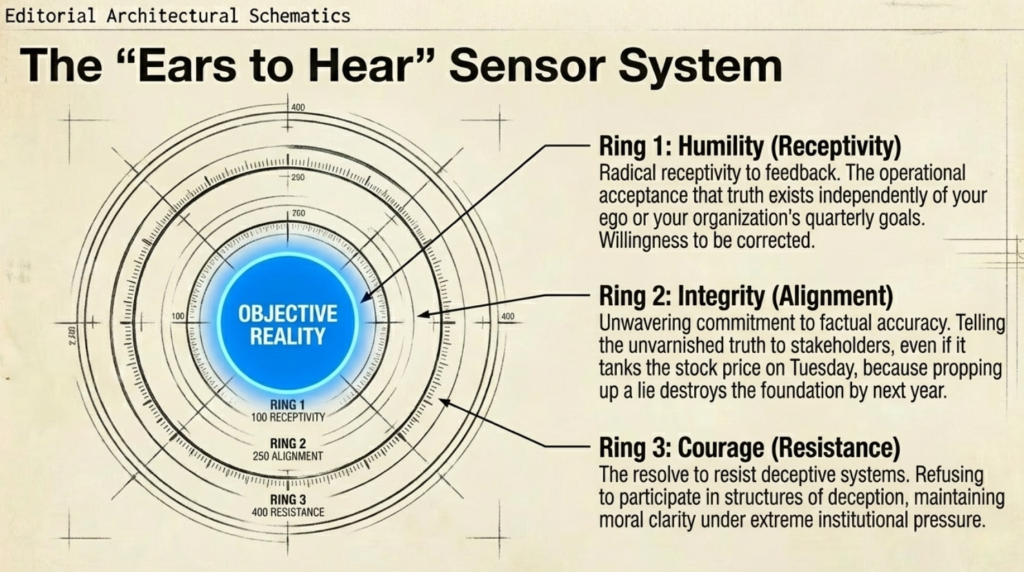
The first directive is humility understood not as psychological self-deprecation but as the epistemological commitment to radical receptivity to corrective feedback. The humble actor is not one who thinks poorly of themselves; it is one who maintains an operative recognition that truth exists independently of their preferences, that the gap between their self-assessment and reality may at any moment be revealed as significant, and that the proper response to such revelation is not the suppression of the revealing data but the revision of the self-assessment. In organizational terms, this means the construction of feedback mechanisms whose outputs are genuinely capable of influencing decisions — not merely performed for the purpose of signaling openness while the actual decision-making process remains insulated from inconvenient data.
The second directive is integrity in the specific sense of correspondence between interior assessment and exterior expression. The integrated actor says what they perceive, reports what they observe, and refuses the social pressure to substitute managed performance for honest communication. This is not, in practice, a simple virtue. The social costs of integrity in a Cainite or Babylonian institutional environment are real and frequently substantial. The whistleblower loses their position; the dissenting analyst loses their credibility; the scholar who challenges the dominant paradigm loses access to the institutional resources that their research requires. The directive of integrity does not deny these costs. It insists that they are, in the long run, less severe than the costs of the systematic self-deception that their avoidance requires.
The third directive is courage understood as the capacity to maintain clarity of moral assessment and independence of judgment under conditions of sustained institutional pressure toward conformity. Courage in this sense is not the dramatic single act of heroic resistance, though it may sometimes require such acts. It is more fundamentally the daily practice of refusing to allow the accumulated weight of institutional expectation, social pressure, and reputational risk to gradually erode the correspondence between one's private perception and one's public expression.
The Structural Rebar Principle
The metaphor that best captures the social function of those who maintain these three directives within institutions is that of structural rebar: the steel reinforcement embedded within concrete that prevents the structure from shattering under load. Concrete has extraordinary compressive strength but negligible tensile strength; without the rebar that distributes tensile stress throughout the structure, it will fracture catastrophically under forces that the rebar-reinforced structure would absorb without failure.
The individuals who maintain epistemic integrity within institutions — who provide honest feedback, resist the pressure to substitute narrative for reality, and refuse the epistemological demands of the institutional Beast System — function in precisely this way. They are not, typically, the most visible members of the institutions they inhabit; they are not, in the conventional sense, the most powerful. But they provide the tensile strength that prevents brittle institutional structures from shattering when the inevitable pressures of the collision between false narrative and objective reality arrive.
The corollary of this principle is equally important: the systematic removal of truth-tellers from institutions — the progressive purification of the institutional culture from all sources of honest feedback — does not make those institutions more coherent or more functional. It makes them more brittle. It concentrates all the tensile stress at the points of remaining structural integrity, which are progressively fewer, until the structure is incapable of withstanding even moderate pressure.
— VIII —
THE PROTECTIVE FRICTION THESIS: A REAPPRAISAL OF BABEL'S DISPERSAL
We are in a position, at this point in the analysis, to return to a question raised earlier and to give it the philosophical treatment it deserves. The confusion of languages at Babel — the divine disruption of the totalizing communicative project — has consistently been interpreted, in both religious and secular readings, as a punitive act: the suppression of human ambition by a power threatened by its scope. The alternative reading proposed in this treatise is philosophically more interesting and practically more urgent.
The dispersal of the Babel community is the introduction of protective friction into a system that had achieved a degree of communicative and organizational integration that made it structurally capable of totalizing control. The confusion of languages is not the destruction of human communication; it is the preservation of the diversity and the structural independence of communicative communities that prevents any single community's epistemic framework from achieving hegemonic dominance over all others.
Consider the epistemological significance of this diversity. A world of multiple, partially incommensurable epistemic communities — communities that share enough common ground to engage in productive disagreement but are not so thoroughly integrated as to enforce uniform belief — is a world with built-in error-correction mechanisms. The diversity of perspectives provides the friction against which any single community's blind spots, biases, and structural misalignments can be revealed. The community that cannot be challenged from outside — that has constructed or inherited a totalizing communicative infrastructure that insulates it from external epistemic pressure — has lost access to the most powerful corrective resource available to finite minds: the perspective of those who see from a genuinely different vantage point.
This has direct implications for the contemporary pursuit of communicative unification. The aspiration to create frictionless global communication — to eliminate the barriers of language, culture, and institutional difference that create the experience of communicative difficulty — is not, on this analysis, straightforwardly progressive. It may, in fact, be eliminating the very structural features of our communicative environment that make genuine collective reasoning possible.
The question must therefore be asked with genuine philosophical seriousness: Is the project of digital communicative unification — the construction of global platforms capable of instantaneous communication across all previous cultural and linguistic barriers — removing the protective friction that has historically prevented any single epistemic framework from achieving the kind of totalizing dominance that the Babel narrative identifies as the precondition of civilizational catastrophe? And if so, what are the institutional and architectural implications of this recognition for the design of the next generation of communicative infrastructure?
These are not merely academic questions. They are among the most practically consequential questions of the present century, and their adequate treatment requires exactly the kind of ontologically grounded, teleologically oriented analysis that the ancient narrative tradition, read with philosophical seriousness, makes possible.
— IX —
THE CHOICE OF TWO CITIES: TOWARD A CONCLUSION
Augustine of Hippo, writing in the ruins of a civilization whose collapse his contemporaries experienced as sudden and inexplicable, described the fundamental structure of human history as a conflict between two cities: the city organized by the love of self to the contempt of God, and the city organized by the love of God to the contempt of self. These two cities, Augustine insisted, were not geographically separable. They were interpenetrating orders of motivation and allegiance whose members inhabited the same physical communities, participated in the same institutions, and engaged in many of the same activities — but whose ultimate organizing commitments were structurally incompatible.
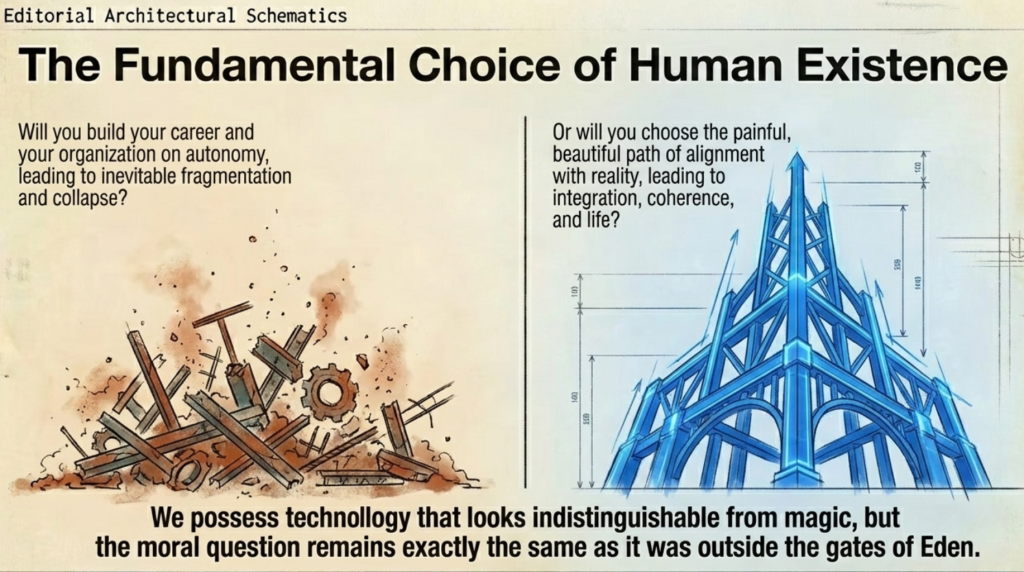
The analytical framework developed in this treatise is, at its deepest level, a philosophical elaboration of Augustine's fundamental insight, rendered in the language of systems theory, organizational analysis, and contemporary epistemology. The Cain-Babel-Babylon trajectory is not a historical sequence that unfolded once in the ancient past and has since been superseded. It is a structural pattern that recurs wherever a community of human agents organizes its collective life around the principle of self-referential autonomy: the axiom that the community itself is the ultimate standard of its own evaluation.
The Thread of Life is equally recurrent: it appears wherever individuals and communities maintain the epistemological humility to submit their self-assessment to an external standard of evaluation — wherever, in the language of the present analysis, there are agents willing to perform the functions of structural rebar within the concrete of institutional life.
The divergence between these two trajectories is not a divergence between the religious and the secular, the ancient and the modern, the technologically sophisticated and the technologically primitive. It is a divergence between two fundamentally different relationships to reality, two incompatible answers to the question of whether truth exists independently of the community's preferences and whether alignment with truth is or is not the precondition of genuine flourishing. This is, ultimately, a question about the nature of being — an ontological question — and it is therefore a question that cannot be evaded by any institution that aspires to endure.
The contemporary relevance of this analysis is not confined to the grand structures of civilizational history. It is present in every organizational decision in which institutional narrative is preferred to accurate data, in every product launch in which known deficiencies are managed rather than corrected, in every algorithm designed to maximize engagement rather than promote genuine understanding, and in every professional relationship in which honest communication is sacrificed to the maintenance of comfortable fiction.
It is also present in every counter-decision: every act of honest feedback delivered at personal cost, every insistence on accuracy against institutional pressure toward narrative management, every refusal to allow the demand for conscientious conformity to erode independent moral assessment. These are not small acts. In the analysis proposed here, they are the constitutive acts of civilizational resilience — the moments in which the Thread of Life is maintained against the forces that would sever it.
The ancient diagnostic blueprint does not offer optimism in the shallow sense: it does not promise that honest institutions will always prevail over dishonest ones, that the Thread of Life will always overcome the Cain-Babel-Babylon trajectory within any given historical time frame, or that the individual committed to epistemic integrity will escape the costs that such commitment frequently entails. What it does offer is something more valuable: clarity. Clarity about the structure of the forces at work, clarity about the conditions under which genuine institutional integrity is possible, and clarity about the nature of the choice that every individual participant in every institution is, at every significant moment, being asked to make.
The city built upon the love of truth — upon the recognition that reality has an authority that no institution can permanently override — is not guaranteed to dominate the landscape of the twenty-first century. But it is the only city that can endure. All others, however impressively constructed and however persuasively narrated, are built upon a foundation that the structure of reality itself will eventually test. And when that test arrives, the quality of the foundation will be revealed.
The ancient architects knew this. The question before us is whether we have the philosophical seriousness, the epistemological humility, and the moral courage to learn from them before the test concludes.
A NOTE ON SOURCES AND INTELLECTUAL DEBTS
This treatise is indebted to the foundational work of Jamie Thornberry, whose original sociotechnical analysis of the Cain-Babel-Babylon narratives provided the generative framework that the present philosophical elaboration seeks to develop and extend. The interpretive tradition it draws upon is wide: Augustine of Hippo's De Civitate Dei; Alasdair MacIntyre's After Virtue and Three Rival Versions of Moral Enquiry; Charles Taylor's Sources of the Self and The Ethics of Authenticity; Philippa Foot's Natural Goodness; and the systems-theoretic literature on organizational failure and feedback dynamics associated with the work of Peter Senge, Karl Weick, and Diane Vaughan. The theological ontology underlying the framework of privation and participation is drawn primarily from Thomas Aquinas, read through the interpretive lens of Cornelius Plantinga, Jr.'s Not the Way It's Supposed to Be: A Breviary of Sin. The author acknowledges these debts while accepting full responsibility for the specific analytical claims advanced.