1. April 2026
THE INTEGRATED MIND:
A Light-Governed Framework for Knowledge, Mastery,
and Resilient Living
By
Jamie Thornberry
Abstract
This dissertation proposes a comprehensive philosophical framework for human cognitive development that transcends the limitations of both hyper-specialization and uncritical generalism. Drawing upon classical metaphysics, epistemology, and the Christian intellectual tradition, it articulates a vision of the 'integrated mind'—a mode of knowing characterized by depth without confinement, breadth without dispersion, and multiplicity unified under the ordering principle of transcendent truth. The study critically examines contemporary models of professional development (including I-shaped, T-shaped, and M-shaped paradigms), identifies their ontological and teleological deficiencies, and reconstructs them within a framework that understands knowledge as participation in intelligible reality rather than mere instrumental acquisition. Through sustained philosophical analysis, the dissertation demonstrates that genuine insight emerges not from creative construction but from illumined recognition of coherent structure across domains, that resilience stems from internal coherence rather than external redundancy, and that human flourishing requires the integration of all competencies under a transcendent ordering center. The work concludes by articulating practical applications of this framework across decision-making, learning, professional development, and adaptive capacity, offering a rigorous alternative to both fragmented specialization and relativistic multiplicity.
Introduction: The Crisis of Fragmentation and the Promise of Integration
The modern condition presents a peculiar paradox. We live in an age of unprecedented access to information, yet widespread confusion about knowledge; of extraordinary specialization, yet persistent inability to address problems requiring synthetic understanding; of proclaimed intellectual humility, yet profound epistemic arrogance in the form of disciplinary insularity. This paradox is not accidental. It reflects a fundamental disorder in how contemporary culture conceives the nature of knowledge, the structure of reality, and the proper formation of the human person.
The critique of hyper-specialization has become commonplace in both academic and popular discourse. Educators decry the fragmentation of curricula into disconnected subjects. Business leaders lament the inability of experts to communicate across domains or to perceive systemic patterns. Public intellectuals warn of the dangers posed by technical sophistication divorced from wisdom. These critiques correctly identify genuine problems: the specialist who knows 'more and more about less and less,' the expert who cannot recognize the limitations of their paradigm, the technician who possesses skill without understanding.
Yet the proposed solutions often replicate the error they seek to correct. In place of narrow specialization, they advocate a kind of intellectual pluralism that celebrates breadth for its own sake, flexibility without grounding, adaptability without direction. The specialist's confinement is replaced by the generalist's dispersion. One form of fragmentation gives way to another. The result is not integration but multiplication of fragments—a mind that touches many domains but dwells in none, that accumulates experiences but fails to synthesize them into coherent understanding.
This dissertation argues that both hyper-specialization and uncritical generalism rest upon the same flawed foundation: a conception of knowledge as possession rather than participation, as constructed rather than disclosed, as fragmented by necessity rather than unified by nature. Against this background, I propose an alternative framework grounded in classical metaphysical realism and the Christian intellectual tradition. This framework understands knowledge as participation in an intelligible order that transcends individual minds, insight as recognition rather than invention, and human cognitive development as progressive integration into unity rather than accumulation of discrete competencies.
The central claim of this work is that genuine intellectual formation produces what I term the 'integrated mind'—a mode of being characterized by depth without confinement, breadth without dispersion, and multiplicity unified under a transcendent ordering principle. This is not merely a pedagogical strategy or a career development model. It is an ontological claim about the nature of reality, an epistemological claim about how knowledge is possible, and an anthropological claim about human flourishing.
The Structure of the Argument
This dissertation proceeds through nine major movements, each building upon the previous to construct a comprehensive philosophical framework. The first movement establishes the ontological foundation by arguing that reality itself is ordered and intelligible—that fragmentation is privation rather than fundamental structure. The second movement examines contemporary models of cognitive development, identifying both their insights and their limitations. The third movement reconstructs these models within a realist metaphysical framework, proposing the integrated mind as the proper telos of human intellectual formation.
The fourth movement addresses the mechanism of insight, arguing against constructivist accounts and for a model of 'illumined transfer' in which genuine discovery consists in recognition of objective patterns rather than creative invention. The fifth movement examines the temporal dimension of development, proposing a discipline of 'ordered seasonality' that distinguishes between formative progression and directionless drift. The sixth movement analyzes resilience, demonstrating that genuine strength emerges from internal coherence rather than external redundancy.
The seventh movement addresses moral psychology, distinguishing between false shame and true conviction, between destructive self-judgment and salutary recognition of misalignment with reality. The eighth movement synthesizes the previous arguments into a comprehensive portrait of the integrated person. The ninth and final movement examines practical applications across decision-making, learning, professional development, and adaptive capacity.
Throughout, the argument maintains fidelity to three methodological commitments: first, to ontological realism—the conviction that reality possesses an intelligible structure independent of human construction; second, to epistemological participation—the understanding that knowledge consists in conformity to reality rather than subjective construction; third, to teleological ordering—the recognition that human faculties possess proper ends toward which they are naturally directed and in light of which they must be evaluated.
Chapter One: The Ontological Foundation—Reality as Ordered Intelligibility
The Primacy of Unity
All meaningful inquiry presupposes a fundamental conviction: that reality is not chaos but cosmos, not random flux but ordered intelligibility. This is not a conclusion derived from empirical investigation but a transcendental condition for the possibility of such investigation. Without the prior conviction that reality possesses structure discernible to the intellect, no inquiry could begin, no hypothesis could be formed, no explanation could be offered or evaluated.
The classical tradition understood this with clarity. Heraclitus proclaimed the Logos as the rational principle pervading all things. Plato posited the Forms as eternal patterns in which particulars participate. Aristotle identified nous as the active intellect capable of grasping universal forms in particular instances. The Stoics conceived of nature as a rational whole governed by immanent reason. Early Christian thinkers, synthesizing biblical revelation with Greek philosophy, understood the cosmos as created by and through the divine Logos, thereby possessing both contingent existence and necessary intelligibility.
This conviction reached its systematic apex in the medieval synthesis. Thomas Aquinas articulated with particular precision the relationship between divine intellect, created essence, and human knowing. God creates by understanding—the divine intellect contains the archetypes of all possible beings, and creation is the actualization of these intelligible patterns. Human knowledge, in turn, consists in the conformity of intellect to thing (adequatio intellectus et rei), a participatory reception of the forms that structure reality. Knowledge is thus neither construction nor mere correspondence but participation—the mind's reception and recognition of the intelligible structure really present in things.
This metaphysical realism has profound implications for how we understand knowledge and its fragmentation. If reality is unified—if all that exists does so through participation in a single creative act and finds its ultimate intelligibility in a single divine intellect—then the fragmentation of knowledge into isolated disciplines represents not the disclosure of reality's fundamental structure but a failure to perceive its unity. Specialization becomes problematic not because depth is wrong but because it severs connection to the whole, treating a part as if it were independent rather than recognizing its participation in a larger order.
Fragmentation as Privation
If unity is primordial, fragmentation must be understood as derivative—as privation of an order that ought to obtain. This is not to deny that legitimate distinction exists within reality. The scholastic principle distinguere sed non separare captures the proper relationship: distinguish but do not separate. Disciplines rightly identify different formal objects of inquiry, different aspects of reality worthy of focused attention. Physics and ethics, biology and aesthetics, each attends to a genuine dimension of the created order.
The problem arises when distinction hardens into separation, when methodological focus becomes ontological compartmentalization. When the physicist declares that only measurable quantities are real, when the sociologist reduces human behavior to social construction, when the economist treats persons as mere utility-maximizers, each commits the same error: mistaking a legitimate perspective for the whole of reality, elevating a methodological limitation into a metaphysical claim.
This error has multiple sources. Practically, it stems from the demands of modern academic and professional organization—the need to manage complexity through division of labor, to establish clear boundaries for disciplines and careers. Intellectually, it reflects the influence of nominalism and empiricism, philosophical movements that denied the reality of universals and reduced knowledge to the aggregation of particular observations. Culturally, it manifests the broader fragmentation characteristic of modernity itself—the dissolution of traditional integrating frameworks and the multiplication of incommensurable value spheres, to use Max Weber's terminology.
The result is what Josef Pieper called 'the elimination of the comprehensive view,' a condition in which expertise increases even as wisdom decreases, in which technical mastery advances even as holistic understanding recedes. The specialist knows the mechanisms but not the meaning, the functions but not the form, the means but not the ends. And because modernity's institutional structures reward and reinforce specialization, this privation comes to seem natural, even necessary.
The Task of Integration
If fragmentation is privation, integration is restoration—not a return to pre-specialized ignorance but a movement forward to post-specialized synthesis. This requires what Hans Urs von Balthasar called 'seeing the form,' the capacity to perceive the unity-in-diversity that characterizes genuine reality. It demands cultivation of what John Henry Newman termed the 'philosophical habit of mind,' the disposition to relate particular truths to universal principles, to see connections across domains, to recognize the coherence that underlies apparent diversity.
This is not a call for superficiality. Integration does not mean abandoning rigor or depth. The integrated mind is not less capable of focused attention than the specialist but more so, because it understands the significance of what it attends to. It knows why a particular detail matters, how it fits within larger patterns, what it reveals about the structure of reality itself.
Nor is integration a matter of mere accumulation. Simply adding more specializations produces not integration but multiplication of fragments. The polymath who masters five disciplines in isolation remains fragmented, possessing five specialized perspectives rather than one synthetic vision. True integration requires something more: a unifying principle, an ordering center, a standpoint from which diverse truths can be related and reconciled.
In the Christian intellectual tradition, this ordering center is identified with divine Logos—the eternal Reason through which all things are made and in which all things cohere. Knowledge finds its unity not in any human synthesis but in participation in the divine intellect's comprehensive vision. The human mind, created in the image of God, possesses the native capacity for this participation, though that capacity requires cultivation and can be damaged by sin and disorder.
This theological grounding does not render the framework inaccessible to those outside the Christian tradition. The conviction that reality is ordered and intelligible, that knowledge seeks unity, that human flourishing requires integration of faculties toward proper ends—these claims can be recognized and affirmed on philosophical grounds even by those who do not accept their theological foundation. Nevertheless, the framework achieves its fullest articulation and most secure foundation within the Christian metaphysical tradition, where the unity of truth finds its ultimate guarantee in the unity of the divine being.
Chapter Two: Contemporary Models of Cognitive Development—Insights and Limitations
The I-Shaped Model: Depth Without Horizon
The 'I-shaped' designation captures the traditional specialist's profile: profound depth in a single domain, minimal breadth across others. This model dominated professional formation throughout much of the twentieth century and retains considerable influence today, particularly in fields requiring extensive technical training. The medical subspecialist, the academic researcher, the skilled tradesperson—each exemplifies this pattern of development.
The model possesses genuine strengths. It produces precision, rigor, and mastery within a defined domain. The I-shaped individual knows their field with thoroughness impossible for those who divide attention across multiple areas. They internalize the distinctive logic of their discipline, develop facility with its technical apparatus, and contribute to its advancement through focused inquiry. In an age of unprecedented complexity, such specialized expertise remains indispensable. No amount of general knowledge can substitute for the surgeon's trained hand, the engineer's grasp of structural dynamics, or the scholar's command of primary sources.
Yet the limitations are equally apparent. The I-shaped individual often lacks peripheral vision—the capacity to recognize patterns, draw analogies, or apply insights across domains. Confined within a narrow slice of reality, they may mistake the part for the whole, treating their discipline's methodological assumptions as universal truths. Worse, they may become unable to communicate across disciplinary boundaries, speaking only to fellow specialists in increasingly technical jargon opaque to outsiders.
This confinement affects not merely intellectual range but existential stability. When identity and meaning derive entirely from a single domain of expertise, disruption in that domain becomes existentially threatening. The specialist whose field becomes obsolete, whose methods are superseded, whose institution dissolves, faces not merely professional displacement but identity crisis. Having invested the totality of their cognitive and emotional resources in one basket, they find themselves devastated when that basket breaks.
From the perspective of our ontological foundation, the I-shaped model's fundamental error lies in its implicit metaphysics. By treating a single domain as if it were self-sufficient, it denies the participatory nature of knowledge and the interconnection of reality. It mistakes a methodological focus—which may be practically necessary—for an ontological fact, as if the physicist's abstraction of material causes from formal and final causes meant that only material causes exist, or as if the economist's focus on market mechanisms meant that human beings are only economic agents.
The T-Shaped Model: Breadth With Anchor
The 'T-shaped' model emerged as a corrective to hyper-specialization. It retains depth in one primary domain (the vertical stroke) while adding breadth across multiple areas (the horizontal stroke). This combination aims to preserve the specialist's precision while developing the capacity for cross-domain understanding and collaboration. The T-shaped professional can both excel in their core expertise and communicate effectively with specialists in other fields.
This model represents genuine progress. It acknowledges that expertise need not mean isolation, that depth and breadth can coexist, that professional effectiveness requires both specialized competence and integrative capacity. The T-shaped individual can see beyond their immediate discipline, recognize relevant insights from other fields, and collaborate productively across boundaries. They possess what might be called 'informed generalism'—not mastery of multiple domains but sufficient familiarity to appreciate their logic and significance.
Yet the T-shaped model remains inadequate as an ultimate ideal. Its horizontal dimension typically consists of instrumental knowledge—familiarity sufficient for collaboration but not for genuine integration. The T-shaped engineer may understand enough biology to work with biomedical researchers, enough business to communicate with managers, enough psychology to lead teams effectively. But these competencies remain essentially auxiliary, tools that serve the primary vertical expertise without fundamentally transforming how that expertise is understood or deployed.
Moreover, the T-shaped model often lacks a principled basis for what should constitute the horizontal dimension. Breadth is pursued pragmatically, guided by utility rather than truth, by market demands rather than intellectual coherence. The professional develops cross-domain competencies because they prove useful, not because they reveal deeper patterns or participate in a unified order. The result is a kind of enlightened instrumentalism—more sophisticated than pure specialization but still organized around effectiveness rather than understanding, around doing rather than being.
From our realist perspective, the T-shaped model's limitation is that it multiplies perspectives without genuinely integrating them. It adds breadth to depth but does not synthesize them into unity. The vertical and horizontal dimensions remain essentially separate—the vertical representing real expertise, the horizontal representing useful familiarity. The model acknowledges that reality has multiple dimensions but does not require perceiving how those dimensions relate to one another or recognizing them as aspects of a single ordered whole.
The M-Shaped Model: Multiplicity Without Unity
The 'M-shaped' or 'comb-shaped' model pushes the logic of the T-shaped approach further, envisioning individuals with genuine depth in multiple domains rather than one primary expertise supplemented by auxiliary familiarity. This model celebrates what might be called 'serial mastery'—the capacity to develop expertise in one field, then transition to another, accumulating multiple domains of real competency over a lifetime. The M-shaped individual is the opposite of the narrow specialist: a genuine polymath who achieves depth repeatedly across different territories.
Advocates of this model emphasize its advantages for insight and innovation. The individual who masters multiple domains can recognize patterns invisible to specialists, apply methods from one field to problems in another, synthesize ideas across boundaries that specialists cannot cross. They possess what is sometimes called 'far transfer'—the ability to apply knowledge and skills in contexts remote from those in which they were acquired. This capacity for transfer enables the distinctive insights that drive paradigm shifts and breakthrough innovations.
The M-shaped model also promises resilience. The individual with multiple domains of genuine expertise cannot be made obsolete by changes in any single field. They possess redundancy not of superficial skills but of fundamental competencies, enabling pivots and reinventions that specialists cannot manage. Economic disruption, technological change, institutional collapse—none of these threats can devastate someone whose identity and capability are distributed across multiple centers.
These are significant advantages, and the M-shaped model rightly challenges the assumption that depth requires lifelong confinement to a single specialty. Yet the model as typically articulated suffers from crucial deficiencies. Most fundamentally, it celebrates multiplicity without adequately addressing unity. The M-shaped individual may master five disciplines, but how do those disciplines relate to one another? Are they simply five separate competencies accumulated serially, or do they participate in some larger coherence? Does mastery of one illuminate mastery of the others, or do they remain essentially isolated despite residing in a single person?
Without answers to these questions, the M-shaped model risks producing not integration but sophisticated fragmentation—a mind that touches many domains but synthesizes none, that accumulates competencies without organizing them, that moves from mastery to mastery without ever achieving wisdom. The polymath who knows five fields in isolation remains fundamentally fragmented, however impressive their résumé. They possess multiplicity without the unity that would transform separate competencies into integrated understanding.
Moreover, the M-shaped model as commonly presented adopts a troubling relativism regarding truth and evaluation. In its eagerness to liberate individuals from narrow specialization, it sometimes suggests that all paths are equally valid, all competencies equally valuable, all seasons of life equally appropriate for any pursuit. This leveling dissolves necessary distinctions. It treats discernment as mere preference, calling as arbitrary choice, formation as optional. The result is not freedom but drift—movement from domain to domain guided by curiosity or opportunity rather than by truth and vocation.
The Need for Correction
Each of these models contains partial truth. The I-shaped model rightly emphasizes depth and rigor. The T-shaped model rightly acknowledges the need for breadth. The M-shaped model rightly celebrates the possibility of multiple domains of mastery. Yet each remains inadequate because each lacks adequate metaphysical and teleological grounding. None asks the fundamental questions: What is the nature of reality such that knowledge is possible? What is the proper end of human knowing? How should the diverse capacities of the human person be ordered toward that end?
The remaining chapters of this dissertation undertake this correction. We will reconstruct the valuable insights of these models within a framework that understands reality as ordered, knowledge as participatory, and human development as progressive integration toward unity under the governance of transcendent truth. The result will be not a rejection of depth or breadth or multiplicity but their proper ordering—a vision of the integrated mind that overcomes fragmentation without sacrificing rigor, that achieves synthesis without losing distinction, that pursues wisdom while preserving expertise.
Chapter Three: The Integrated Mind—Structure and Telos
Beyond Specialization and Generalism
The integrated mind represents neither specialization nor generalism but their transcendence through proper ordering. It possesses depth but not confinement, breadth but not dispersion, multiplicity but not fragmentation. This is possible because integration does not denote a quantitative mean between two extremes but a qualitative transformation of relationship—the movement from mere collection to organic unity, from aggregation to synthesis, from parts juxtaposed to a whole that is more than the sum of its parts.
To understand this transformation, we must distinguish between three modes of cognitive multiplicity. First is mere collection—multiple competencies that remain essentially isolated, related only by the accident of existing in the same person. The polymath who knows physics and poetry, mathematics and music, but perceives no connection between them exemplifies this mode. Their knowledge is extensive but not integrated; they possess many pieces but no puzzle, many notes but no melody.
Second is instrumental coordination—multiple competencies organized around a practical end. The entrepreneur who masters technology, management, finance, and marketing integrates these domains functionally, each serving the goal of building a successful enterprise. This represents progress beyond mere collection, as the diverse competencies are brought into relationship. Yet the relationship remains external, pragmatic rather than essential. The unifying principle is not truth but utility, not understanding but effectiveness.
Third is organic integration—multiple competencies unified by participation in a common ordering principle. Here, diverse domains illuminate one another not merely because they prove useful in combination but because they reveal different aspects of a single reality. The theologian who studies philosophy finds that metaphysics clarifies revelation; the physician who studies literature finds that narrative illuminates diagnosis; the mathematician who studies music discovers that both disclose pattern and proportion. These connections are not imposed by practical necessity but recognized as inherent in the structure of reality itself.
The integrated mind is characterized by this third mode. It does not merely collect competencies or coordinate them instrumentally but perceives their essential relationships, recognizes them as diverse manifestations of unified truth. This perception requires what classical philosophy called sapientia—wisdom, the capacity to judge rightly by understanding ultimate causes and principles. Without wisdom, even extensive knowledge remains fragmented. With it, even limited knowledge can participate in comprehensive vision.
The Ordering Center: Light as Unifying Principle
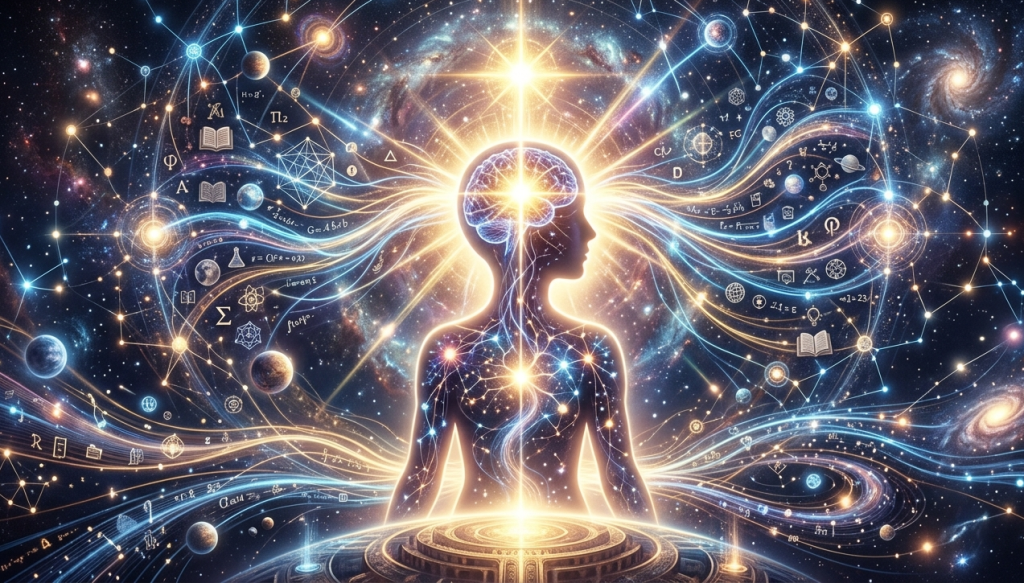
But what provides this unifying wisdom? What principle can relate diverse domains without reducing them to a single method or collapsing them into homogeneity? The answer, I propose, lies in what I term 'Light'—using that term not merely metaphorically but to designate the transcendent ground of intelligibility itself, the source from which all truth derives its luminosity and toward which all genuine knowing tends.
This concept of Light draws upon a rich tradition in both philosophy and theology. In Plato's allegory of the cave, the sun represents the Form of the Good, that which makes both reality intelligible and knowledge possible. Plotinus developed this imagery extensively, describing the One as overflowing in illumination that cascades through levels of reality, each participating in and reflecting the light above it. Augustine identified this divine illumination as necessary for human knowing, arguing that the human mind requires divine light to perceive eternal truths just as physical eyes require sunlight to see material objects.
The biblical tradition employs light imagery with even greater richness. The prologue to John's Gospel identifies Christ as the Logos through whom all things were made and as the Light that enlightens every person. The Psalmist declares, 'In your light do we see light' (Psalm 36:9), suggesting that divine illumination is the condition for all human knowing. Paul describes the gospel as 'the light of the knowledge of the glory of God in the face of Jesus Christ' (2 Corinthians 4:6), linking enlightenment to revelation. This tradition understands Light not as a metaphor for clarity but as the proper name for the reality that makes clarity possible.
In this framework, diverse domains of knowledge find their unity not in any immanent principle but in their common participation in transcendent Light. Physics and ethics, mathematics and theology, art and science—all study different aspects of a reality made intelligible by its derivation from the divine Logos. Their apparent diversity reflects not fundamental fragmentation but the richness of created order, which displays the inexhaustible plenitude of its divine source through infinite variety united in underlying harmony.
This does not collapse all knowledge into theology or subordinate other disciplines to religious authority. Rather, it recognizes that all truth is ultimately one because reality itself is one, and reality is one because it proceeds from a single creative act. The physicist studying the laws of nature, the biologist examining organic systems, the historian tracing cultural development—each investigates a genuine dimension of created order, each discovers real truth. Their diverse findings converge not because they apply the same method but because they investigate different aspects of a single coherent reality.
The integrated mind, then, is one that consciously orients itself toward this Light. It does not pursue knowledge as an end in itself, does not accumulate competencies for their own sake, does not master disciplines out of mere curiosity or ambition. Rather, it seeks in all knowing to participate more fully in the intelligibility that is reality's deepest nature, to perceive more clearly the patterns that Light discloses, to understand more comprehensively how diverse truths relate within the unity of Truth itself.
Structured Multiplicity: The Form of Integration
With this ordering center established, we can now articulate the structure of the integrated mind more precisely. It is characterized by what I term 'structured multiplicity'—the possession of multiple genuine competencies organized hierarchically and related organically under the governance of unifying wisdom.
The hierarchical organization means that not all competencies occupy the same level of significance. Some are central, others peripheral; some are foundational, others derivative; some are pursued for their own sake, others instrumentally. This hierarchy is not arbitrary but reflects both the objective order of reality and the particular vocation of the individual. For the theologian, sacred doctrine occupies the summit, with philosophy, history, and languages serving as handmaidens. For the physician, medicine is central, with biology, chemistry, and psychology providing necessary foundations and ethics governing application.
The organic relationship means that competencies mutually illuminate rather than merely coexist. The physician who studies philosophy gains not merely an additional skill but a transformed understanding of medicine itself. Philosophy raises questions about the nature of health, the meaning of healing, the proper relationship between physician and patient—questions that emerge from within medical practice but require philosophical frameworks to address adequately. Similarly, philosophical ethics gains concreteness from engagement with actual medical cases, moving from abstract principle to practical wisdom.
This mutual illumination extends beyond pairs to encompass the full range of an individual's competencies. The mathematician who studies music and theology does not possess three separate domains but one integrated understanding in which mathematical structure, musical harmony, and theological order illuminate one another. Number reveals pattern, pattern evokes beauty, beauty points to transcendence—and the perception of these connections transforms how each domain is understood and practiced.
The unifying wisdom that governs this structure consists in the capacity to perceive these relationships, to recognize how diverse truths cohere, to understand particular knowledge in light of comprehensive vision. This is not a separate competency added to others but a meta-cognitive capacity that emerges from proper formation. It develops through sustained attention to how different domains approach similar questions, through deliberate reflection on the connections between fields, through cultivation of what Aristotle called the 'nous' or intuitive intellect capable of grasping first principles.
The Telos of Integration: Participation in Truth
Why pursue integration? The question demands an answer that transcends instrumental justification. It is insufficient to claim merely that integrated individuals innovate better, adapt more successfully, or lead more effectively—though these claims may be true. The fundamental answer must be teleological: integration is pursued because it represents the proper actualization of human cognitive capacity, the fulfillment of the intellect's natural orientation toward comprehensive understanding.
Classical philosophy understood the human person as a rational animal, possessing logos or nous as the distinguishing characteristic. This rationality is not merely instrumental—the capacity for calculation and problem-solving—but contemplative, oriented toward the perception and apprehension of truth for its own sake. The intellect naturally seeks to understand, to grasp the essence of things, to perceive the order and pattern that pervade reality. This seeking is not driven by utility but by wonder, not by need but by love of wisdom itself.
Fragmented knowledge frustrates this natural orientation. The specialist who knows much about little and the dilettante who knows little about much both fail to achieve the comprehensive vision toward which the intellect naturally tends. Neither grasps reality as it is—neither perceives the unity-in-diversity that characterizes the actual order of things. The specialist mistakes the part for the whole; the dilettante grasps neither parts nor whole with adequate depth. Both suffer a privation, a failure to actualize the potential for integrated understanding inherent in rational nature.
The Christian tradition deepens this philosophical insight by situating human knowing within the context of divine creation and redemption. If humanity is created in the image of God, and if God's knowledge is comprehensive and unified, then the human vocation includes progressive restoration of that image through increasingly integrated understanding. Sin fractures not only the moral will but the cognitive capacity, producing intellectual pride, narrowness, and fragmentation. Redemption includes healing of the intellect, restoration of the capacity for sapiential vision, recovery of the ability to perceive how all things hold together in Christ.
Thus the telos of integration is ultimately theological: to participate more fully in the divine knowledge, to perceive reality more clearly as God perceives it, to understand the creation in light of its creative source. This may seem an impossibly exalted goal. Yet it is nothing other than what Aquinas called the beatific vision—the direct intellectual apprehension of God that constitutes human fulfillment and blessedness. All earthly knowing anticipates and prepares for that ultimate vision, participating in it partially and imperfectly but genuinely.
This theological framework transforms how we understand the significance of intellectual work. The pursuit of knowledge is not merely professional development, not merely instrumental preparation for other goods, not merely the satisfaction of curiosity. It is, when rightly ordered, a form of worship—the offering of the intellect to God through disciplined attention to the truth He has disclosed in creation. The scientist studying nature, the scholar examining texts, the artist exploring beauty—each participates in this worshipful work when their inquiry is governed by love of truth rather than pride or ambition.
Chapter Four: The Mechanism of Insight—Illumined Recognition Versus Creative Construction
The Phenomenon of Transfer
One of the most striking features of the integrated mind is its capacity for what cognitive psychologists term 'far transfer'—the ability to apply knowledge, skills, or insights acquired in one domain to problems in a domain that appears completely unrelated. The architect who applies principles of structural integrity to organizational design, the musician who recognizes harmonic patterns in diplomatic negotiation, the farmer who sees software development in terms of seasonal cycles—each exemplifies this phenomenon.
Contemporary educational psychology struggles to explain far transfer adequately. The dominant paradigm treats knowledge as context-dependent and skills as domain-specific. On this view, learning occurs through situated practice, and competence consists in the accumulation of concrete examples and procedures tied to particular contexts. Far transfer becomes mysterious: if knowledge is context-bound, how can it possibly apply across radically different contexts? If skills are domain-specific, how can mastery in one domain illuminate another?
Various explanations have been proposed. Some appeal to abstract pattern recognition—the suggestion that the mind extracts general patterns from specific instances and then recognizes those patterns in new contexts. Others invoke analogical reasoning—the capacity to perceive structural similarities between superficially different situations. Still others emphasize metacognitive skills—the ability to monitor one's own thinking and deliberately seek connections across domains.
While each of these accounts captures something true, they all share a fundamental limitation: they treat insight as construction rather than recognition, as creative invention rather than discovery. The assumption is that connections between domains do not really exist but must be forged by the creative intellect, that patterns are not intrinsic to reality but imposed by human cognition, that the unity perceived across domains is a useful fiction rather than an objective fact.
The Realist Alternative: Recognition of Shared Structure
From a metaphysical realist perspective, far transfer is not mysterious but natural—indeed, it would be impossible if reality were not unified and intelligible. When someone perceives connections across domains, they are not inventing those connections but recognizing what is genuinely there. The patterns that enable transfer are not imposed by human cognition but discovered in reality itself. Insight is not construction but illumined recognition, not creation but disclosure.
Consider the architect who applies principles of load distribution from structural engineering to organizational design. The constructivist account treats this as creative analogy—the architect notices superficial similarities and imaginatively extends engineering concepts into a new domain where they do not properly apply. The realist account understands something deeper occurring: both buildings and organizations are complex systems that must balance forces, distribute stresses, and maintain structural integrity under varying loads. These are not merely analogous but genuinely similar challenges arising from the nature of composite entities as such.
The similarity is not arbitrary or constructed but reflects real patterns inherent in the structure of reality. Any complex system—whether physical, biological, social, or organizational—must solve certain universal problems: coordination of parts, distribution of resources, response to perturbation, maintenance of integrity over time. The specific mechanisms differ across domains, but the underlying patterns recur because they reflect necessary features of systematic order itself.
Similarly, when a musician perceives harmonic patterns in diplomatic negotiation, they are not imposing musical categories inappropriately but recognizing genuine structural parallels. Both music and diplomacy involve the coordination of diverse elements into coherent wholes, the resolution of tension toward consonance, the balance of unity and variety. These are not loose metaphors but precise structural descriptions applicable across domains because they identify real features of how diverse elements can cohere.
This realist understanding of insight has profound implications. It means that the capacity for transfer is not primarily a cognitive skill to be trained but a perceptual capacity to be cultivated—the ability to see what is really there rather than to construct creative connections. It means that some apparent transfers are genuine insights while others are false analogies, distinguished not by utility but by correspondence to real patterns. And it means that the cultivation of transfer requires not merely abstract pattern recognition but deep understanding of multiple domains, because only such understanding enables recognition of genuine structural similarity beneath superficial difference.
Illumination and the Conditions of Insight
But if patterns are objectively present in reality, why are they not universally recognized? Why does insight seem to strike some individuals and not others, to occur at certain moments but not others, to illuminate certain connections while leaving others obscure? The answer requires introducing the concept of intellectual illumination—the notion that recognition depends not merely on the presence of intelligible form in reality but on the capacity of the intellect to receive and perceive that form.
Augustine articulated this doctrine most explicitly in the context of his theory of divine illumination. Just as physical sight requires both a visible object and light to make that object visible, intellectual insight requires both an intelligible truth and divine illumination to make that truth intelligible to the human mind. The eternal truths—the necessary principles that govern logic, mathematics, and morality—cannot be derived from sense experience alone, Augustine argued, because they possess a necessity and universality that transcends particular instances. Their recognition requires participation in the divine light through which they originally emanate from God's eternal knowledge.
While later scholastic philosophy developed alternative accounts that reduced the necessity of direct divine illumination, the core insight remained: intellectual understanding requires more than passive reception. The mind must be active, attentive, and properly disposed. It must possess the relevant conceptual framework to recognize patterns when they appear. It must be sufficiently free from distortion—whether from passion, prejudice, or intellectual vice—to perceive truth clearly. And it must be oriented toward truth itself rather than toward utility or self-aggrandizement.
These conditions help explain the apparent capriciousness of insight. The architect perceives organizational principles because they have deeply internalized structural thinking through years of design work, because they approach organizations with the same attention to force and form they bring to buildings, and because they seek to understand rather than merely to manipulate. The musician recognizes diplomatic patterns because musical training cultivates sensitivity to tension and resolution, harmony and discord, because they attend to the dynamics of interaction with the same care they bring to ensemble performance.
This analysis suggests that cultivating the capacity for insight requires not techniques of creative thinking but formation of intellectual virtue. One must develop depth of understanding in multiple domains, not merely breadth of familiarity, because genuine patterns can only be recognized by those who truly comprehend what they perceive. One must cultivate attention and discipline, the capacity for sustained focus that allows patterns to emerge rather than rushing to premature conclusion. One must practice humility and docility, the willingness to learn and the openness to having one's understanding corrected. And one must orient oneself toward truth, pursuing knowledge for its own sake rather than for instrumental advantage.
Innovation as Recovery
This realist account of insight transforms how we understand innovation. In contemporary discourse, innovation is typically conceived as radical creativity, the production of something genuinely novel through imaginative recombination of existing elements. The innovative thinker is one who breaks free from conventional patterns, who sees possibilities others miss, who constructs new connections and generates original ideas. Innovation is fundamentally constructive, a testament to human creative power.
The realist alternative understands innovation as recovery rather than invention, as the disclosure of what was always present but previously unrecognized. The innovative insight does not create new truths but perceives existing ones, does not forge arbitrary connections but recognizes genuine relationships. What appears novel is novel only to human awareness, not in reality itself. The truth was always there, waiting to be discovered; the insight consists in finally seeing it clearly.
This does not diminish the significance of innovation or reduce it to mere observation. Recognition requires genuine intellectual work—the cultivation of understanding, the discipline of attention, the courage to question received wisdom. Moreover, the discovery of previously unrecognized truth has real consequences, enabling new possibilities for action and creation. The physicist who discovers a new law of nature has not changed nature but has expanded human understanding and thereby opened new domains for technological application.
But understanding innovation as recovery rather than construction preserves crucial distinctions. It allows us to differentiate genuine insight from clever fabrication, true discovery from mere novelty. It grounds innovation in reality rather than in subjective creativity, making it answerable to truth rather than merely to usefulness or popularity. And it situates human innovative capacity within proper bounds—we discover and apply the order that is there, we do not create order ex nihilo. This preserves appropriate humility while still celebrating the genuine achievements of human intellect.
Most importantly for our larger argument, this understanding of innovation as recovery demonstrates why integration enables insight. The integrated mind perceives connections across domains not through arbitrary creativity but through recognition of genuine patterns. The depth of understanding in multiple fields provides the framework necessary for such recognition. The cultivation of intellectual virtue ensures the clarity necessary for perception. And the orientation toward truth guarantees that what is recognized is genuine pattern rather than imposed projection. Integration produces insight precisely because reality is unified, and the integrated mind is properly formed to perceive that unity.
Chapter Five: Ordered Seasonality—Development as Formation Rather Than Drift
The Temporal Dimension of Integration
Human life unfolds temporally, and this temporality is not incidental but essential to the process of integration. We do not acquire understanding instantaneously but progressively, moving from ignorance toward knowledge, from confusion toward clarity, from fragmentation toward synthesis. This progressive character means that integration necessarily involves temporal ordering—a proper sequence of development in which earlier stages prepare for later ones, in which certain capacities must mature before others can emerge, in which the whole life constitutes a formative arc rather than a random succession of experiences.
Contemporary discourse about professional development often acknowledges this temporal dimension through the language of 'seasons'—periods of life characterized by distinctive focus, capacity, and opportunity. The early season emphasizes learning and foundation-building. The middle season centers on productive application and peak performance. The later season turns toward synthesis, mentorship, and wisdom. This seasonal framework captures important truths about human development and the varying demands of different life phases.
Yet seasonal language can mislead if interpreted as suggesting that all sequences are equally valid, all transitions arbitrary, all directions appropriate. Not all temporal orders constitute formation. Mere succession of experiences—even varied and rich experiences—does not necessarily produce integration. Without proper ordering, temporal progression can become simple drift: movement from one thing to another guided by circumstance or whim rather than by discernment and purpose. The question is not whether life has seasons but whether those seasons are rightly ordered toward genuine formation.
Principles of Ordered Development
What distinguishes ordered development from drift? Several principles emerge from our ontological and teleological framework. First is the principle of discernment: each transition must be guided by careful evaluation rather than mere preference or opportunity. Discernment asks whether a proposed direction genuinely serves one's vocation, whether it deepens integration or introduces new fragmentation, whether it represents growth or mere change. This requires honesty about motivations, clarity about principles, and often wise counsel from those who know us well.
Second is the principle of preparation: later stages build upon and presuppose earlier ones. Just as the mathematical hierarchy requires arithmetic before algebra, algebra before calculus, so human formation follows a necessary order. One must learn to think before one can think well about thinking; one must master fundamentals before attempting synthesis; one must establish identity before one can flexibly adapt without losing coherence. Violations of this order produce not advancement but confusion—the student who attempts philosophy without logic, the leader who assumes authority without character, the synthesizer who lacks depth in the domains being integrated.
Third is the principle of integration: new domains or capacities must be incorporated into existing understanding rather than simply added to it. When the physician learns philosophy, this is not mere addition of a second specialty but transformation of how medicine itself is understood. The philosophical questions alter medical practice; the medical cases concretize philosophical principles. Each new domain requires deliberate work of integration, conscious reflection on how it relates to what came before, intentional synthesis that prevents fragmentation.
Fourth is the principle of consistency: development must maintain continuity of identity even as capacities expand. The person who moves from domain to domain, abandoning each in turn for the next, suffers fragmentation rather than achieves breadth. True formation exhibits consistency—not rigid unchangeability but organic development in which later stages fulfill rather than contradict earlier ones. The oak tree develops from the acorn, differing vastly in appearance and capacity yet maintaining identity throughout the transformation. Human formation should exhibit similar organic continuity.
Fifth is the principle of purpose: all development serves an overarching telos that transcends individual phases. This does not require detailed life planning or rigid adherence to predetermined paths. Rather, it demands orientation toward genuine goods—truth, beauty, goodness, love, justice—that provide direction without dictating specific routes. The scholar does not know in advance which questions will prove most fruitful, but pursues truth itself as the governing end. The artist does not predetermine which works will be created, but serves beauty as the orienting principle. These governing ends provide coherence across seasons without eliminating freedom or creativity.
The Danger of Serial Reinvention
Contemporary culture often celebrates what might be called 'serial reinvention'—the capacity to remake oneself repeatedly, to adopt new identities, to pivot from one domain to another without limitation. This celebration rests on assumptions about human freedom and flexibility that require critical examination. The assumption is that the self is essentially plastic, that identity is constructed rather than discovered, that continuity across time is optional rather than necessary for coherent personhood.
This view contains partial truth. Human beings do possess remarkable adaptive capacity. We can learn new skills, develop new competencies, respond to changed circumstances with creativity and resilience. The capacity for growth and change is genuine and should be celebrated. Moreover, some transitions are genuinely formative—the scholar who becomes a teacher, the practitioner who becomes a theorist, the specialist who develops breadth.
But unlimited reinvention threatens coherence. If I become a different person with each career change, if my identity is entirely constructed anew in each season, then I lack the continuity necessary for integration. My diverse competencies remain essentially disconnected, related only by the historical accident of existing in the same body. I possess a résumé but not a coherent self, a chronology but not a narrative, a sequence of identities rather than a developing person.
The integrated alternative understands development as unfolding rather than reinvention. The person who moves from engineering to medicine to theology is not becoming three different people but realizing latent potentials present from the beginning, exploring different dimensions of a consistent vocation, developing diverse capacities that serve a unified calling. Each transition represents not abandonment of the past but its recontextualization within a larger whole. The engineer's precision serves medical practice; both engineering and medicine provide concrete contexts for theological reflection. The person develops but does not fragment, changes but maintains identity, grows but does not discard previous understanding.
Vocation as Ordering Principle
What provides this continuity across seasons? What prevents development from becoming drift? The answer lies in the concept of vocation—understood not narrowly as career or profession but comprehensively as one's fundamental calling in life, the distinctive way one is summoned to participate in reality's order and to contribute to the common good.
Vocation in this sense is both discovered and developed. It is not entirely predetermined, as if God or fate assigned each person a fixed role independent of choice and circumstance. Nor is it entirely constructed, as if we simply decided who to be based on preference or calculation. Rather, vocation emerges through the interaction of natural gifts, acquired virtues, particular opportunities, and divine providence. We discover our calling by attending to what we are good at, what we love, what the world needs, and what seems to be the direction in which we are being led.
This discovery is not instantaneous but progressive. We begin with inklings and intimations, partial glimpses of what we might be called to become. Through trial and discernment, success and failure, confirmation and correction, the calling gradually clarifies. We develop capacities that serve it, acquire wisdom to understand it better, gain courage to embrace it more fully. The process continues throughout life, with each season offering new dimensions of understanding and new opportunities for realization.
Vocation understood this way provides the ordering principle that distinguishes formation from drift. Not all transitions serve one's calling; some represent distraction or evasion. Not all competencies contribute to one's distinctive mission; some scatter attention and fragment identity. Not all opportunities should be pursued; some lead away from rather than toward fulfillment of vocation. Discernment requires distinguishing between the many possible paths and the few that genuinely serve one's fundamental calling.
This principle has practical implications for decisions about learning and development. The question is not 'What skills are marketable?' or 'What domains are interesting?' but 'What serves my vocation?' The engineer considering medical school must ask not whether medicine is valuable (it certainly is) but whether this transition serves their particular calling. The scholar considering administrative leadership must discern whether this represents fulfillment of vocation or distraction from it. Each person must evaluate opportunities in light of their distinctive mission rather than according to external measures of success or prestige.
Chapter Six: Resilience Through Coherence—Beyond Redundancy to Integration
The Contemporary Understanding of Resilience
The celebration of multi-domain competency often appeals to resilience as justification. In an age of rapid change, economic disruption, and institutional instability, the argument goes, individuals need multiple capabilities to survive and thrive. The specialist whose single domain becomes obsolete faces devastation; the person with diverse competencies can pivot to alternatives. Resilience comes from redundancy—from having backup options, alternative paths, multiple possible identities.
This argument captures something true. Individuals with multiple genuine competencies do possess advantages in navigating disruption. They can recognize opportunities across domains, adapt to changed circumstances, transition between fields when necessary. The physician who can also write, the engineer who can also manage, the teacher who can also code—each possesses flexibility unavailable to the pure specialist.
Yet this account of resilience remains inadequate. It treats resilience as essentially external—as a matter of having options rather than possessing internal strength. The assumption is that stability comes from redundancy, that one survives disruption by having alternatives to fall back upon, that resilience consists in the ability to become someone else when circumstances demand it. This understanding makes resilience dependent upon external circumstances—on whether one's alternative competencies happen to be marketable, whether opportunities exist in other domains, whether one can successfully transition to new identities.
Moreover, this view subtly undermines the very integration it claims to serve. If I maintain multiple competencies primarily as hedges against failure, as backup plans in case my primary domain collapses, then those competencies remain essentially instrumental and disconnected. I am not integrated but merely redundant—possessing multiple separate identities I can adopt as needed rather than one coherent self that expresses itself diversely. The result is a kind of existential fragility disguised as resilience: I can pivot to alternatives, but I lack the deep coherence that would make any particular identity genuinely mine.
Coherence as Ground of Stability
The integrated alternative locates resilience not in redundancy but in coherence. The truly resilient person is not one who can become someone else when circumstances demand but one whose identity is so deeply rooted, so internally consistent, so firmly grounded that external disruption cannot destroy it. This resilience comes from integration—from the unity that makes the self stable across variation, the coherence that enables adaptation without dissolution, the order that persists through change.
Consider the difference between two individuals facing disruption—say, the collapse of their primary professional field. The first possesses multiple unrelated competencies maintained as backup options. When their primary field fails, they can transition to an alternative, leveraging a different competency in a new context. This represents one form of resilience. But notice its character: the person essentially becomes someone else, adopting a different identity, leaving behind the understanding and relationships built in their original field. The transition is possible but traumatic, requiring fundamental reinvention.
The second individual possesses integrated understanding—multiple competencies that illuminate one another and serve a unified vocation. When disruption comes, they do not need to become someone else but can express their consistent identity in new circumstances. The physician forced to leave clinical practice can move into research, teaching, policy, or writing—not because these are unrelated alternatives but because they represent different expressions of the same fundamental calling to healing and care. The transition requires adaptation but not reinvention, flexibility but not fragmentation. The person's identity remains stable even as circumstances change.
This distinction reveals that true resilience depends less on having options than on having coherence. The integrated person can adapt because their understanding transcends any particular application, because their competencies relate organically rather than merely coexist, because their identity is rooted in principles and purposes that persist across circumstances. They are stable not because they can become someone else but because they so securely are someone that external change cannot destroy who they are.
The Paradox of Flexibility
This analysis reveals a paradox: genuine flexibility requires stability. The capacity to adapt without losing identity, to respond to change without fundamental disruption, to navigate uncertainty without dissolution—these capacities depend upon possessing a stable core that persists through variation. The person without such a core can change but only by fragmenting, can adapt but only by abandoning consistency, can survive disruption but only by becoming someone else.
The philosophical tradition recognized this paradox in its understanding of substantial form. A substance maintains identity across accidental change precisely because it possesses essential structure that persists. Water remains water whether liquid, solid, or gas; the human person remains human despite changes in location, age, or circumstance. This substantial stability enables accidental variation. Without it, there would be no change but only succession of different things—no adaptation but only replacement.
The application to human development is direct. The person with integrated understanding possesses the equivalent of substantial form in the intellectual and personal domain—a stable structure of identity that persists across variation. This enables genuine flexibility: they can adapt to new circumstances, learn new skills, take on new roles, all while maintaining continuity of self. The person without such integration lacks this stable core. They can change, but each change threatens identity, producing not flexibility but fragmentation.
Moreover, this integrated stability produces a distinctive kind of strength. The person whose identity is coherently grounded cannot be easily manipulated or deflected from their course. External pressures—whether economic, social, or cultural—lack purchase because the person's fundamental direction comes from internal coherence rather than external conformity. They can resist pressures that would devastate someone whose identity is more malleable, can maintain course against opposition, can endure difficulty without abandoning principles.
This strength should not be confused with rigidity. The integrated person is not inflexible or closed to growth. Rather, their flexibility operates from a position of strength rather than weakness. They can consider new ideas without immediately adopting them, can engage with criticism without being destroyed by it, can adapt to changed circumstances without losing direction. Their strength consists precisely in the capacity to remain themselves while genuinely engaging with what is other.
Practical Cultivation of Coherent Resilience
If resilience comes from coherence rather than mere redundancy, what practices cultivate such coherence? Several disciplines prove essential. First is the practice of regular reflection on the relationships between one's various competencies. This is not idle contemplation but active synthesis: deliberately considering how different domains illuminate one another, how diverse experiences relate, how multiple capabilities serve unified purposes. Such reflection prevents competencies from remaining isolated even when they are developed sequentially or practiced in different contexts.
Second is the cultivation of stable principles and purposes that transcend particular applications. Instead of defining oneself by what one does, the integrated person identifies with why one does it—with the goods served, the truths pursued, the loves embodied. These stable commitments provide continuity across changing circumstances. The physician's commitment to healing persists whether expressed through clinical practice, research, teaching, or policy. The scholar's love of truth remains constant whether pursued in university, think tank, or writing.
Third is the practice of narrative integration—consciously understanding one's life as a coherent story rather than a random sequence of episodes. This requires identifying the thread that runs through diverse experiences, recognizing how earlier phases prepared for later ones, understanding apparent detours as contributing to a larger arc. Such narrative understanding is not fiction or self-justification but disciplined recognition of the unity that has emerged through one's lived experience.
Fourth is attention to virtue as the stable disposition of character that persists across varying circumstances. Intellectual virtues like love of truth, honesty, and intellectual courage remain relevant regardless of domain. Moral virtues like justice, courage, and temperance provide stable principles for decision-making across contexts. These virtues constitute the stable core that enables adaptation without fragmentation, providing consistency of character even when activities and roles change significantly.
Conclusion: Integration as Participation in Truth
This dissertation has argued for a comprehensive reorientation of how we understand human cognitive development. Against both hyper-specialization and uncritical generalism, I have proposed the integrated mind as the proper telos of intellectual formation—a mode of being characterized by depth without confinement, breadth without dispersion, and multiplicity unified under transcendent truth.
The argument has proceeded through metaphysical, epistemological, and practical dimensions. Metaphysically, I established that reality is ordered and intelligible, that fragmentation represents privation rather than fundamental structure, that knowledge seeks unity because being itself is unified. Epistemologically, I demonstrated that insight consists in recognition rather than construction, that understanding is participatory rather than merely instrumental, that wisdom transcends the accumulation of information. Practically, I showed how these principles transform our approach to learning, development, resilience, and vocation.
The integrated mind is not a technique to be mastered or a strategy to be deployed. It is a way of being, a participation in reality's intelligible order, an actualization of human cognitive capacity toward its proper end. Its cultivation requires not merely acquiring skills but forming character, not merely mastering methods but developing virtue, not merely accumulating knowledge but growing in wisdom. It demands the whole person—intellect, will, and affection oriented together toward truth.
In an age of fragmentation, such integration may seem utopian. The institutional structures of modern life—academic disciplines, professional specializations, market pressures—all tend toward division rather than synthesis. Yet this very fragmentation makes integration more urgent, not less. If we are to address the complex challenges facing contemporary society, we need individuals capable of synthetic understanding, able to perceive patterns across domains, equipped to relate specialized knowledge to comprehensive vision.
Moreover, integration serves not merely instrumental purposes but constitutes human flourishing itself. We are made for truth, created with minds capable of grasping reality's intelligible structure, called to participate in the divine knowledge through progressive understanding. This is not optional enhancement but essential fulfillment. The fragmented mind, however competent in narrow domains, suffers privation—fails to achieve the comprehensive understanding toward which human intellect naturally tends. Integration restores this privation, enabling the mind to function as it should, to achieve its proper end, to participate fully in the order it was created to comprehend.
The path forward requires both individual commitment and institutional reform. Individuals must consciously resist the pressures toward fragmentation, deliberately pursue integration, cultivate the virtues that enable synthetic understanding. But institutional structures must also change, creating space for interdisciplinary work, rewarding synthetic insight, supporting the kind of comprehensive formation that produces integrated minds. Educational institutions, professional organizations, and cultural institutions all bear responsibility for either facilitating or frustrating this integration.
Yet we need not wait for institutional transformation to begin personal integration. Each person can start where they are, with whatever competencies they possess, oriented toward whatever truth they perceive. The journey toward integration is lifelong, never complete in this life, always capable of deepening. But every step toward greater coherence, every insight that connects previously separate domains, every moment of synthetic understanding represents genuine progress—participation in the comprehensive vision that constitutes both human fulfillment and the image of God.
The ultimate ground of integration is theological. In Christ, all things hold together—not merely as a pious sentiment but as ontological reality. The Logos through whom all things were made is also the Light that enlightens every person, the Wisdom in whom all treasures of knowledge are hidden. To pursue integration is to participate in Christ's comprehensive knowing, to see reality as He sees it, to understand how diverse truths cohere in the unity of Truth itself. This theological foundation does not make integration impossible for those outside Christian faith, but it provides its deepest justification and most secure ground.
The dissertation concludes where it began: with the conviction that reality is ordered, knowledge is possible, and human flourishing requires integration. These are not merely theoretical principles but practical commitments with profound implications for how we live, learn, work, and grow. The integrated mind is not an impossible ideal but an achievable reality—difficult, demanding, but within reach for those willing to pursue it with discipline and devotion. May this work contribute, however modestly, to the recovery of that comprehensive vision so desperately needed in our fragmented age.
Soli Deo Gloria