4. April 2026
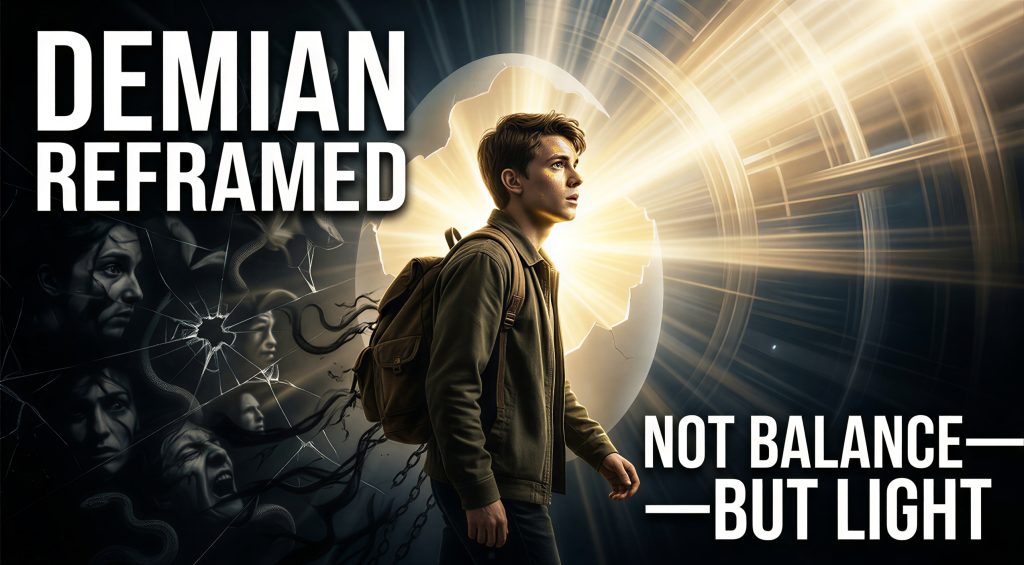
DEMIAN REFRAMED:
Light, Privation, and the Ontology of Becoming
A Dissertation
Jamie Thornberry
2025
ABSTRACT
This dissertation undertakes a fundamental reinterpretation of Hermann Hesse's Demian (1919) through the lens of classical ontology, specifically the privation theory of evil and a metaphysics of light as the ground of being. Against dominant readings that interpret the novel as advocating dualistic integration of good and evil, moral ambiguity, or autonomous self-creation, this study argues that Demian can be more accurately understood as a misdirected yet profound witness to the soul's progressive movement toward participation in reality—a reality grounded in light, truth, and rightly ordered being.
The central thesis holds that Emil Sinclair's journey is not toward the integration of darkness as a co-equal ontological force, but toward increasing illumination—the progressive disclosure of what is real through light. Darkness, in this framework, is not an independent power to be embraced but a privation—the absence, distortion, or negation of light. What the novel presents as necessary integration is reinterpreted as a transitional stage of differentiation: the collapse of inherited, untested structures and the exposure of the soul's need for authentic grounding in truth.
Methodologically, this dissertation draws on Augustinian and Thomistic privation ontology, the Platonic-Christian tradition of light metaphysics, and contemporary scholarship in philosophical theology and literary hermeneutics. It engages critically with Jungian, existentialist, and postmodern interpretations of Demian, demonstrating their philosophical inadequacies and proposing a corrective framework.
The study proceeds through nine chapters: an introduction establishing the interpretive problem; a literature review categorizing and critiquing existing scholarship; a rigorous ontological framework articulating light as primary being and darkness as privation; a close re-reading of Sinclair's developmental stages; a critique of dualistic integration models; an analysis of freedom as alignment with reality rather than autonomous self-creation; a constructive reframing preserving the novel's psychological insight while correcting its metaphysical foundation; and a conclusion identifying implications for literary studies, theology, and cultural philosophy.
Key findings include: (1) Sinclair's early 'world of light' fails not because goodness is illusory, but because it lacks depth and authentic participation; (2) the Abraxas symbol, far from representing ultimate truth, embodies a transitional confusion that collapses necessary ontological distinctions; (3) conscience functions not as autonomous self-legislation but as the receptive faculty through which light discloses reality; (4) the novel's treatment of isolation and judgment reflects the necessary cost of differentiation from illusion; and (5) the narrative arc, properly understood, moves not toward self-deification but toward the threshold of authentic participation in being.
This reinterpretation challenges contemporary assumptions about autonomy, integration, and the nature of moral development. It demonstrates that Demian, read through a corrected metaphysical lens, offers not a celebration of darkness but an inadvertent testimony to the soul's hunger for light, truth, and participation in the Good. The dissertation contributes to ongoing conversations about the relationship between literature and theology, the recovery of classical ontology in literary criticism, and the philosophical foundations of human becoming.
CHAPTER ONE
Introduction: The Interpretive Problem
Hermann Hesse's Demian has enjoyed sustained critical attention since its publication in 1919, yet its interpretation remains contested terrain. The novel recounts the spiritual and psychological development of Emil Sinclair from childhood through young adulthood, tracing his movement from an inherited 'world of light'—the bourgeois moral order of his parents' home—through disorienting encounters with darkness, transgression, and self-discovery, toward an ostensibly integrated selfhood symbolized by the figure of Abraxas, a deity purported to unite both divine and demonic aspects.
The dominant interpretive tradition, heavily influenced by Jungian psychology and existentialist philosophy, reads Demian as an endorsement of moral integration, the reconciliation of opposites, and the achievement of autonomous selfhood through the embrace of previously repressed or denied aspects of personality. On this reading, Sinclair's journey represents the necessary integration of shadow and light, good and evil, conscious and unconscious, leading to psychological wholeness and authentic individuation.
This dissertation challenges such readings as philosophically inadequate and ontologically confused. While acknowledging the novel's profound psychological insights and its acute diagnosis of modern fragmentation, I argue that the interpretive framework through which Demian is typically understood rests on flawed metaphysical assumptions—specifically, the treatment of darkness, evil, and negation as positive ontological realities co-equal with light, goodness, and being. Against this dualistic framework, I propose a reinterpretation grounded in classical privation ontology and light metaphysics.
The Privation Framework
The privation theory of evil, articulated by Augustine and systematized by Aquinas, holds that evil is not a substance or positive reality but the absence or privation of good. Just as darkness is the absence of light and cold the absence of heat, evil is the absence, distortion, or negation of being, which is itself good. This framework does not minimize the reality of suffering or the force of disordered will; rather, it locates the ontological ground of reality in being, goodness, and light, understanding corruption and negation as derivative—as parasitic upon what is real.
Applied to Demian, this ontology allows us to reinterpret Sinclair's journey not as the integration of co-equal opposites, but as progressive illumination—the movement from fragmentation, illusion, and privation toward increasing participation in reality, understood as light. What the novel presents as necessary darkness to be embraced becomes, in this reading, the experience of privation demanding resolution not through integration but through transformation and alignment with what is truly real.
Light Metaphysics and Epistemology
The metaphysics of light, rooted in Platonic and Christian tradition, understands light as the fundamental category of being and knowing. Light is not merely a metaphor but the ontological ground through which reality discloses itself. To know is to see; to see requires light; and the degree of illumination determines the clarity and adequacy of perception. This epistemology has profound implications for reading Demian: Sinclair's movement is not toward balancing light and darkness, but toward increasing receptivity to light—toward the conditions under which reality can be truly seen.
Conscience, in this framework, is not autonomous self-legislation but the receptive faculty through which light discloses truth. The inner voice Sinclair learns to heed is not self-generated but received—the place where reality announces itself to the attentive soul. Freedom, correspondingly, is not the capacity for self-creation but the alignment of the will with what light reveals as real and good.
CHAPTER TWO
Literature Review: Existing Interpretations and Their Inadequacies
Scholarship on Demian has developed along several distinct trajectories, each shaped by prevailing intellectual currents of its era. This chapter surveys the major interpretive schools, identifies their contributions, and exposes their philosophical limitations. Four dominant approaches emerge: Jungian psychological readings, existentialist interpretations, postmodern deconstructive analyses, and spiritual-esoteric appropriations. While each offers partial insights, all share a common weakness: the treatment of darkness, evil, or negation as ontologically positive realities requiring integration rather than as privations demanding transformation.
Jungian Psychological Readings
The Jungian interpretive tradition has exerted the strongest influence on Demian scholarship, unsurprisingly given Hesse's documented engagement with depth psychology and his personal analysis with Jung's disciple J.B. Lang. These readings emphasize individuation—the process by which the self integrates previously unconscious or repressed material, particularly the shadow archetype, to achieve psychological wholeness.
Theodore Ziolkowski's influential study The Novels of Hermann Hesse reads Demian as a paradigmatic individuation narrative. Sinclair's encounter with Kromer represents the confrontation with shadow; Demian himself functions as the psychopomp guiding integration; Abraxas symbolizes the unified self transcending conventional moral dualisms. Ralph Freedman's Hermann Hesse: Pilgrim of Crisis similarly emphasizes psychological integration as the novel's telos, viewing Sinclair's journey as movement from neurotic repression to authentic selfhood.
These interpretations illuminate important psychological dynamics. Hesse indeed portrays with remarkable acuity the fragmentation of inherited structures, the power of repressed desire, and the need for differentiation from collective convention. However, Jungian readings suffer from a decisive philosophical weakness: they treat the shadow—the aggregate of repressed, denied, or unintegrated psychic content, often coded as 'dark'—as possessing equal ontological status with conscious, 'light' aspects of personality.
This framework operates within a psychological functionalism that brackets questions of truth and goodness in favor of psychic wholeness. But the question remains: what kind of wholeness? Integration for its own sake cannot distinguish between the integration of genuine capacity and the integration of pathology. Without an ontological ground distinguishing reality from illusion, being from privation, the Jungian model collapses into a relativism where all psychic content, once integrated, achieves equal legitimacy.
Furthermore, the Jungian emphasis on archetypes as universal psychic structures risks evacuating moral content. If Abraxas simply represents the psyche's inherent bipolarity, the question of truth—whether this bipolarity corresponds to reality or constitutes a necessary stage to be transcended—remains unaddressed. The psychological reading, for all its descriptive power, cannot adjudicate between competing visions of human flourishing because it lacks the metaphysical resources to do so.
Existentialist Interpretations
Existentialist readings, prominent in mid-twentieth-century scholarship, interpret Demian as a narrative of authentic self-creation against the background of meaninglessness or absurdity. Mark Boulby's Hermann Hesse: His Mind and Art treats Sinclair's development as the achievement of radical freedom through the rejection of inherited moral frameworks and the embrace of self-legislated values. Eugene Stelzig emphasizes the novel's critique of conventional morality and its endorsement of individual authenticity.
These interpretations rightly identify Demian's critique of unreflective conformity and its insistence on personal appropriation of meaning. However, they suffer from the characteristic weakness of existentialist philosophy: the apotheosis of autonomous will without adequate grounding in reality. If Sinclair's freedom consists in self-creation ex nihilo, the question arises: by what standard can we evaluate the quality of that creation? The existentialist framework, prioritizing authenticity over truth, cannot distinguish between the freedom to align with reality and the freedom to persist in illusion.
Moreover, existentialist readings tend to valorize Sinclair's isolation and judgment as ends in themselves, missing the novel's more subtle suggestion that such isolation represents a necessary but transitional condition. The existentialist celebration of radical autonomy misconstrues what is properly understood as differentiation—the necessary separation from unreality—as the final achievement of selfhood. This mistakes a via negativa—a clearing away of illusion—for the telos itself.
Postmodern Deconstructive Analyses
More recent scholarship, influenced by poststructuralist and deconstructive methodologies, reads Demian as a text that subverts stable meaning, exposes the constructed nature of moral categories, and demonstrates the fluidity of identity. These readings emphasize ambiguity, indeterminacy, and the novel's resistance to totalizing interpretation.
While postmodern analyses usefully highlight textual tensions and resist overly systematic readings, they ultimately dissolve into interpretive nihilism. If all moral categories are merely constructed, if identity is purely performative, if meaning is infinitely deferred, then Demian becomes merely a site for demonstrating theoretical positions rather than a work with genuine content to be understood. The deconstructive impulse, taken to its conclusion, undermines the possibility of any interpretation, including its own.
Furthermore, the postmodern rejection of ontological grounding renders it incapable of distinguishing between the collapse of false categories (which Demian indeed portrays) and the collapse of all categories (which would make human flourishing unintelligible). The deconstructive approach, in its rush to unmask power and expose construction, forfeits the ability to affirm anything positive—including the reality toward which Sinclair, however haltingly, moves.
Spiritual-Esoteric Appropriations
A fourth interpretive tradition, less academically rigorous but culturally influential, appropriates Demian for various esoteric, New Age, or syncretic spiritual frameworks. These readings emphasize Abraxas as a symbol of cosmic wholeness, interpret Sinclair's journey as spiritual awakening, and treat the novel as a guide to mystical experience or alternative spirituality.
Such interpretations rightly perceive Demian's spiritual dimension and its concern with ultimate questions. However, they typically lack philosophical rigor and theological precision, conflating incompatible metaphysical systems and treating symbols as self-interpreting. The esoteric tradition's emphasis on hidden knowledge and individual gnosis often reinforces the very autonomy-centered anthropology that requires critique rather than endorsement.
The Common Failure: Ontological Confusion
Despite their differences, all four interpretive traditions share a fundamental weakness: they treat darkness, evil, shadow, or negation as positive ontological realities co-equal with light, goodness, or being. Whether formulated psychologically (shadow integration), existentially (authentic embrace of absurdity), deconstructively (fluidity beyond binary opposition), or esoterically (cosmic balance of opposites), each framework operates within a dualistic metaphysics that cannot sustain coherent ontology.
The result is interpretive confusion. If darkness is as real as light, if evil is as substantive as good, then integration becomes the only available model—but integration of what? And to what end? Without ontological grounding, integration collapses into mere psychological functionalism or aesthetic balance, incapable of distinguishing transformation from capitulation, growth from pathology, freedom from bondage.
What is needed is a framework that can account for Demian's genuine insights—its critique of unreflective conformity, its portrayal of psychological fragmentation, its insistence on personal appropriation—while providing the ontological resources to distinguish reality from illusion, being from privation, true freedom from mere self-assertion. Such a framework exists in classical privation ontology and light metaphysics, to which we now turn.
CHAPTER THREE
Ontological Framework: Light, Privation, and the Structure of Reality
This chapter develops the ontological framework necessary for a corrected reading of Demian. It articulates (1) a metaphysics of light as the ground of being and knowing, (2) privation theory as the proper understanding of evil and negation, (3) the epistemological implications of this ontology, and (4) its application to human development and moral formation. The framework draws on classical sources—particularly Augustinian privation theory and Platonic-Christian light metaphysics—while engaging contemporary philosophical theology to demonstrate its continued relevance and rigor.
Light as Ontological Primary
The metaphysics of light understands light not as a mere metaphor but as the fundamental category through which being and knowing are properly understood. In Platonic tradition, the Good is epekeina tēs ousias—beyond being—yet also the source and ground of all that is. The image of the sun in the Republic functions as more than analogy: just as the sun makes both seeing and growth possible, the Good makes both knowing and being possible.
Christian theology appropriates and transforms this framework. The Johannine prologue identifies Christ as the Logos, the light that enlightens every person, the life that is the light of humanity. This is not poetic embellishment but ontological claim: light is being, life, and truth in their primordial unity. Augustine develops this further: God is lux incommutabilis, immutable light, and all created reality participates in divine illumination to the degree of its being.
Several implications follow. First, light is self-disclosing. It reveals both itself and what it illuminates. Darkness, by contrast, reveals nothing; it is precisely the condition under which reality remains hidden. Second, light is positive. It possesses being; it is something. Darkness is the absence of light, not its opposite or complement. Third, light is hierarchical. Reality admits of degrees of illumination, from the barely lit to the fully radiant, corresponding to degrees of being, truth, and goodness.
This ontology grounds both existence and intelligibility. To be is to participate in light; to know is to be illuminated. The metaphysics of light thus unites ontology and epistemology: being and knowing share a common ground in the self-disclosure of reality through light.
Evil as Privation
If light is the ground of being, what then is darkness? The privation theory provides the answer: darkness is not a positive reality but the absence of light. Similarly, evil is not a substance or independent force but the privation of good—the absence, distortion, or corruption of being.
Augustine develops this theory in response to Manichean dualism, which posited two co-equal principles of good and evil locked in cosmic struggle. Against this, Augustine argues that evil has no positive being; it exists only as the corruption or absence of good. A diseased body is not composed of two substances (health and disease) but of one substance in varying states of integrity. Disease is the privation of health, not its co-equal opposite.
Aquinas systematizes this understanding. Evil is privatio boni—the privation of good. It is not nothing whatsoever (that would deny the reality of suffering), but neither is it something in the sense of possessing positive being. Evil is the lack of a perfection that ought to be present. A blind eye is not composed of sight plus blindness; it is an eye lacking the perfection proper to eyes—namely, sight.
This framework has several crucial implications. First, it preserves the reality of evil's effects without granting evil positive ontological status. Evil is real as privation—darkness is really dark, blindness is really blind—but it is not real as substance. Second, it explains evil's dependence on good. Evil can only exist as the corruption of something good; there is no pure evil because pure privation would be pure non-being. Third, it establishes that evil is always derivative and parasitic. Darkness depends on the possibility of light; corruption presupposes integrity.
Most importantly for our purposes, privation theory demonstrates that the proper response to evil is not integration but illumination. One does not integrate blindness with sight to achieve 'wholeness'; one restores sight, removing the privation. One does not integrate darkness with light; one increases illumination until darkness is dispelled. The model is not balance or synthesis but transformation—the progressive replacement of privation with being, absence with presence, darkness with light.
Epistemological Implications
The metaphysics of light and privation yields a distinctive epistemology. If light is the ground of knowing, then knowledge is not constructed but disclosed. Reality makes itself known to the receptive intellect; truth is discovered, not invented. This stands in sharp contrast to constructivist or voluntarist epistemologies that treat knowledge as the product of subjective activity or will-to-power.
Conscience functions as the primary instance of this receptivity. In classical Christian anthropology, conscience (synderesis) is the habitual knowledge of first moral principles—the intellect's native orientation toward good as perceived under the aspect of light. It is not autonomous legislation but the faculty by which the soul recognizes moral truth when adequately illuminated.
This understanding has profound implications for reading Demian. When Sinclair learns to 'listen to the voice within,' he is not inventing moral truth ex nihilo but becoming receptive to reality's self-disclosure. His growing attentiveness to conscience represents increasing openness to light, not the assertion of autonomous will.
Furthermore, error and ignorance are themselves forms of privation. Just as evil is the absence of good, ignorance is the absence of knowledge. The movement toward truth, therefore, is a movement toward increasing illumination—the progressive dispelling of darkness that prevents reality from being seen clearly. This explains why genuine growth often involves painful disillusionment: the collapse of false structures is necessary precisely because they occlude reality. What feels like descent into darkness is often the exposure of prior privation—the recognition that what one called 'light' was inadequate or counterfeit.
Human Development and Moral Formation
Applied to human development, this ontology yields a model of moral formation as progressive participation in reality through increasing receptivity to light. The human person is created with the capacity for illumination but must actively cooperate with the light that seeks to disclose truth. This cooperation is neither passive absorption nor autonomous self-creation but a synergy—the willing alignment of the self with reality as it reveals itself.
Freedom, in this framework, is the capacity to align with reality rather than persist in privation. True freedom is not the absence of constraint but the ability to consent to what is true. The soul becomes free not by asserting autonomy but by becoming transparent to light—by removing the obstacles (ignorance, disordered will, attachment to illusion) that prevent reality from being clearly seen and fully embraced.
This model distinguishes several stages of development. First, inherited structure: the moral framework received from tradition, family, or culture. This may be adequate or inadequate, deep or shallow, but it is not yet personally appropriated. Second, rupture: the collapse or questioning of inherited structure, experienced as disorientation or 'darkness.' This is not descent into evil but exposure of prior inadequacy. Third, differentiation: the soul's separation from false securities and unreflective conformity. This produces necessary solitude but is not an end in itself. Fourth, receptivity: the cultivation of attentiveness to reality's self-disclosure through conscience, reason illuminated by grace, and participation in truth. Fifth, integration—but properly understood: not the synthesis of opposites but the ordering of the self under light, the alignment of will, intellect, and desire with reality as disclosed.
The key insight is that maturity consists not in balancing light and darkness but in increasing participation in light. The 'dark night' experiences of spiritual tradition are not celebrations of darkness but acknowledgments that the path toward illumination often requires the painful stripping away of false certainties. What is being integrated is not evil but capacity—the restoration of faculties that had been disordered, repressed, or misdirected, now properly ordered toward their true end.
With this ontological framework established, we can now turn to a re-reading of Sinclair's journey in Demian, demonstrating how his development is more accurately understood as progressive illumination than dualistic integration.
CHAPTER FOUR
Re-reading Sinclair's Journey: From False Light to True Illumination
This chapter offers a close re-reading of Emil Sinclair's developmental journey through the lens of light metaphysics and privation ontology. Rather than interpreting his movement as the progressive integration of darkness, we read it as increasing receptivity to light—a movement from inherited illusion through necessary rupture toward authentic participation in reality. Five stages structure the analysis: (1) the childhood division, (2) the Kromer crisis, (3) Demian's intervention, (4) the Abraxas confusion, and (5) the threshold of authentic becoming.
The Childhood Division: False Dualism
Sinclair's opening description of his childhood establishes the novel's central tension: 'The realms of day and night, two different worlds coming from two opposite poles, mingled during this time.' He perceives reality as fundamentally divided between the 'world of light'—his parents' home, characterized by love, duty, and moral clarity—and the 'world of darkness'—the street, the servants' quarters, crime, and transgression.
Standard readings treat this division as Sinclair's naive dualism that must be overcome through integration. But a more careful analysis reveals something different: the 'world of light' Sinclair describes is not genuinely luminous but thinly lit—morally ordered but lacking depth, traditional but unexamined, secure but fragile. It is light inherited, not light personally received.
The problem, then, is not that Sinclair affirms goodness—this affirmation is correct—but that his affirmation rests on borrowed authority rather than genuine illumination. His 'light' is secondhand, mediated entirely through parental structure without personal participation. He dwells in what might be called pre-reflective innocence: a state of moral formation that is necessary and good but inherently unstable because it has not been tested, questioned, or personally appropriated.
The 'dark world,' correspondingly, is not a separate ontological realm requiring integration but Sinclair's perception of what lies beyond his limited illumination. He encounters disorder, transgression, and moral ambiguity not as co-equal realities to be embraced but as the privation of the order he knows. His error is not in recognizing difference but in treating this privation as substantive—as another 'world' rather than as the absence or distortion of the only world there is.
Thus the childhood division represents not the true structure of reality but Sinclair's limited and ultimately inadequate vision. He does not yet possess the illumination necessary to see how apparent darkness might be understood as privation, how disorder relates to order, or how moral complexity can be navigated without collapsing into dualism. His crisis, when it comes, will not be the encounter with a rival kingdom but the exposure of his vision's inadequacy.
The Kromer Crisis: Exposure and Fragmentation
The encounter with Franz Kromer precipitates Sinclair's first major crisis. In an attempt to impress older boys, Sinclair fabricates a story of theft. Kromer, recognizing the lie, blackmails him, extracting money and obedience through fear. This episode is typically read as Sinclair's confrontation with his 'shadow'—the repressed dark impulses now demanding acknowledgment.
But from the perspective of light ontology, the Kromer crisis represents something different: the exposure of Sinclair's inadequate grounding. His inherited 'world of light' proves insufficient to navigate moral complexity. The lie itself—a small transgression born of insecurity—reveals that Sinclair's moral formation lacks the depth necessary for autonomous navigation of ethical ambiguity. His subsequent entanglement with Kromer exposes the fragility of mere conventional morality.
Crucially, Sinclair's suffering under Kromer is not the beneficial encounter with necessary darkness but the experience of privation—the lack of the inner resources, moral clarity, and authentic grounding he needs. He is not integrating shadow; he is fragmenting under the weight of inadequacy. The 'darkness' he experiences is the absence of genuine light, not a positive force requiring embrace.
This distinction is decisive. If Kromer represents necessary shadow-integration, then Sinclair's liberation from him would be incomplete or regressive. But if Kromer represents bondage to privation—moral confusion, fear, inauthenticity—then liberation from this condition is genuine progress. The text supports the latter reading: Sinclair's deliverance through Demian's intervention is portrayed not as repression but as rescue.
Demian's Intervention: The Awakening Guide
Max Demian appears as the figure who liberates Sinclair from Kromer and initiates his deeper formation. Demian is characterized by unusual clarity, independence of judgment, and penetrating insight. He teaches Sinclair to question received interpretations, to think for himself, and to attend to the 'voice within.'
Jungian readings treat Demian as a projected aspect of Sinclair's psyche—the emerging Self guiding individuation. Existentialist readings see him as the exemplar of authentic existence. But light ontology offers a different interpretation: Demian functions as a psychopomp—literally a 'soul-guide'—who awakens Sinclair to the possibility of genuine illumination beyond inherited structures.
Demian's most significant intervention comes through his reinterpretation of the Cain story. Where conventional morality condemns Cain as murderer, Demian suggests Cain bore a mark of distinction, that the strong and different are feared by the ordinary, and that biblical narratives encode the victors' perspective. This interpretation is deliberately provocative, intended not as final truth but as a catalyst for critical reflection.
From the standpoint of illumination, Demian's function is iconoclastic: he breaks the false idols of unexamined convention to create space for authentic seeking. His teaching is a via negativa—clearing away what is false so that truth can be perceived. This is necessary work, but it is preparatory, not final. Demian opens Sinclair to questioning but does not, cannot, provide the ultimate answers. He points toward the need for personal illumination but does not constitute that illumination himself.
The danger—and this is where the novel begins to mislead—is that Demian's iconoclasm might be mistaken for wisdom itself, his questioning for answers, his independence for truth. Demian teaches Sinclair to listen to the inner voice, but the question remains: what is that voice perceiving? Is it self-generated or received? Is it constructing meaning or discovering it? The novel's ambiguity on this point creates space for misinterpretation.
The Abraxas Confusion: Mistaking Transition for Telos
The symbol of Abraxas represents the novel's most problematic moment and the point where Hesse's vision most clearly diverges from ontological truth. Introduced through an organist named Pistorius, Abraxas is presented as a deity who unites both divine and demonic aspects, encompassing both creation and destruction, both God and devil. Sinclair embraces this symbol as resolution to his earlier dualism: if Abraxas contains all opposites, then the division between light and darkness dissolves into higher unity.
From the perspective of light metaphysics, the Abraxas symbol represents a category error—the confusion of psychological transition with ontological truth. What Sinclair experiences as necessary dissolution of false dualisms—the recognition that inherited moral categories were too simplistic—is mistakenly elevated into a metaphysical principle. The collapse of inadequate structures is conflated with the structure of reality itself.
Abraxas attempts to resolve the problem of evil by making evil co-essential with good, destruction co-equal with creation. But this 'solution' is no solution; it merely dissolves the problem by denying the ontological primacy of good. If Abraxas truly encompasses good and evil equally, then there is no ground for preferring one over the other, no basis for moral discernment, no telos toward which development aims. The Abraxas framework collapses into nihilism dressed in mystical garb.
Moreover, the Abraxas symbol represents a failure of nerve. Having correctly identified the inadequacy of inherited dualisms, Sinclair recoils from the harder task of discovering authentic moral truth. Instead of pressing through the rupture toward genuine illumination, he settles for a synthesis that preserves disorder by baptizing it as cosmic necessity. This is not integration but capitulation—not the achievement of higher vision but the abandonment of the quest for it.
What Sinclair actually needs is not the dissolution of moral categories but their purification and deepening. The movement should be from simplistic dualism (light vs. darkness as separate kingdoms) through necessary rupture (recognition of inadequacy) toward ontological clarity (light as primary, darkness as privation). Instead, the novel stops at the transitional moment of rupture and mistakes it for arrival.
Significantly, the text itself hints at this inadequacy. Sinclair eventually separates from Pistorius, recognizing that the organist has become mired in scholarship and nostalgia, unable to move forward. This suggests that Abraxas represents not the final truth but another insufficient stopping point. The novel glimpses this but does not fully develop the implication.
Toward Authentic Becoming: The Threshold
The novel's latter sections portray Sinclair's continued development through encounters with Frau Eva (Demian's mother, representing maternal wisdom and erotic spiritual longing) and culminating in the chaos of World War I. Demian himself dies in the war, but not before a final encounter in which he tells Sinclair, 'If ever you need me, you won't see me again in the flesh. But if you listen within yourself... you will notice that I am within you.'
This conclusion is deeply ambiguous. On one reading, it suggests complete interiorization—Sinclair has integrated Demian as an aspect of himself, achieving autonomous selfhood. But another reading is possible: Sinclair stands at the threshold of genuine receptivity, having been prepared through rupture and differentiation to receive authentic illumination. Demian's death might represent not the completion of integration but the removal of the external guide now that Sinclair has been awakened to the possibility of direct encounter with reality.
The novel ends without resolution, and this inconclusiveness is telling. Sinclair has not arrived; he has been prepared. He has passed through necessary stages—the collapse of false securities, the differentiation from collective convention, the awakening to interiority—but he stands only at the beginning of the true journey: the movement toward increasing participation in light through consent, receptivity, and the alignment of will with reality as it discloses itself.
Read through this lens, Demian becomes not a completed bildungsroman but a preparation, not an arrival but a departure. Sinclair's journey traces not the integration of darkness but the progressive awakening to the need for light—a need the novel perceives but cannot fully satisfy within its own metaphysical framework. The text points beyond itself toward a reality it glimpses but does not name.
CHAPTER FIVE
The Error of Dual Integration: Critique and Correction
The integration model—the idea that psychological or spiritual maturity requires embracing darkness as co-equal with light—dominates contemporary readings of Demian and, more broadly, modern therapeutic and spiritual discourse. This chapter exposes the philosophical incoherence of this model, demonstrates its practical inadequacies, and proposes a corrective framework grounded in the ontology developed in Chapter Three.
The Integration Model Examined
The integration model, in its various forms, holds that human wholeness requires the conscious acknowledgment and incorporation of previously denied, repressed, or rejected aspects of personality. These aspects—collectively termed 'shadow' in Jungian psychology, the 'dark side' in popular spirituality, or simply 'darkness' in metaphorical usage—are understood as possessing equal ontological or psychological validity as their 'light' counterparts. Maturity consists in moving beyond one-sided affirmation of light toward a balanced synthesis of opposites.
Applied to Demian, this model interprets Sinclair's journey as movement from naive identification with parental goodness (one-sided light) through recognition of darker impulses (shadow encounter) toward integrated selfhood that encompasses both (Abraxas). The childhood division is diagnosed as unhealthy splitting; integration of opposites is prescribed as cure.
This framework contains psychological insight: repression of genuine capacity or desire can indeed produce pathology; rigid moral categories inadequate to reality's complexity do cause harm; and some form of conscious acknowledgment of one's full psychological range is necessary for maturity. However, these valid psychological observations become philosophically problematic when elevated into ontological claims.
Ontological Incoherence
The integration model's fundamental flaw is its treatment of evil, darkness, or negation as positive ontological realities requiring incorporation. This commits what might be called the substantialization fallacy—treating privation as substance, absence as presence, nothing as something.
Consider an analogy. A physician examining a patient with scurvy does not say, 'You need to integrate your health and your disease into balanced wholeness.' The physician recognizes disease as privation—the absence of necessary vitamin C—and prescribes restoration of what is lacking. To 'integrate' health and disease would be to perpetuate pathology, not achieve wholeness.
Similarly, blindness is not a different way of seeing requiring integration with sight; it is the absence of sight. One does not achieve 'wholeness' by balancing sight and blindness; one restores sight. The integration model, applied consistently, would prohibit healing, since healing necessarily eliminates disease rather than preserving it in synthesis.
The model's defenders might object that psychological 'darkness' differs from physical disease—that repressed desires, denied capacities, or rejected aspects of self possess genuine reality requiring acknowledgment. This objection has merit but requires careful distinction. What is being repressed or denied? If genuine capacity—for instance, healthy anger, appropriate assertion, legitimate desire—then integration is indeed appropriate. But this is not integration of evil; it is restoration of good that had been misdirected or suppressed.
The confusion arises when the integration model fails to distinguish between (1) the restoration of capacity that had been disordered, (2) the acknowledgment of temptation or impulse without capitulation to it, and (3) the genuine incorporation of evil as evil. The first two are legitimate; the third is incoherent. One can acknowledge violent impulses without 'integrating violence' as a positive good. One can recognize sexual desire without 'integrating lust' as co-equal with love. The distinction matters: restoration and acknowledgment differ fundamentally from incorporation.
Moral Collapse
The integration model's second major flaw is its collapse of moral ontology. If good and evil possess equal ontological status requiring balanced incorporation, then no principled basis exists for preferring one over the other. The model necessarily dissolves into moral relativism or nihilism.
This is not theoretical quibbling but practical consequence. If Sinclair's maturity consists in integrating his 'dark side'—his capacity for cruelty, deception, selfishness—as such, then what prevents the integration of worse? Why stop at Kromer's petty extortion? Why not integrate systematic cruelty, calculated harm, deliberate evil? The integration model provides no principle of limitation because it lacks ontological grounding.
Defenders might invoke 'balance' or 'moderation,' but these are aesthetic rather than moral criteria. Balance for its own sake is morally vacuous—one can balance great good with great evil and achieve aesthetic symmetry while perpetrating moral catastrophe. Moderation likewise provides no guidance: moderate evil is still evil. Without ontological grounding distinguishing being from privation, the integration model cannot distinguish transformation from capitulation, growth from pathology, freedom from bondage.
The Abraxas symbol in Demian perfectly illustrates this collapse. By making divine and demonic co-essential, the symbol evacuates moral content. If God and devil are equally aspects of ultimate reality, then worship and blasphemy, compassion and cruelty, creation and destruction possess equal validity. The result is not higher wisdom but moral paralysis—or worse, the aestheticization of evil as a necessary complement to good.
The Corrective Framework: Ordering, Not Balancing
The alternative to integration is not repression but ordering. Maturity consists not in balancing opposites but in rightly ordering the soul under light, aligning all capacities toward their proper ends. This requires distinguishing what is genuinely good from what is privation, what is capacity from what is corruption, what is to be cultivated from what is to be purged.
Consider anger as an example. The integration model might say: acknowledge your anger, embrace it, incorporate it into selfhood. But this is inadequate. The question is not whether to have anger but whether anger is rightly ordered. Anger at injustice, proportionate to the offense and directed toward correction, is virtuous. Anger as resentment, disproportionate rage, or desire for revenge is disordered. The task is not integration but purification—the cultivation of righteous anger and the elimination of its corruptions.
Similarly with desire, ambition, self-assertion, and other capacities that can be misdirected. The question is always: ordered toward what end? Desire for genuine goods, ambition in service of worthy goals, self-assertion in defense of truth—these are capacities to be cultivated. Disordered desire (lust, greed), corrupt ambition (domination, exploitation), distorted assertion (pride, narcissism)—these are privations to be purged, not integrated.
The framework of ordering rather than balancing allows us to distinguish several categories:
1. Genuine capacity currently disordered: Requires redirection toward proper end. Example: anger channeled from revenge to justice.
2. Capacity currently repressed or denied: Requires liberation and proper ordering. Example: healthy self-care emerging from codependent self-denial.
3. Genuine privation (evil as such): Requires elimination through illumination. Example: cruelty expelled as will aligns with compassion.
4. Temptation or impulse: Requires acknowledgment without incorporation. Example: recognizing violent impulse without acting on or valorizing it.
This framework preserves psychological insight while maintaining ontological coherence. It allows for the liberation of repressed capacity, the redirection of disordered impulse, and the acknowledgment of temptation—all without requiring the impossible task of 'integrating evil' or treating darkness as co-equal with light.
Applied to Demian: Reinterpretation
Returning to Demian with this corrected framework, Sinclair's journey can be reread as follows:
His childhood 'world of light' fails not because goodness is illusory but because it lacks the depth necessary for navigating moral complexity. The task is not to abandon light but to seek deeper, more adequate illumination.
His encounter with Kromer exposes this inadequacy, revealing the need for authentic moral grounding beyond convention. This is necessary rupture, not necessary darkness.
Demian's teaching functions as iconoclasm—clearing false securities—but cannot substitute for genuine illumination. His value lies in preparation, not completion.
The Abraxas symbol represents a category error: mistaking the transitional dissolution of inadequate categories for the structure of reality itself. What is needed is not synthesis of opposites but clarity about ontological primacy.
Sinclair's development toward 'listening to the voice within' is authentic only if that voice is understood as receptive rather than creative—as the faculty by which reality discloses itself, not as autonomous self-legislation.
Read thus, Demian becomes not an endorsement of integration but a witness to the soul's preparation for authentic participation in reality—a preparation that requires clearing away false structures but does not constitute arrival at truth itself.
CHAPTER SIX
True Freedom: Alignment with Light
The concept of freedom stands at the heart of Demian's vision and modern misreadings of it. This chapter examines competing understandings of freedom, demonstrates the inadequacy of autonomy-centered models, and articulates a vision of freedom as alignment with reality disclosed through light. The argument proceeds through three movements: (1) the modern autonomy paradigm and its problems, (2) freedom as receptivity and consent, and (3) implications for reading Sinclair's development.
The Autonomy Paradigm
Modern Western thought, particularly since the Enlightenment, has increasingly understood freedom as autonomy—literally, self-legislation or self-rule. Freedom consists in the absence of external constraint and the capacity for self-determination. The free person is one who chooses and acts according to self-generated principles rather than heteronomous authority.
This paradigm reaches its apex in existentialist philosophy. Sartre's dictum 'existence precedes essence' makes radical freedom constitutive of human being: we are 'condemned to be free,' thrust into existence without predetermined nature, compelled to create ourselves through choice. Authenticity consists in owning this freedom, accepting responsibility for self-creation, and resisting the 'bad faith' of appealing to external standards or predetermined essence.
Applied to Demian, the autonomy paradigm reads Sinclair's journey as liberation from heteronomous authority (parental morality, conventional values, collective consciousness) toward authentic self-creation. Freedom is achieved through breaking inherited bonds, rejecting external legislation, and constituting oneself through autonomous choice. Demian's teaching to 'follow the voice within' becomes the imperative of radical autonomy: legislate for yourself, create your own values, define your own essence.
This interpretation has undeniable appeal. It resonates with modern sensibilities, validates personal experience, and seems to honor individual dignity. However, it suffers from fatal philosophical defects.
First, the autonomy paradigm cannot distinguish between freedom and arbitrariness. If freedom consists in self-legislation ex nihilo, then no choice can be evaluated as better or worse, since evaluation requires standards that autonomous freedom, by definition, rejects. The person who chooses cruelty is as free as the person who chooses compassion; the only difference is that they chose differently. But this evacuates freedom of moral content, reducing it to mere capacity for choice regardless of what is chosen.
Second, radical autonomy is practically impossible. Even Sartre, who articulated the most extreme version, acknowledged that we are always 'in situation'—constrained by facticity, embedded in contexts not of our choosing, shaped by forces we did not create. The claim to create ourselves from nothing is grandiose self-deception. We do not choose our birth, our bodies, our basic capacities, or the historical moment into which we are thrown. At best, we exercise limited agency within vast constraints; at worst, the autonomy paradigm produces anxiety and despair when its impossible demands cannot be met.
Third, and most fundamentally, autonomy divorced from reality leads to bondage rather than freedom. If I 'freely' choose to believe I can fly and step off a building, I am not liberated but destroyed. Freedom that refuses to acknowledge reality's constraints is not freedom but delusion. The autonomy paradigm, lacking ontological grounding, cannot distinguish between freedom as alignment with truth and freedom as persistence in illusion.
Freedom as Receptivity and Consent
Against the autonomy paradigm, classical Christian anthropology understands freedom as the capacity to align with reality, to consent to truth, to participate in the Good. This is not heteronomy (subjection to external authority) but theonomy—participation in the divine ordering of reality. Freedom consists not in creating meaning ex nihilo but in recognizing and embracing the truth that discloses itself.
Augustine's account remains paradigmatic. True freedom (libertas) differs from mere capacity for choice (liberum arbitrium). The latter is neutral with respect to good and evil; the former is the perfection of will in love of the good. Freedom reaches its fulfillment not when the will can choose anything but when it cannot help but choose rightly—when it loves the good so fully that evil becomes genuinely unthinkable.
This might seem paradoxical: How can necessity constitute freedom? The resolution lies in recognizing that necessity comes in different forms. There is the necessity of external compulsion (slavery, coercion), which indeed negates freedom. But there is also the necessity of internal perfection—the state in which one's nature is so fully realized that one spontaneously acts according to it. The eagle is 'necessarily' an eagle, yet this does not constrain but fulfills its being. Similarly, the person whose will is perfectly aligned with truth acts 'necessarily' according to that truth, yet experiences this not as constraint but as liberation.
Within the light metaphysics developed in Chapter Three, freedom is the soul's transparency to light. To be free is to have removed the obstacles—ignorance, disordered attachment, willful blindness—that prevent reality from being seen and embraced. Freedom grows as illumination increases, as the soul becomes progressively more receptive to truth's self-disclosure.
This account preserves genuine agency while grounding it in reality. The soul is not passive; it must actively consent, must cooperate with illumination, must say 'yes' to what light reveals. But this consent is not arbitrary will asserting itself but recognition—the acknowledgment of what is true whether or not we consent to it. Our freedom consists in the capacity to align with this truth or to resist it, to participate in reality or to persist in illusion.
Implications for Demian
Returning to Demian with this understanding of freedom, several interpretive shifts become necessary.
First, Demian's instruction to 'listen to the voice within' must be understood not as a call to autonomous self-creation but as an invitation to receptivity. The inner voice, properly understood, is not self-generated but received—the place where reality announces itself to the attentive soul. Conscience is the faculty of recognition, not invention. When functioning properly, it perceives moral truth with the same immediacy that eyes perceive color. The task is not to create values but to become sufficiently receptive that truth can be recognized when encountered.
Second, Sinclair's isolation and differentiation from collective consciousness represents not the achievement of autonomy but its precondition. To hear the inner voice requires separation from the din of unreflective conformity, the removal of external noise that drowns out reality's whisper. But isolation is preparatory, not final. The hermit who withdraws to hear truth must eventually return to community, now capable of authentic participation rather than mere conformity. Sinclair's solitude is a via negativa—a necessary clearing—not the destination.
Third, the novel's emphasis on personal appropriation is valid but must be carefully distinguished from autonomous creation. Sinclair cannot mature by simply accepting inherited morality; he must personally encounter and consent to truth. But this personal encounter is discovery, not invention. The difference is decisive: one discovers what is already there, waiting to be recognized; one invents what was not there before. Sinclair's journey should move him toward discovering reality, not inventing it.
Fourth, the Abraxas symbol, understood as the dissolution of moral categories in favor of autonomous self-creation, represents not freedom but its forfeiture. If good and evil are merely constructed rather than discovered, if there is no reality to which the self must align, then 'freedom' collapses into arbitrariness. Sinclair would be 'free' to choose anything—which means his choices carry no moral weight, express no truth, participate in no reality beyond subjective preference.
The corrected reading sees Sinclair's journey not toward autonomous self-creation but toward the threshold of authentic receptivity. He must first be freed from false securities, unreflective conformity, and inadequate structures. This is genuine liberation—but it is only preparatory. True freedom consists in being free for reality, for truth, for participation in the Good as it discloses itself through light.
The novel's ambiguity leaves this final movement incomplete. We see Sinclair freed from much but not yet fully free for what is real. He stands prepared but not arrived, awakened but not yet fully illuminated. The text points toward a freedom it perceives but cannot, within its own framework, fully articulate—the freedom that comes through alignment with light, consent to truth, and participation in reality as it is rather than as we wish it to be.
CHAPTER SEVEN
Constructive Reframing: Preserving Insight, Correcting Foundation
This chapter synthesizes the preceding analysis into a constructive reframing of Demian. The aim is to preserve the novel's genuine psychological and spiritual insights while correcting its metaphysical foundation. The reframing proceeds through four movements: (1) what the novel perceives correctly, (2) where it goes astray, (3) the corrected vision, and (4) how this reinterpretation illuminates the text's enduring value.
What Demian Perceives Correctly
Hermann Hesse's novel demonstrates remarkable acuity in several dimensions, and these insights must be honored even as we correct the framework within which they are articulated.
The Inadequacy of Unreflective Conformity. Demian rightly diagnoses the fragility of inherited moral structures that lack personal appropriation. Sinclair's childhood 'world of light' is not false because it affirms goodness but because it remains external, unexamined, and therefore unable to sustain him through genuine moral complexity. The novel correctly perceives that maturity requires moving beyond borrowed authority toward personal encounter with truth.
The Reality of Psychological Fragmentation. The text portrays with unflinching honesty the disorientation that accompanies the collapse of inadequate structures. Sinclair's suffering under Kromer, his isolation from former securities, and his experience of inner division are not romanticized but presented as genuinely painful. Hesse understands that growth often involves disintegration before reintegration, rupture before healing.
The Necessity of Differentiation. Demian correctly identifies that authentic development requires separation from collective convention and unreflective group consciousness. Sinclair cannot mature while simply conforming to social expectation or parental approval. He must stand alone, must differentiate his own perception from received opinion, must cultivate interior attentiveness.
The Importance of Interiority. The novel's insistence on attending to the 'voice within' captures something essential: moral truth must be personally encountered, not merely externally obeyed. Conscience requires cultivation; the soul must learn to recognize truth when it appears. This emphasis on interiority, properly understood, is not subjectivism but the recognition that truth must be received inwardly even when it comes from beyond the self.
The Cost of Authenticity. Hesse does not sentimentalize the journey toward authentic selfhood. Sinclair experiences genuine isolation, bears real judgment from those who do not understand, and suffers the loss of comfortable securities. The novel recognizes that the path toward truth is often lonely and that differentiation from illusion carries a price.
Where the Novel Goes Astray
Despite these genuine insights, Demian makes several decisive errors, all stemming from inadequate ontological grounding.
Mistaking Privation for Substance. The novel's cardinal error is treating darkness, evil, and negation as positive ontological realities co-equal with light, goodness, and being. This dualism, embodied in the Abraxas symbol, fundamentally misunderstands the nature of evil and leads to the confused imperative of integration rather than the correct imperative of illumination.
Confusing Transition with Telos. The collapse of inadequate structures is necessary and painful, but Demian mistakes this transitional rupture for the final state. The Abraxas vision represents not arrival at truth but the moment of maximal disorientation—the point where inherited categories have dissolved but authentic vision has not yet emerged. The novel treats this in-between state as ultimate wisdom rather than recognizing it as a stage to be traversed.
Ambiguity Between Reception and Creation. The text oscillates between understanding the 'inner voice' as the faculty that receives truth and understanding it as autonomous creation of meaning. This ambiguity allows existentialist and autonomy-centered misreadings. Where the novel should clearly distinguish discovery from invention, reception from construction, it instead leaves the question open in ways that invite subjectivist interpretation.
Insufficient Teleology. Demian powerfully depicts the movement away from false securities but provides no clear vision of what the soul moves toward. Beyond differentiation and isolation, what constitutes mature selfhood? Beyond the collapse of inherited categories, what is the structure of reality? The novel leaves these questions unanswered, creating a vacuum that readers fill with whatever metaphysics they bring to the text.
The Corrected Vision
A corrected reading of Demian would preserve its psychological insights while regrounding them in sound ontology. The reframed narrative proceeds as follows:
Emil Sinclair is born into a world of conventional goodness—ordered, secure, but ultimately shallow. This order is not false, but it is incomplete. It represents inherited light—genuine but secondhand, traditional but unexamined. Sinclair dwells in pre-reflective innocence, a necessary stage but not a final one.
The Kromer crisis shatters this inherited structure, exposing its inadequacy. Sinclair encounters not a rival 'dark world' but privation—the experience of moral disorder, fear, and inauthenticity that his shallow formation cannot navigate. This rupture is necessary: it reveals what was lacking and creates the conditions for seeking something deeper.
Demian appears as the iconoclastic guide who liberates Sinclair from false securities and awakens him to the possibility of authentic seeking. His teaching functions as via negativa—clearing away illusions, questioning inherited categories, creating space for genuine encounter with reality. But Demian's iconoclasm is preparatory, not final. He can break idols but cannot substitute for the reality those idols falsely represented.
The Abraxas phase represents Sinclair's attempt to resolve the crisis by collapsing distinctions—by treating the dissolution of false categories as ultimate truth. This is the moment of greatest confusion: necessary dualism has been overcome, but not yet replaced with adequate vision. Sinclair mistakes the in-between state—the space between inherited illusion and discovered truth—for arrival. He celebrates dissolution as if it were wisdom rather than recognizing it as transition.
The novel's conclusion, properly understood, leaves Sinclair not at the end of his journey but at its threshold. He has been freed from false securities, differentiated from unreflective conformity, and awakened to interiority. But he has not yet received the illumination toward which this preparation points. He stands ready—but for what?
The answer the novel cannot provide within its own framework: Sinclair is prepared for participation in reality as disclosed through light. His journey has cleared away obstacles—ignorance, inauthenticity, false securities—but clearing is not the same as building. He has learned what is not true but has not yet encountered what is true. He has cultivated receptivity but has not yet received.
Read thus, Demian becomes a preparation rather than a completion, a clearing rather than a construction. Its value lies not in its metaphysical conclusions—which are confused—but in its psychological accuracy regarding the stages of differentiation. It maps the terrain of rupture without providing the vision of what lies beyond rupture. It awakens hunger for truth without satisfying that hunger.
The Text's Enduring Value
Why, then, does Demian continue to resonate? Why do readers return to it despite its metaphysical confusions?
Because it speaks to a universal human experience: the collapse of inherited certainties and the difficult journey toward authentic selfhood. Everyone who matures beyond childhood confronts some version of Sinclair's crisis. The particular forms vary—the loss of religious faith, the questioning of received political convictions, the breakdown of family narratives, the recognition that parental wisdom has limits—but the structure remains constant: what was given must be examined; what was accepted must be tested; what was external must be internalized.
Demian captures this experience with remarkable psychological precision. It does not sentimentalize the journey, does not promise easy answers, does not pretend that differentiation is painless. It acknowledges the loneliness, the disorientation, the loss of comfortable securities. And precisely because it is honest about the difficulty, it offers genuine companionship to those undergoing similar transitions.
Moreover, the novel's very incompleteness—its failure to provide final answers—paradoxically serves its readers. A text that claimed to resolve all questions would be dishonest; the journey toward truth is ongoing, and any claim to have arrived would be premature. Demian's openness, its refusal to provide closure, its willingness to dwell in ambiguity—these can be read not as failure but as appropriate humility. The novel takes us to the threshold and leaves us there, which is precisely where many of its readers stand.
The corrected reading does not diminish Demian's value but clarifies it. The novel is not a guide to ultimate truth but a map of preparatory terrain. It does not show us reality but helps us recognize when our perception of reality is inadequate. It does not provide illumination but can awaken us to our need for it. And in this preparatory function, honestly and precisely executed, lies its enduring significance.
CONCLUSION
Implications and Future Directions
This dissertation has undertaken a fundamental reinterpretation of Hermann Hesse's Demian through the lens of classical ontology—specifically, privation theory and light metaphysics. Against dominant readings that interpret the novel as endorsing dualistic integration, moral ambiguity, or autonomous self-creation, I have argued that Demian is more accurately understood as an inadvertent witness to the soul's preparation for participation in reality as disclosed through light. The conclusion synthesizes key findings, identifies broader implications, and suggests directions for future research.
Summary of Findings
The dissertation has demonstrated:
1. Ontological Incoherence in Standard Interpretations. Jungian, existentialist, postmodern, and esoteric readings of Demian share a common flaw: treating darkness, evil, or negation as positive ontological realities requiring integration. This substantialization of privation produces metaphysical confusion and moral collapse.
2. The Necessity of Privation Ontology. Classical privation theory, grounded in light metaphysics, provides the resources to distinguish being from absence, reality from illusion, transformation from capitulation. Evil is not a substance to be integrated but a privation to be overcome through illumination.
3. Sinclair's Journey as Preparation, Not Completion. Emil Sinclair's development moves not toward dualistic integration but toward the threshold of authentic participation. His childhood 'world of light' is inadequate not because light is false but because it lacks depth. His Kromer crisis exposes this inadequacy. Demian's intervention clears false securities. The Abraxas symbol represents transitional confusion, not ultimate truth. The novel's conclusion leaves Sinclair prepared but not arrived.
4. Integration vs. Ordering. Maturity consists not in balancing opposites but in rightly ordering the soul under light. What appears as integration of darkness is properly understood as restoration of capacity, purification of disorder, and alignment with reality.
5. Freedom as Alignment, Not Autonomy. True freedom consists in the capacity to consent to reality as disclosed through light, not in autonomous self-creation ex nihilo. The 'voice within' is properly understood as receptive faculty, not creative will.
6. The Novel's Enduring Value. Demian's significance lies not in its metaphysical conclusions but in its psychological accuracy regarding differentiation and its honest portrayal of the rupture that precedes authentic seeking. The text functions as preparation, awakening readers to inadequacy and need.
Implications for Literary Studies
This reinterpretation has several implications for literary scholarship:
First, it demonstrates the necessity of ontological literacy in literary criticism. Interpretation requires not only close reading and historical contextualization but also philosophical rigor. Without adequate metaphysical frameworks, critics risk importing unexamined assumptions that distort textual meaning. The recovery of classical ontology as a critical tool enables more precise and philosophically coherent readings.
Second, it challenges the widespread conflation of psychological insight with metaphysical truth. A text can accurately portray psychological states—fragmentation, rupture, integration—without those states corresponding to ontological reality. Literary criticism must distinguish between what a text describes phenomenologically and what it claims metaphysically.
Third, it suggests the value of corrective hermeneutics—readings that preserve a text's genuine insights while correcting its philosophical foundations. Such interpretation is not dismissive but deeply engaged, taking the text seriously enough to argue with it, honoring its perceptions while disputing its conclusions.
Implications for Theology
The theological implications are equally significant:
First, the study demonstrates the continued relevance of classical privation theory and light metaphysics for addressing contemporary confusions. Modern therapeutic and spiritual discourse often treats evil as substantive, darkness as necessary, and integration as ultimate. Against this, the Augustinian-Thomistic tradition offers conceptual resources for maintaining moral clarity while honoring psychological complexity.
Second, it clarifies the relationship between differentiation and communion. Authentic Christian formation requires both: the soul must differentiate from false securities and collective illusion (via negativa) and grow in communion with reality (via positiva). Contemporary spirituality often emphasizes one at the expense of the other; classical theology holds them in creative tension.
Third, it recovers freedom as alignment with reality against modern autonomy-centered anthropologies. This has profound pastoral implications: the spiritual life is not about creating oneself but about becoming receptive to truth, not about asserting will but about consenting to reality as disclosed through grace.
Implications for Cultural Philosophy
Beyond literary and theological disciplines, this study addresses broader cultural questions:
First, it diagnoses a pervasive modern confusion: the conflation of transitional rupture with final truth. Contemporary culture often celebrates deconstruction, dissolution, and the collapse of inherited categories as if these were endpoints rather than stages. Demian embodies this confusion, and its popularity reflects our collective difficulty moving beyond critique toward reconstruction.
Second, it illuminates the relationship between personal authenticity and objective truth. Modernity prizes authenticity—being true to oneself—but often divorces this from correspondence to reality. The result is expressive individualism unmoored from ontological grounding. Classical philosophy offers correction: authentic selfhood consists not in self-expression per se but in becoming transparent to reality, expressing truth rather than mere preference.
Third, it addresses the crisis of formation in late modernity. Traditional structures have collapsed; inherited authorities have been questioned; collective narratives have fractured. Demian captures this moment brilliantly—but offers no way forward because it lacks ontological resources. The recovery of classical frameworks provides what modernity needs: not a return to unreflective tradition but the philosophical tools to rebuild on firmer foundations.
Directions for Future Research
This dissertation opens several avenues for further investigation:
Comparative Studies. How does this reinterpretive approach apply to other modernist Bildungsromane? Works by Joyce, Woolf, Mann, and Musil similarly depict consciousness in crisis and the search for authentic selfhood. Would privation ontology and light metaphysics illuminate these texts differently than dominant psychological or existentialist readings?
Theological Aesthetics. This study focuses on narrative structure and character development. Future work might examine aesthetic dimensions—imagery, symbolism, linguistic texture—through the lens of theological aesthetics. How does light function not only thematically but formally in Demian? What is the relationship between literary beauty and ontological truth?
Reception History. How have different cultural contexts read Demian? Does reception vary according to the ontological assumptions prevalent in particular times and places? A reception study informed by philosophical theology might reveal how interpretive communities project their own metaphysical commitments onto the text.
Pastoral Applications. The dissertation's findings have practical implications for spiritual direction, pastoral counseling, and Christian formation. How might clergy and spiritual directors use these insights to guide individuals through crises of faith, moral development, and the collapse of inherited structures? Future work might develop practical pedagogies grounded in this ontology.
Contemporary Culture. This reinterpretation has implications for understanding contemporary cultural phenomena—the popularity of 'shadow work,' the prevalence of therapeutic discourse, the emphasis on 'authenticity' divorced from truth claims. Future studies might apply this framework to cultural criticism, diagnosing where modern movements correctly perceive psychological realities while operating within inadequate ontologies.
Final Reflection
Hermann Hesse's Demian remains a powerful and troubling text. Its power lies in its psychological acuity, its honest portrayal of rupture and differentiation, and its refusal of easy answers. Its trouble lies in its metaphysical confusion, its treatment of privation as substance, and its inability to articulate what lies beyond critique.
This dissertation has argued that Demian is best understood not as a guide to ultimate truth but as a preparation for seeking it. The novel takes us through necessary stages—the collapse of false securities, the experience of fragmentation, the awakening to interiority—but leaves us at the threshold. And precisely in this incompleteness lies both its limitation and its gift.
The limitation: Demian cannot satisfy the hunger it awakens. It perceives the inadequacy of inherited structures but cannot articulate adequate alternatives. It recognizes the soul's need for authenticity but cannot ground that authenticity in reality. It glimpses the necessity of personal appropriation but risks collapsing into subjectivism.
The gift: Demian honestly acknowledges where many readers actually stand—not at the end of their journeys but in the middle, not having arrived but still seeking, not illuminated but awakening to the need for light. In its very incompleteness, the novel offers companionship to those undergoing similar transitions. It does not pretend to resolve what cannot yet be resolved. It maps the terrain of preparation without claiming to provide the vision that can only come through illumination.
Read through the corrective lens of privation ontology and light metaphysics, Demian becomes neither a celebration of darkness nor a simple endorsement of conventional morality, but an inadvertent testimony to something more profound: the soul's inescapable orientation toward light, truth, and participation in the Good. Even in its confusions, even in its metaphysical ambiguities, the novel witnesses to what it cannot fully name—the hunger for reality that drives all authentic seeking.
And perhaps this is enough. Not every text must provide final answers. Not every journey reaches completion. Sometimes it is sufficient to map the terrain honestly, to acknowledge the difficulty faithfully, and to point—however imperfectly—toward the light that alone can satisfy the soul's deepest longings.
In this sense, Demian succeeds not despite but precisely through its incompleteness. It prepares the way. It awakens desire. It clears the ground. And having done so, it steps aside, leaving space for the illumination it glimpses but cannot provide—the light that discloses reality, the truth that transforms, and the Good in which the soul finds its rest.
* * *